What to Do After Forming a US LLC: A 12-Step Checklist for Non-Residents
Your US LLC has state approval. What next? Verify the formation record, sign internal documents, obtain the EIN, organize a company file and prepare banking evidence. Separate business funds, keep books, align customer materials, map the jurisdictions where you operate, assess any personal ITIN need and calendar filings and renewals. Review as facts change.
A formed LLC is not automatically an operational, bank-ready or compliant business. Tasks can run in parallel, including KYC preparation during the EIN wait; the exact order depends on activity and jurisdictions. This is an action map, with mechanics in the linked guides. If state approval is still pending, see the formation and EIN timeline.
Scope. The working example is a Wyoming single-member LLC wholly owned by a foreign person that has not elected corporate taxation and is generally a disregarded entity for US federal income-tax purposes. Multi-member LLCs, corporate elections, employees, inventory, regulated activity, a physical US presence, or a US trade or business can change the filing and licensing map. The owner’s residence and place of management also matter. Have qualified cross-border tax and legal professionals assess your particular facts.
Contents
- 12-step quick checklist
- Steps 1–4: Secure the foundation
- Steps 5–8: Become transaction-ready
- Steps 9–12: Map and maintain compliance
- Five mistakes to avoid
- More complex operations
- FAQ
- Choose your next step
The 12-Step Quick Checklist
| Step | Action | When | Result or record |
|---|---|---|---|
| 1 | Verify the state formation record | Immediately after approval | Filed documents and confirmed state data |
| 2 | Sign internal governance records | Before operating | Signed agreement and consents |
| 3 | Obtain the LLC’s EIN | After formation | SS-4 and IRS EIN evidence |
| 4 | Build one company file | From day one | Controlled master data and documents |
| 5 | Prepare banking and payment KYC | During EIN wait; before applications | Provider-ready evidence file |
| 6 | Separate business financial flows | After provider approval | Dedicated rails and documented owner transfers |
| 7 | Start bookkeeping and owner ledger | Before or with first transaction | Reconciled records and related-party trail |
| 8 | Make customer materials consistent | Before first sale or supplier transaction | Matching website, contract, invoice and payment details |
| 9 | Map the operating footprint | Before launch; after material changes | Jurisdiction and adviser action list |
| 10 | Test personal ITIN need | When a real personal US tax purpose arises | Reasoned eligibility decision |
| 11 | Calendar distinct filing and renewal clocks | At formation; refresh yearly | Federal, Wyoming, RA and home-country calendar |
| 12 | Review changes and ongoing compliance | Monthly/quarterly; annually; at changes | Updated records and review log |

Steps 1–4: Secure the Foundation
1. Save and verify the formation record
What to do. Download the filed Articles of Organization, state acknowledgment or certificate, and payment receipt. Check the exact legal name, formation date, state filing ID, listed principal and mailing addresses, registered agent, and live state status against the Secretary of State’s record. Correct an error through the proper state process rather than carrying it into subsequent applications. Keep personal information out of public filings when it is not required.
Why and when. Do this immediately after approval. A mismatched spelling, address or formation date can spread into IRS, provider and contract records. A certificate of good standing may later be useful if a specific provider or transaction calls for it; it is not an automatic day-one purchase.
Outcome and deep dive. Store a verified formation packet, with a note of what was checked and when. An operating agreement belongs with internal company records; Wyoming does not approve or file it as part of the Articles. The LLC documents guide explains the broader document set.
2. Execute internal governance documents and confirm the intended tax classification
What to do. Sign an operating agreement that identifies the member, ownership, management authority and initial contribution. Document any necessary initial member consent or resolution—for example, the person authorized to open an account or enter a contract. Keep the signed originals and an amendment trail internally.
Why and when. Set this up before meaningful operations and provider applications. A domestic single-member LLC is generally disregarded for federal income-tax purposes by default unless a valid corporate election changes that classification. This does not decide the owner’s home-country tax treatment or mean there is no US filing obligation. An election has consequences and deadlines; it should be evaluated professionally, not treated as a casual optimization. A nonresident alien cannot be an S-corporation shareholder.
Outcome and deep dive. Keep a signed governance record consistent with state and provider profiles. See the company documents guide for record types.
3. Apply for the LLC’s EIN and preserve the evidence
What to do. Apply after state formation with the actual responsible party and consistent company information. The EIN identifies the LLC; an ITIN identifies an individual for an appropriate US tax purpose. The IRS provides routes for international applicants who cannot use the online application. Current Form SS-4 instructions allow foreign or N/A for a responsible party who has no SSN or ITIN and is ineligible to obtain one. Choose the current IRS-accepted route for your facts; do not build a launch plan around a guaranteed processing time.
Why and when. An EIN is commonly needed for federal reporting and business provider onboarding. Preserve a copy of the signed SS-4 and the IRS CP 575-series notice (including a digital CP 575 if available) or later official verification such as Letter 147C. If the responsible party changes, the IRS currently requires Form 8822-B within 60 days. Review that form for address or location changes too.
Outcome and deep dive. The company file should contain the application record and a reliable EIN proof, with no mismatch between it and the state record. Use the detailed nonresident EIN guide for methods and delays; The
describes assistance within current setup packages; inquire about options for an already formed LLC.
4. Build one consistent company file and master data record
What to do. Set up a controlled folder for state documents, signed governance, IRS notices, identity and address evidence, provider submissions, contracts, invoices, statements, tax records and deadlines. In a master data sheet, record the exact legal name, EIN, filing ID and date, members, registered agent, addresses, provider profiles, and renewal dates. Keep access limited and protect sensitive documents.
Why and when. Start now and update it whenever facts change. A registered agent address receives state/legal notices; a mailing address receives correspondence; a principal, residential or genuine operating address describes a different fact. They are not interchangeable labels, and a provider may require evidence for the specific address it asks about.
Outcome and deep dive. One reliable data source should drive IRS, state, banking, payment, invoice and contract entries. The address guide examines those roles; the documents guide helps structure the folder.
Steps 5–8: Become Transaction-Ready
5. Build banking and payment KYC readiness before applying
What to do. During the EIN wait, assemble formation and EIN evidence, the operating agreement and ownership details, passport, genuine address evidence, a clear business description, and activity evidence such as a website, contracts or invoices. Explain expected volumes, countries, payment flows and source of funds. Check each provider’s rules before applying.
Why and when. Submit only when the provider’s requested evidence is supportable. A registered agent address is not automatically an accepted physical or operating address. Bank and payment-provider reviews are separate private decisions; country and risk policies vary, and neither an LLC nor an EIN guarantees approval.
Outcome and deep dive. Keep a dated evidence file. The banking guide covers provider fit and KYC. The free ten-question check screens provider/country fit, records, addresses, activity and intended account/payment use at a high level; it does not select providers, review documents or prepare applications. The
describes preparation within current setup packages; ask about an already formed LLC.
6. Open dedicated business financial rails and separate funds
What to do. After a suitable provider confirms eligibility and approves the application, use a dedicated business account or appropriate business financial rails for company receipts and expenses. Keep customer money and company costs separate from personal consumption. Record owner contributions, owner-paid costs, reimbursements, loans and distributions under their actual character, with dates and supporting evidence.
Why and when. Begin with the first business flow. Clear financial separation makes reconciliation and tax information reporting more reliable. It does not, by itself, guarantee liability protection, account approval or a particular tax outcome. A bank account and a payment processor may each ask different questions and make independent decisions.
Outcome and deep dive. Trace each balance and owner-company transfer. For the stages between formation, banking and real operating evidence, see building an operational base.
7. Start bookkeeping from day one, including an owner and related-party ledger
What to do. Before the first transfer—or at the latest when it occurs—record each invoice, receipt, business expense, owner payment and exchange-rate basis. Reconcile bank and payment statements regularly. Maintain a separate ledger of formation payments, capital contributions, owner-paid LLC expenses, loans, reimbursements and distributions, with counterparties and supporting documents.
Why and when. Those transfers may be reportable related-party transactions for a wholly foreign-owned US disregarded entity. Do not wait for customer sales to exist before asking what is reportable. No revenue does not automatically mean no federal filing. A first year funded only by the owner can still contain relevant transactions; the exact Form 5472 trigger depends on the facts. Record retention likewise depends on the document and applicable issue, not one universal seven-year rule.
Outcome and deep dive. Produce a reconciled ledger and an adviser-ready related-party trail. The annual filing guide explains the filing scenarios; the IRS recordkeeping guidance explains the underlying discipline.
8. Make the company transaction-ready
What to do. Before the first customer or supplier transaction, use the exact legal name consistently on the website, agreements, invoices, provider profiles and payment instructions. Make the offer, contracting party, price and payment terms, delivery/refund terms and evidence of performance understandable. Check that the public business description matches what you tell financial providers.
Why and when. Inconsistencies create preventable customer, provider and accounting friction. There is no universal Wyoming invoice template that resolves every international sale. VAT, sales tax, consumer disclosures, licenses and e-commerce rules vary with what is sold, where activity happens and who buys.
Outcome and deep dive. Keep a coherent set of customer-facing materials and transaction records. If card processing is part of the model, the Stripe-specific guide covers that separate application context.
Steps 9–12: Map and Maintain Compliance
9. Map the real operating footprint and every relevant jurisdiction
What to do. Before launch, document where owners and staff work, where decisions are made, where offices, inventory, suppliers and customers are, and what contracts and services actually involve. Assess US federal tax position, potential registration in another US state, sales tax, payroll, licensing and permits separately from tax, VAT, accounting and management questions in your country of residence or activity.
Why and when. Wyoming formation does not displace rules in another state or your home country. A US office, employees, inventory, people acting for the business and other activity can change the analysis. Customers alone do not yield one universal nexus test; neither does a “no US office” sentence settle every federal or foreign-country question. Revisit the map after material changes.
Outcome and deep dive. Keep a jurisdiction map and obtain qualified cross-border tax/legal advice where needed. Government license and permit guidance is a starting point, not a substitute for jurisdiction-specific advice.
10. Decide whether the owner independently needs an ITIN
What to do. Ask whether the individual owner has a real US federal tax purpose for an ITIN and is ineligible for an SSN. An individual US return requirement, eligible treaty claim or refund claim may be relevant in particular circumstances. Assess the personal rule and required documentation before starting an application.
Why and when. Do this when a concrete personal tax purpose arises, rather than automatically at LLC formation. Owning a US LLC, getting its EIN, or having a Form 5472 question does not itself require the owner to obtain an ITIN. Nor does a provider’s request alone prove IRS eligibility. Do not assume every foreign owner owes Form 1040-NR.
Outcome and deep dive. Record the reason an ITIN is or is not currently needed and revisit when the facts change. The EIN versus ITIN guide covers individual eligibility and application mechanics; ITIN application support is relevant once a valid purpose is identified.
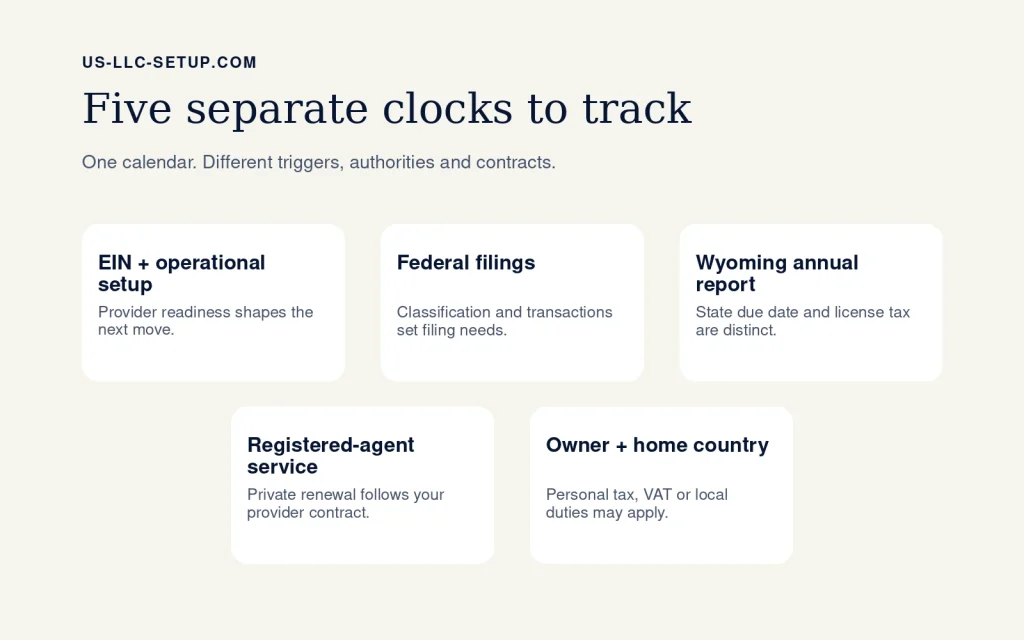
11. Calendar federal filings, Wyoming reporting, registered-agent service and home-country duties separately
What to do. Keep four distinct calendar lines: (1) US federal information and tax filings; (2) Wyoming annual report and license tax; (3) the private registered-agent service renewal; and (4) the owner’s or company’s home-country filings. Assign a responsible person, year, source, due date and evidence of completion to each. Refresh the dates and filing instructions for the applicable tax year before submitting.
Under the IRS Form 5472 instructions, a reportable related-party transaction triggers Form 5472 with a limited pro forma Form 1120 for a wholly foreign-owned US disregarded entity. Formation and owner funding can matter even without revenue, but filing is not automatic in every transaction-free year. The pro forma cover is not an ordinary C-corporation income-tax return or a corporate election. Failure may trigger a $25,000 penalty. Determine the applicable tax year and deadline from current IRS instructions. The current special method is fax or mail, not ordinary e-filing; Form 7004 must use the specified special route by the original due date. Recheck the instructions, addresses and fax details before submission.
Wyoming’s annual report is due on the first day of the LLC’s anniversary month, starting with its first anniversary year. As verified September 28, 2026, the minimum license tax is $60 (higher amounts can apply under the state calculation), and an online processing convenience fee may be added. The private registered-agent bill is a separate contract renewal, not a state “registered-agent filing.” Home-country accounting or tax deadlines require their own review.
When, why and outcome. Build the calendar at formation and verify dates/methods yearly. Retain submissions, receipts and workpapers. See annual filing requirements, annual costs and
12. Run an ongoing compliance and change-control review
What to do. Reconcile records monthly or quarterly, run a formal annual review, and trigger a review whenever an owner, responsible party, address, activity, provider, employee, inventory location or jurisdiction changes. Ask whether state records, IRS responsible-party/address records, licenses, provider KYC and foreign registrations need updating. Log the decision even if no filing is needed.
Why and when. Formation-day records become stale. BOI status is separate from bank KYC. As checked September 28, 2026, FinCEN’s final rule, effective August 14, 2026, exempts US-created entities from federal BOI reporting even when foreign-owned. Recheck FinCEN’s current BOI page before publication and during annual reviews. IRS, state, provider and home-country duties remain.
Outcome and deep dive. Keep a dated review log. At the annual review, verify: formation status and registered agent; master data and addresses; ownership and activity; bookkeeping and owner transfers; federal filing analysis; Wyoming annual report; service renewal; provider KYC; and home-country obligations. Decide the next action and who owns it.
Five Mistakes to Avoid After Formation
- Treating state approval as fully operational status. It does not supply EIN evidence, books or a jurisdiction review.
- Applying to providers before evidence is ready. Check their eligibility and document rules first.
- Mixing personal and company transactions. Label and document each owner transfer.
- Assuming no revenue means no filing. Owner transactions may be reportable.
- Applying for an ITIN without personal US federal tax purpose. An LLC’s EIN is different.
What Changes for Multi-Member LLCs or More Complex Operations?
A domestic multi-member LLC is generally a partnership for federal tax purposes unless it elects corporate treatment; returns and partner reporting can differ. Corporate elections, US employees, inventory, physical presence, regulated activity or a US trade or business add other tax, payroll, licensing and state questions. Residence and management abroad can add duties there. Have qualified cross-border professionals map the facts.
Frequently Asked Questions
Verify the filed record and live state status, sign internal governance documents, and start the EIN and company file. Prepare banking evidence in parallel.
Yes. The IRS has non-online routes for qualifying international applicants; SS-4 addresses a responsible party ineligible for an SSN or ITIN. Check the EIN guide and current instructions.
No universal day-one rule requires a particular US account. Arrange suitable business financial rails and separate records; provider eligibility and evidence rules vary. Prepare before applying.
Not automatically. It requires an individual US federal tax purpose and no SSN eligibility; LLC ownership, EIN or Form 5472 alone does not establish that purpose.
It can. A reportable related-party transaction, including possible owner funding or formation transfers, can trigger Form 5472 with pro forma Form 1120 despite no sales. Analyze actual transactions.
As checked September 28, 2026, the first report is due the first day of the anniversary month in the year after formation; a June formation generally means June 1 the next year. Verify with Wyoming SOS.
Under FinCEN’s current rule, checked September 28, 2026, US-created entities are exempt even when foreign-owned. Recheck before publication; bank KYC remains separate.
State approval does not settle payment, consumer, VAT, sales-tax or licensing rules. Align the contracting entity and terms, establish payment rails and review relevant jurisdictions before trading.
Choose Your Next Step
| Your situation | Useful next action |
|---|---|
| LLC formed; banking is still open | START THE BANKING SELF-CHECK — a free, high-level ten-question readiness check. |
| Not formed yet | COMPARE LLC SETUP PACKAGES. |
| First renewal approaching | VIEW ANNUAL RENEWAL OPTIONS. |
| Valid personal ITIN purpose established | REVIEW ITIN APPLICATION SUPPORT. |
| Cross-border facts remain unclear | BOOK A 20-MINUTE INTRO CALL. |
Bosse LLC provides practical setup support and administrative guidance only. We do not provide legal, tax, accounting or regulated financial advice. Government, bank, fintech and payment provider approvals cannot be guaranteed.