Which Forms Does a US LLC Have to File Every Year? A Practical Guide for Non-US Owners
Forming a US LLC is only the first step.
After formation, your LLC needs to stay in good standing. That usually means tracking annual filings, state fees, IRS forms and sometimes additional reports depending on how the LLC is owned, taxed and operated.
The confusing part is that there is no single universal “annual LLC form” for every company.
A Wyoming LLC with one non-US owner does not have the same filing profile as a Delaware LLC with several members. A single-member LLC does not usually file the same federal return as a multi-member LLC. And if your LLC has employees, US-source income, foreign owners, sales tax registration or activity in another state, the checklist may change again.
This guide gives you a practical overview of the most common annual forms US LLC owners should understand.
It is written especially for European and non-US founders who use a US LLC for freelancing, consulting, online business, digital services, e-commerce, software, agencies or international business operations.
Table of Contents
- Why annual LLC filings are confusing
- The three filing layers: state, IRS and special cases
- Quick answer: which forms apply to which LLC?
- State annual reports and fees
- Federal IRS filings for single-member LLCs
- Federal IRS filings for multi-member LLCs
- What about BOI / FinCEN reporting?
- Special filings: employees, contractors, sales tax and local activity
- Annual filing calendar for non-US owners
- How US LLC Setup helps you stay organized
- Final compliance note
Why Annual LLC Filings Are Confusing
Many founders search for one simple answer:
“What form does my LLC have to file every year?”
The more accurate answer is:
“It depends on your LLC’s state, ownership structure, tax classification and business activity.”
A US LLC is created under state law. But tax filings are handled separately by the IRS. On top of that, some businesses may have extra obligations if they hire people, collect sales tax, operate in a specific state or have foreign owners.
For IRS purposes, a domestic LLC can generally be treated as a disregarded entity, partnership or corporation depending on the number of members and any tax elections made. The IRS explains that a single-member LLC is generally disregarded unless it elects corporate treatment, while a domestic LLC with two or more members is generally treated as a partnership unless it elects corporate treatment.
That classification matters because it usually determines which federal forms apply.
The Three Filing Layers: State, IRS and Special Cases

Most US LLC owners should think in three layers.
1. State compliance
This is handled by the state where your LLC was formed, such as Wyoming or Delaware.
Typical state compliance may include:
- Annual report
- Annual license tax
- Franchise tax
- Registered agent renewal
- Address or company detail updates
2. Federal IRS filings
This depends mainly on how the LLC is taxed.
Typical IRS filings may include:
- Form 5472 with pro forma Form 1120 for certain foreign-owned single-member LLCs
- Form 1065 for multi-member LLCs treated as partnerships
- Schedule K-1 and sometimes Schedule K-3 for members or partners
- Form 1040-NR for certain non-US individual owners with US tax filing obligations
- Form 7004 if an extension is needed
3. Special activity-based filings
These do not apply to every LLC.
They may include:
- Payroll filings if the LLC has employees
- 1099 filings if the LLC pays certain US contractors
- Sales tax returns if the LLC is registered for sales tax
- State income or franchise filings if the LLC has nexus or activity in a state
- Local licenses or renewals depending on the business
Quick Answer: Which Forms Apply to Which LLC?
Here is a simplified overview.
| LLC situation | Common annual filing focus | Typical deadline |
|---|---|---|
| Wyoming single-member LLC owned by a non-US person | Wyoming annual report + Form 5472 with pro forma Form 1120 | Wyoming: anniversary month. IRS: usually April 15 for calendar-year LLCs |
| Wyoming multi-member LLC | Wyoming annual report + Form 1065 + K-1/K-3 where applicable | Wyoming: anniversary month. IRS partnership return: usually March 15 for calendar-year LLCs |
| Delaware LLC | Delaware annual tax, usually no Delaware LLC annual report | June 1 for Delaware annual tax |
| LLC taxed as a corporation | Corporate tax return, usually Form 1120 | Usually April 15 for calendar-year corporations |
| LLC with employees | Payroll filings such as Form 941, W-2 and related forms | Quarterly and annual payroll deadlines |
| LLC with sales tax registration | State sales tax returns | Depends on state and filing frequency |
This table is only a practical starting point. The real answer should always be checked based on your LLC’s exact facts.
State Annual Reports and Fees
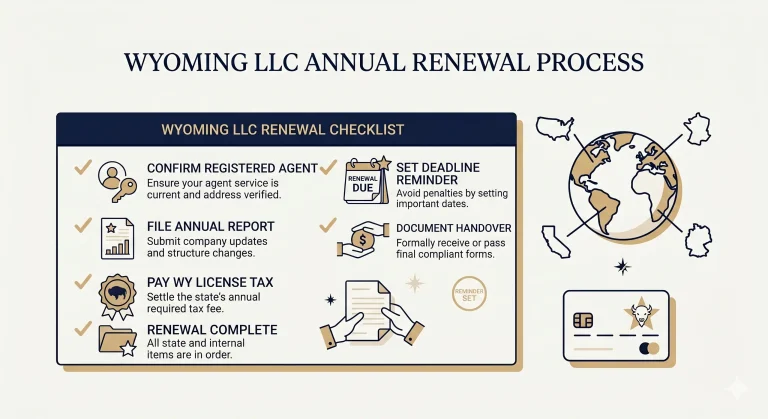
Wyoming LLC annual report
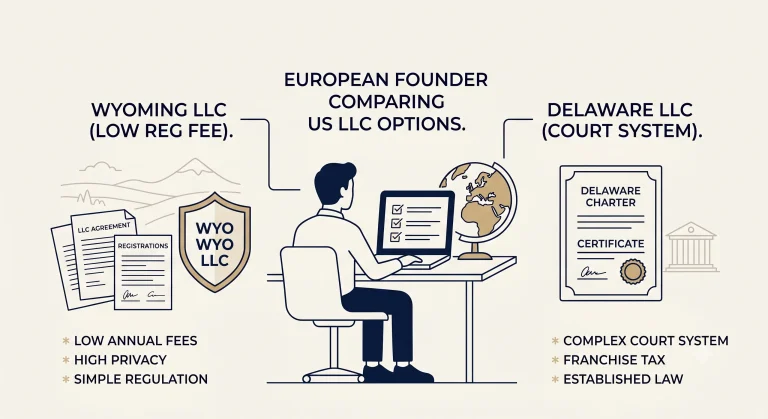
For many non-US founders, Wyoming is popular because the ongoing state compliance is relatively simple and predictable.
Wyoming LLCs file an annual report with the Wyoming Secretary of State. Wyoming states that annual reports for LLCs are due on the first day of the anniversary month of formation. For example, if the initial filing date is May 15, the annual report is due May 1 each year.
The Wyoming annual license tax is generally the greater of $60 or two-tenths of one mill on the dollar of assets located and employed in Wyoming. Wyoming also explains that an entity with $300,000 or less in assets located and employed in Wyoming pays $60.
For many non-US online businesses with no Wyoming assets, the state fee is therefore commonly the minimum amount.
Where to file: Wyoming Secretary of State / WyoBiz
Typical state cost: minimum $60, plus any payment processing fee
Deadline: first day of the LLC’s anniversary month
Example: LLC formed on September 20 → annual report due September 1 each year
You can learn more about Wyoming as a formation state in our guide to Wyoming LLC formation.
Delaware LLC annual tax
Delaware works differently.
Delaware LLCs generally do not file an annual report like corporations do. Instead, they pay an annual LLC tax.
Important update: Delaware House Bill 400 changed several Secretary of State fees. The Delaware General Assembly describes the bill as changing various fees and notes that changes to partnership, limited partnership and LLC annual tax take effect January 1, 2026. Delaware Code now states that every domestic LLC and every foreign LLC registered to do business in Delaware shall pay an annual tax of $400.
The Delaware LLC annual tax is due June 1 following the close of the calendar year. Delaware Code also states that failure to pay by June 1 results in a $200 amount being added, with further consequences for good standing.
Where to pay: Delaware Division of Corporations
Typical state cost: $400 under the updated Delaware Code
Deadline: June 1
Important note: Delaware state webpages may not all update at the same time, so always check the official payment portal and current Delaware Code before filing.
Florida LLC annual report
Florida LLCs file an annual report between January 1 and May 1. The Florida Division of Corporations lists the LLC annual report fee at $138.75, and the fee after May 1 at $538.75. Florida also states that annual reports are due by May 1 to avoid late fees.
Where to file: Florida Sunbiz
Typical state cost: $138.75 on time
Deadline: May 1
Late filing: $538.75 total after May 1
Texas LLC annual franchise tax / public information reporting
Texas does not work like Wyoming or Florida.
Texas has franchise tax reporting rules. The Texas Comptroller states that annual franchise tax reports are due May 15, and for 2026 and 2027 the no-tax-due threshold is $2,650,000.
For report years 2024 and later, a taxable entity at or below the no-tax-due threshold is generally not required to file a No Tax Due Report, but it is still required to file a Public Information Report or Ownership Information Report.
Where to file: Texas Comptroller
Typical state cost: depends on revenue and report type
Deadline: May 15
Important: Texas can still require information reporting even if no franchise tax is due.
Federal IRS Filings for Single-Member LLCs
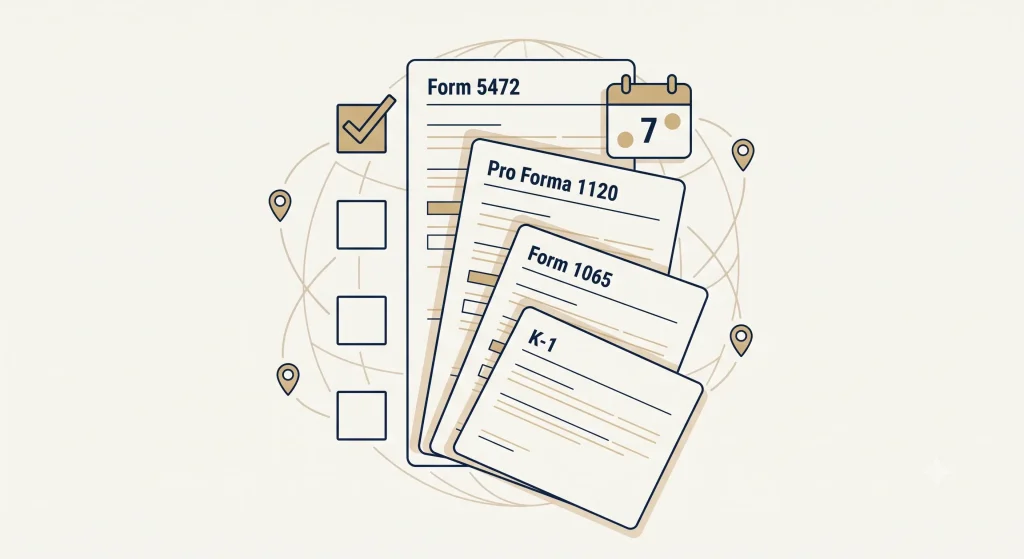
A single-member LLC is often the structure used by freelancers, consultants, digital founders and non-US solo business owners.
For US tax classification, the IRS generally treats a single-member LLC as disregarded unless it elects to be treated as a corporation.
But “disregarded” does not mean “nothing to file.”
Foreign-owned single-member LLC: Form 5472 + pro forma Form 1120
If a US LLC is a domestic disregarded entity wholly owned by a foreign person, it may have a special IRS filing requirement.
The IRS instructions for Form 5472 state that a foreign-owned US disregarded entity must file a pro forma Form 1120 with Form 5472 attached by the due date, including extensions, of Form 1120.
For a calendar-year LLC, the practical deadline is usually April 15 of the following year because Form 1120 is generally due by the 15th day of the fourth month after the end of the tax year.
Typical situation:
A German, Spanish, French, Dutch or other non-US individual owns 100% of a Wyoming LLC.
Common filing:
Form 5472 attached to a pro forma Form 1120.
Where to file:
IRS.
Government filing fee:
Usually no direct IRS filing fee, but preparation costs may apply.
Deadline for calendar-year LLCs:
Usually April 15.
Extension:
Form 7004 can generally be used to request an automatic extension for certain business returns. The IRS describes Form 7004 as the form used to request an automatic 6-month extension for certain business income tax, information and other returns.
Why Form 5472 should not be ignored
Form 5472 is an information return, but the penalty risk is serious.
The IRS states that you may be subject to a $25,000 penalty for each failure to file a complete and correct Form 5472 by the due date.
That is why foreign-owned single-member LLCs should not treat annual compliance as optional.
Does the owner also file Form 1040-NR?
Sometimes yes, sometimes no.
A non-US individual owner may need to file Form 1040-NR if they have a US tax filing obligation, for example because of US-source income or effectively connected income.
The IRS explains that nonresident aliens are taxed only on income from US sources and certain income connected with a US trade or business. The Form 1040-NR deadline depends on the person’s situation. For example, the IRS states that if a nonresident alien did not receive wages as an employee subject to US withholding, Form 1040-NR is generally due by the 15th day of the sixth month after the tax year ends; for a 2025 calendar-year return, that was June 15, 2026.
This is one of the areas where personal tax advice is important, because the answer depends on facts such as residence, source of income, US activity, treaty position and business model.
Federal IRS Filings for Multi-Member LLCs
A domestic LLC with two or more members is generally treated as a partnership for federal tax purposes unless it elects to be treated as a corporation.
That usually means Form 1065.
Form 1065
Partnerships file Form 1065 as an information return to report income, gains, losses, deductions and credits. The IRS explains that partnerships do not pay income tax at the partnership level; instead, profits and losses pass through to the partners.
Typical situation:
Two founders own a Wyoming LLC together.
Common filing:
Form 1065.
Where to file:
IRS.
Deadline:
The IRS 2026 tax calendar states that Form 1065 is due by the 15th day of the third month after the end of the partnership’s tax year. For a calendar-year LLC, that is usually March 15, adjusted if the date falls on a weekend or holiday.
Schedule K-1 and Schedule K-3
A partnership generally provides Schedule K-1 to partners showing their share of income, deductions and other items.
For international situations, Schedule K-3 may also be relevant where applicable. The IRS tax calendar notes that partnerships provide Schedule K-1 and, if applicable, Schedule K-3 by the 15th day of the third month after the end of the partnership’s tax year.
Foreign partners and Forms 8804 / 8805
If a partnership has foreign partners and effectively connected taxable income, additional withholding forms may apply.
The IRS explains that Forms 8804, 8805 and 8813 are used to report and pay section 1446 withholding tax based on effectively connected taxable income allocable to foreign partners.
This is not a simple admin detail. Multi-member LLCs with foreign partners should usually work with a qualified US tax professional.
What About BOI / FinCEN Reporting?
Beneficial Ownership Information reporting changed significantly.
As of the current FinCEN guidance, entities created in the United States — including entities previously known as domestic reporting companies — and their beneficial owners are exempt from the requirement to report BOI to FinCEN. FinCEN’s interim final rule also states that domestic entities created in the United States are exempt from initial BOI reports and from updating or correcting previously filed BOI reports.
For most standard US-formed LLCs, this means BOI is currently not an annual filing requirement.
However, foreign entities registered to do business in the US can still be treated differently. FinCEN states that foreign companies registered to do business in the US on or after March 26, 2025 have 30 calendar days to file an initial BOI report after receiving notice that registration is effective.
Because BOI rules have changed more than once, founders should always verify the current FinCEN status before relying on older guides.
Special Filings: Employees, Contractors, Sales Tax and Local Activity
Some LLC filings are not triggered by the LLC itself, but by what the business does.
If the LLC has US employees
If your LLC has employees, payroll filings may apply.
For example, Form 941 is generally filed quarterly by employers. The IRS states that Form 941 is filed by the last day of the month following the end of the quarter, with common due dates of April 30, July 31, October 31 and January 31.
Employers may also have W-2 and unemployment tax obligations.
If the LLC pays US contractors
If your LLC pays certain US contractors, Form 1099-NEC may apply.
The IRS instructions state that Form 1099-NEC is filed on or before January 31.
This is usually more relevant for LLCs paying US-based service providers than for a solo non-US founder only receiving client payments.
If the LLC sells taxable goods or services
Sales tax is state-based.
There is no single federal sales tax return. If your LLC is registered for sales tax in a state, that state sets the filing frequency and deadline.
This can be monthly, quarterly or annual depending on the state and sales volume.
If the LLC is registered in another state
If your LLC is “foreign qualified” in another state, that state may require separate annual reports, franchise tax filings or local compliance.
For example, a Wyoming LLC registered to do business in Florida may need to comply with Florida annual reporting rules as well.
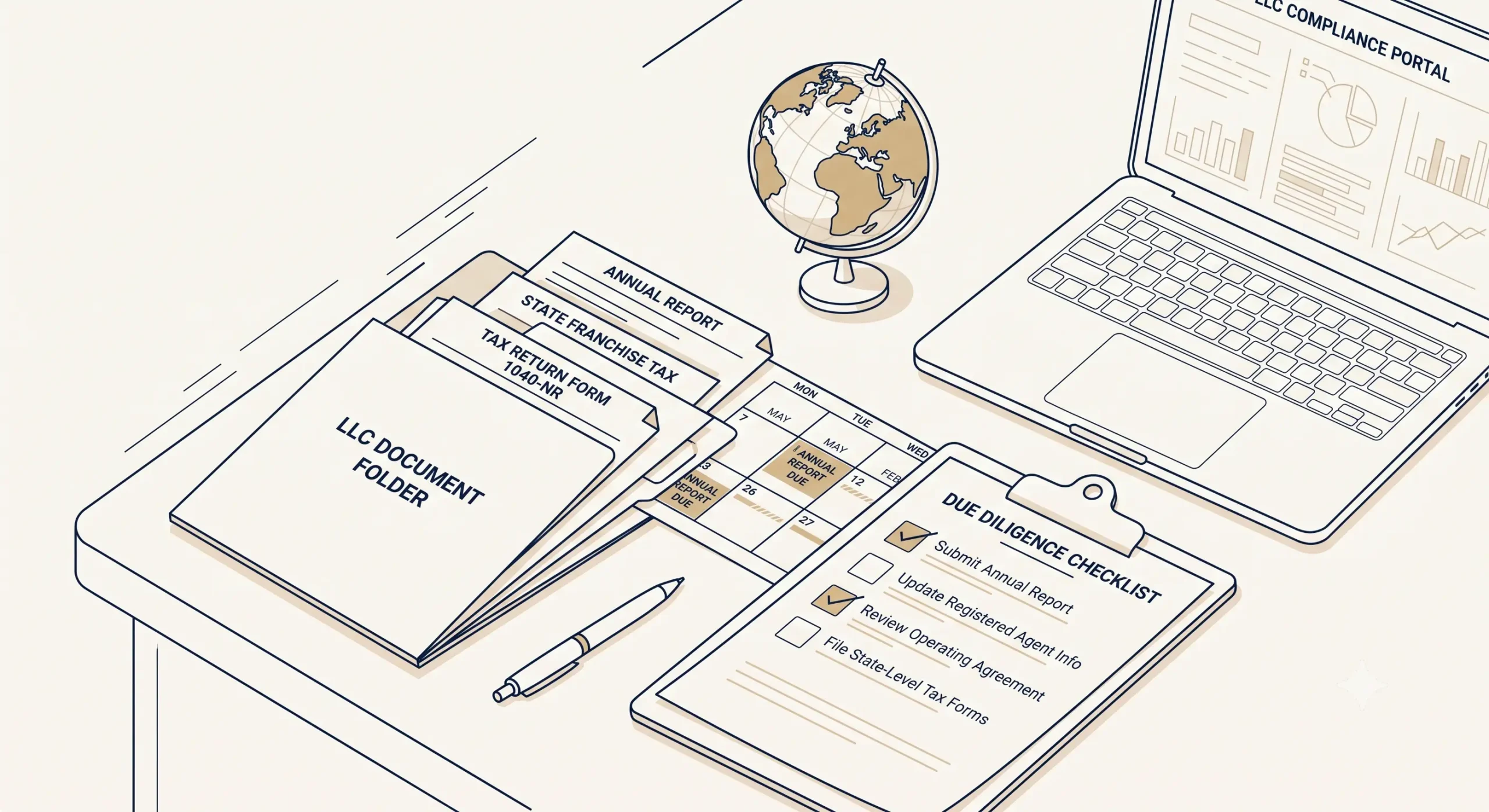
Annual Filing Calendar for Non-US LLC Owners

Here is a practical calendar for common US LLC compliance planning.
| Month | Possible filing or admin task |
|---|---|
| January | 1099-NEC and some payroll year-end forms, if applicable |
| March | Form 1065 for calendar-year partnerships, if applicable |
| April | Form 5472 + pro forma Form 1120 for many foreign-owned disregarded LLCs; Form 1120 for corporations |
| May | Florida annual report; Texas franchise/public information reporting |
| June | Delaware annual tax; some nonresident individual filings |
| Anniversary month | Wyoming annual report and license tax |
| Ongoing | Registered agent renewal, bookkeeping, address updates, bank/payment processor compliance, sales tax filings if registered |
The most important point is simple:
Do not wait until the deadline month to organize your records.
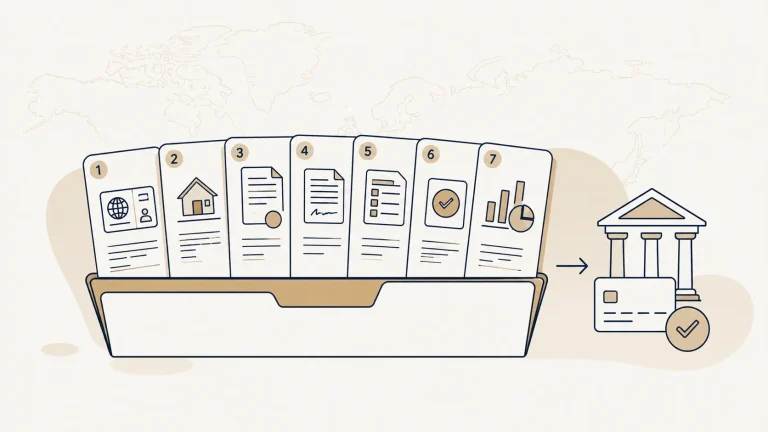
A clean compliance folder should include:
- Articles of Organization
- EIN letter
- Operating Agreement
- Initial resolutions
- IRS filing confirmations
- State annual report receipts
- Registered agent invoices
- Bank statements
- Payment processor statements
- Bookkeeping exports
- Contractor or payroll records, if applicable
This makes annual filings easier and also helps with bank reviews, payment processor checks and future changes to the company.
How US LLC Setup Helps You Stay Organized
US LLC Setup supports European and non-US founders with practical formation support, EIN application guidance and banking readiness.
We do not replace a tax advisor or attorney. But we do help founders understand the administrative structure around their LLC, including what to track, what documents to keep and which deadlines commonly matter.
If you want a clean formation process from the beginning, you can view our
If you already know you want a Wyoming LLC, start with our
And if you are unsure which setup fits your situation, you can
and we will help you understand the administrative steps clearly.
Final Compliance Note
Annual LLC filings are manageable when they are understood early.
The mistake is thinking that a US LLC has no annual obligations at all.
In reality, the recurring checklist depends on your state, ownership, tax classification and business activity. For many non-US founders, the core annual compliance may be quite simple — but it still needs to be tracked carefully.
A well-maintained LLC is easier to operate, easier to verify with banks and payment providers, and less stressful when tax season arrives.
Bosse LLC provides practical setup support and administrative guidance only. We do not provide legal, tax, accounting or regulated financial advice. Government, bank, fintech and payment provider approvals cannot be guaranteed.