Can a US LLC Be 100% Tax-Free? Yes—Here’s the Rare Legal Scenario (2026)
Yes—a US LLC can be part of a completely legal zero-income-tax outcome. The headline is not automatically hype. When the owner is a nonresident alien, the LLC remains a disregarded single-member entity, the income comes from services performed outside the United States, there is no US business footprint, and the owner’s genuine residence country imposes no income tax on that exact fact pattern, the result can genuinely be zero income tax. Real-world fact patterns like this do exist. The outcome comes from the facts aligning—not from an LLC magically erasing tax.
Table of contents
- Yes, the headline can be true
- What “100% tax-free” means here
- The alignment formula
- Alex and Jurisdiction Z: a complete example
- The nine-condition test
- US clients, US banking and payment processors
- When to recheck the analysis
- Zero income tax with full compliance
- Pre-formation checklist
- Frequently asked questions
- Conclusion
Yes, the headline can be true
“Tax-free US LLC” is catchy because it describes a possible result. It becomes misleading only when the conditions disappear from the claim.
A domestic single-member LLC is generally disregarded for US federal income-tax purposes unless it elects corporate treatment. Its activity is then normally analysed as the owner’s activity. For the right non-US owner, foreign-source service income may sit outside US federal income tax. If the owner’s real country of tax residence also imposes no income tax on that income, the combined result can be zero.
This is a real legal outcome, not merely a thought experiment. Non-US residents can own a US LLC, but ownership alone proves none of the tax conditions. Ask instead: Do the owner, classification, income, activity, residence and compliance facts all produce the same answer?
This model excludes US citizens, green-card holders and US tax residents; multi-member LLCs and corporations; US operations; ecommerce inventory; US real estate; and passive investments. Those require different analyses.
What “100% tax-free” means here
Here, the phrase means zero income tax on the defined service profit across the relevant federal and residence-country layers.
| Layer | Possible result in the scenario | What can still remain |
|---|---|---|
| US federal income tax at LLC level | $0 because the LLC is disregarded | Information returns can still apply |
| US federal income tax for the owner | $0 on the defined foreign-source service profit | Other US-source income would be analysed separately |
| Residence-country income tax | $0 if local rules confirm that exact result | Local registration or reporting may still apply |
| State and indirect taxes | Not part of the “zero income tax” claim | Annual charges, sales tax, VAT/GST, payroll or excise can apply |
| Administration | Never automatically $0 | Registered Agent, bookkeeping, filings and professional review remain |
Income tax can be zero even when state fees, returns, bookkeeping or VAT registration remain.
The alignment formula
The result is easiest to understand as six aligned layers:
nonresident owner + disregarded LLC + foreign-performed services + no US taxable footprint + compatible residence-country treatment + no other tax nexus = a possible zero-income-tax outcome
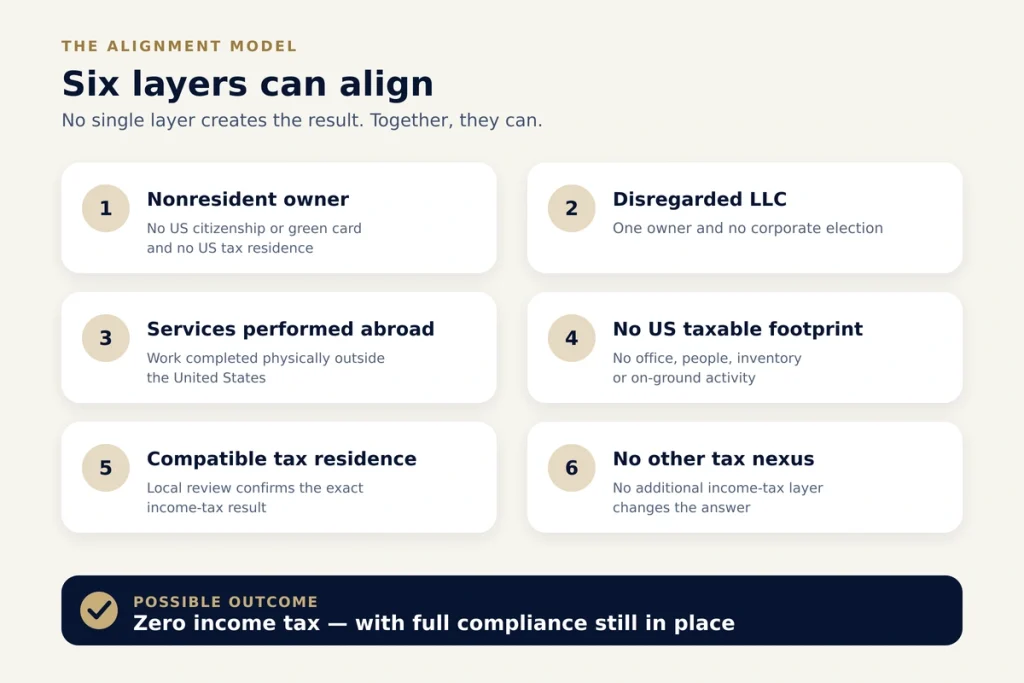
No single item does all the work. Together, they can. IRS guidance generally sources personal-service income according to where the services are physically performed. Customer location, currency, invoice address and receiving bank are not the primary test. Work split between the United States and abroad may require allocation.
Residence matters just as much. A US LLC cannot switch off worldwide taxation in a country that taxes residents on worldwide income. A person genuinely resident where the exact profit lawfully attracts no income tax may complete the alignment. Immigration permission and tax residence are not interchangeable.
For a broader suitability discussion, see our US LLC guide for European freelancers. A founder resident in Germany should instead start with the Germany-specific analysis.
Alex and Jurisdiction Z: a complete example
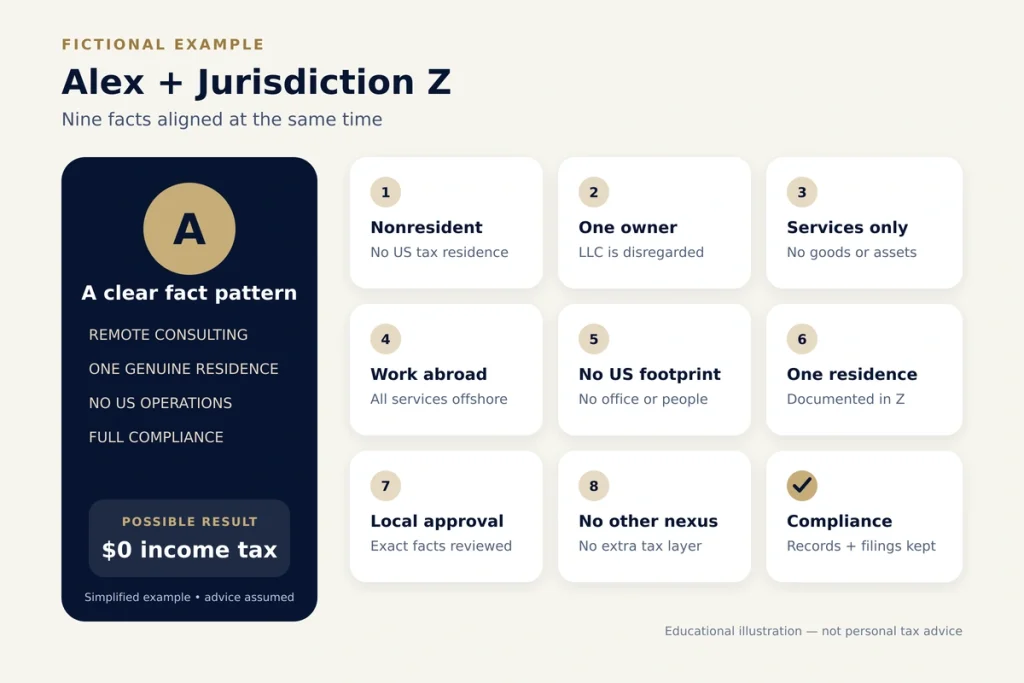
Alex and Jurisdiction Z are fictional, allowing the logic to be shown without suggesting one country works identically for everyone.
Alex is neither a US citizen nor a green-card holder. Alex does not meet the substantial presence test and has no other basis for US tax residence.
Alex solely owns a domestic single-member LLC and has not elected corporate treatment. Under the IRS’s single-member LLC rules, it is disregarded for federal income tax, so its service activity is analysed through Alex.
The business sells remote strategy consulting. Alex performs all substantive work outside the United States. There are no products, inventory, employees, royalties, investments or real estate. IRS guidance points to where the work is performed, even when an American client pays a US account.
The LLC has no US office, employee, warehouse, dependent agent or on-the-ground operation. Alex has no US-source FDAP or real-estate income. The stated facts support no US trade or business producing effectively connected service income under the ECI framework.
Alex is demonstrably tax-resident only in Jurisdiction Z, with no competing residence, permanent establishment or effective-management claim. A qualified local adviser confirms that this exact person, activity and entity classification attracts no local income tax or equivalent business-income charge.
No sales-tax, VAT/GST, payroll, excise or other tax nexus applies. Alex keeps books, maintains the LLC and completes every applicable return.
Result: Alex could lawfully owe no US federal income tax on the service profit and no income tax in Jurisdiction Z. That is the headline’s “100% tax-free” outcome: the full fact pattern works.
The nine-condition test
| Condition | Alex’s fact | Why it supports the result |
|---|---|---|
| 1. Owner status | Nonresident alien | Keeps the example in the nonresident US tax framework |
| 2. Entity classification | One owner; no corporate election | Preserves disregarded treatment |
| 3. Income type | Straightforward personal services | Supports a clear sourcing analysis |
| 4. Work location | All services performed abroad | Supports foreign-source service income |
| 5. US footprint | No office, people, inventory or operational presence | Supports the assumed no-US-business conclusion |
| 6. Genuine residence | One documented residence in Jurisdiction Z | Avoids relying on “nowhere resident” claims |
| 7. Local treatment | Qualified local review confirms no income tax | Completes the second tax layer |
| 8. Other nexus | No indirect, payroll, excise or third-country trigger | Prevents a different tax from being mistaken for income tax |
| 9. Compliance | Records and required filings are maintained | Keeps the result lawful and defensible |
All nine can align. The outcome is possible, specific and testable.
US clients, US banking and payment processors
Alex may serve US clients without that fact alone converting foreign-performed consulting into US-source personal-service income. Work location is central. A US bank, Stripe, Mercury or Wise can receive money, but payment routing does not determine where Alex performed the service.
A non-US client does not guarantee foreign-source income if Alex performs the work in the United States. Substance beats labels.
Keep common proxies in their proper role:
- a Registered Agent or US mailing address handles administration, not tax residence;
- a residence permit does not settle tax residence; and
- “no fixed home” does not override day counts, ties, domestic law or treaties.
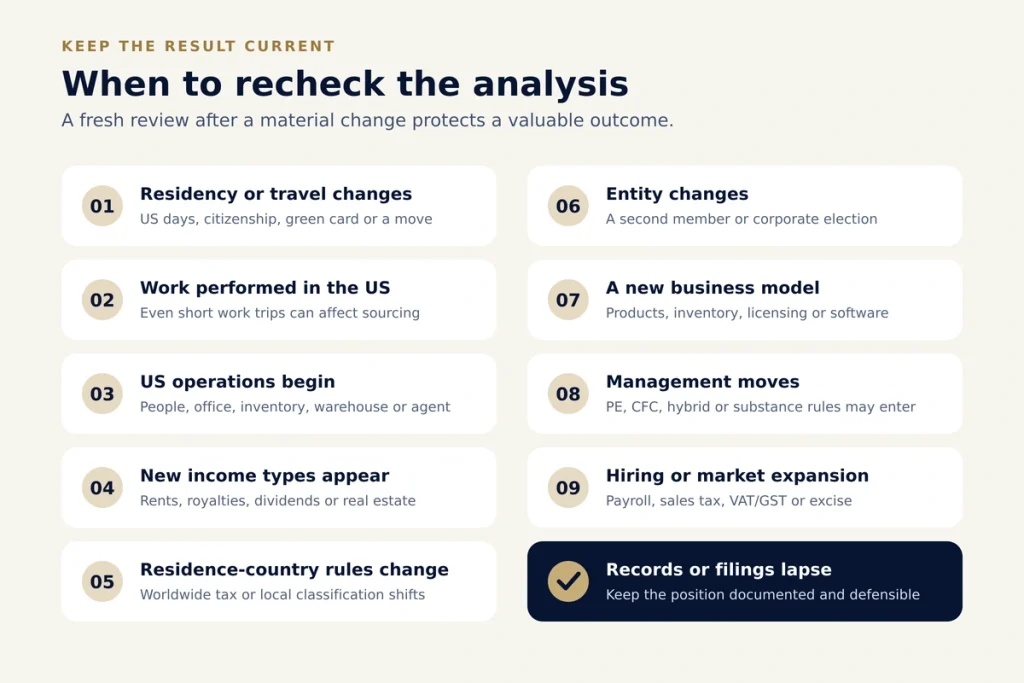
When to recheck the analysis
A confirmed structure can remain straightforward while its facts stay stable. Recheck it when a material fact changes:
| Change | New question to answer |
|---|---|
| US citizenship, green card or substantial presence | Has the owner entered the US resident-tax framework? |
| Work performed during US travel | Does part of the service income become US-source? |
| US office, employee, inventory, warehouse or dependent agent | Is there a US trade or business, state nexus, payroll or sales-tax exposure? |
| Rents, royalties, dividends, investments or US real estate | Which source, withholding and ECI rules govern the new income? |
| A second member or Form 8832 election | Has the entity classification changed? |
| Products, inventory, licensing or a different software model | Does the original service-income analysis still fit? |
| Move to a worldwide-tax country | Will the new residence country tax the LLC profit? |
| Local reclassification or management from another country | Is there corporate residence, PE, CFC, hybrid, substance or registration exposure? |
| Hiring or new markets | Do VAT/GST, sales tax, payroll or excise obligations arise? |
| Missed records or filings | Can the position still be substantiated and penalties avoided? |
A short review after a move, hire or business-model change protects a valuable result.
Zero income tax with full compliance
The best version of this structure is documented, filed and easy to explain.
A foreign-owned US disregarded entity may need Form 5472 with a pro forma Form 1120 for reportable transactions with its foreign owner or another foreign related party. Contributions and distributions can qualify. The IRS currently states a $25,000 base penalty for a required Form 5472 filed incorrectly or late.
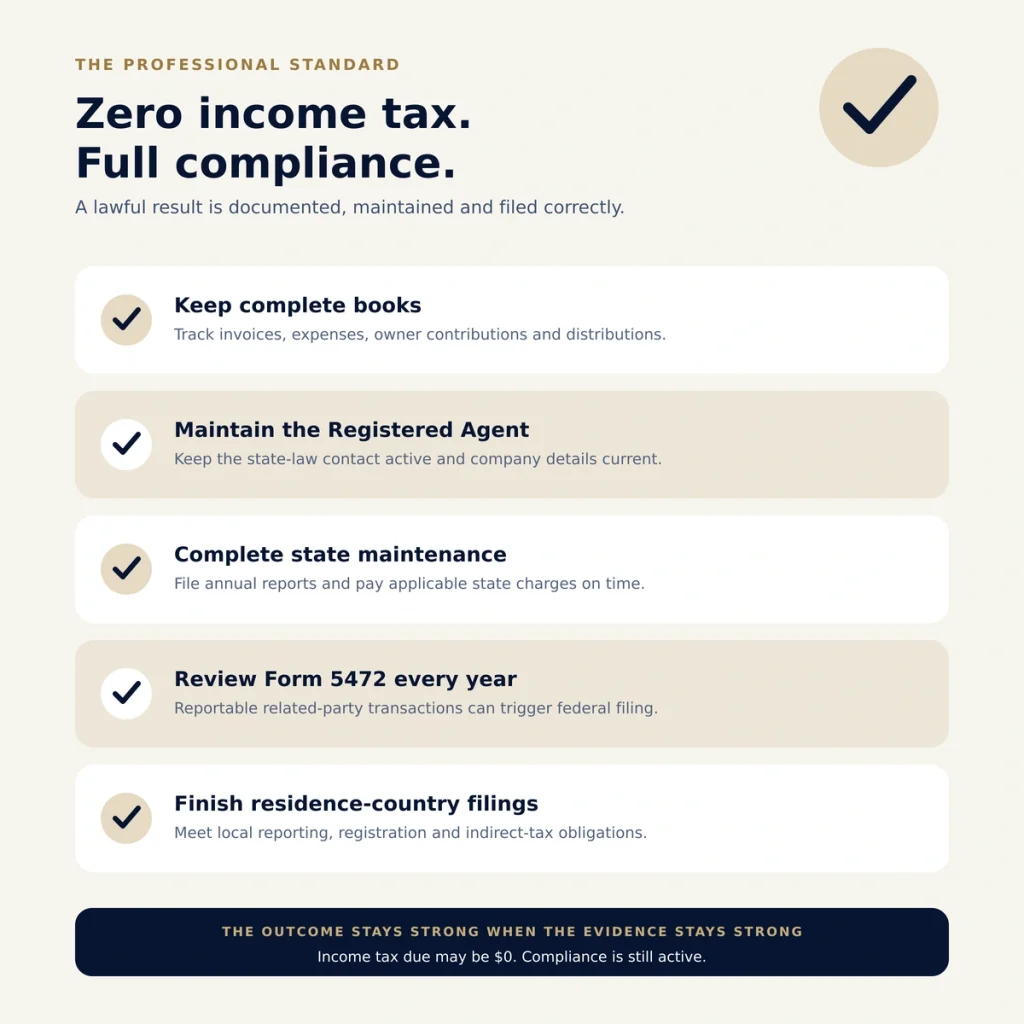
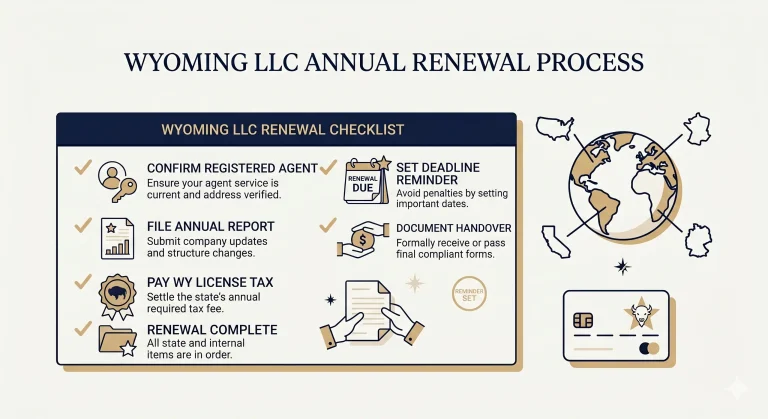
Wyoming, for example, requires an annual report by the first day of the anniversary month and an annual license tax of at least $60; the asset-based amount can be higher. Registered Agent fees, bookkeeping and professional review may remain. See our guides to annual filings and recurring costs.
As verified on September 16, 2026, FinCEN’s final rule exempts US-created companies from BOI reporting. Confirm the current position on FinCEN’s BOI page.
These obligations do not contradict the headline: the income-tax bill can be zero while the company remains fully maintained.
Pre-formation checklist
Get written answers for the facts that matter.
Ask a qualified US international-tax professional:
- Am I a nonresident alien after applying citizenship, green-card and presence rules?
- How is each revenue stream characterised and sourced?
- Could my travel, people, contracts or facilities create a US trade or business, ECI or state nexus?
- Is the LLC disregarded, and which federal information returns apply?
- What changes if I add a member, hire, hold inventory or elect corporate treatment?
Ask a qualified adviser in your genuine residence country:
- Am I tax-resident here under domestic law and any treaty?
- How does this country classify the US LLC and its profit?
- Does worldwide taxation, management and control, PE, CFC, hybrid or anti-avoidance law apply?
- Are business registration, social contributions, VAT/GST or local filings required?
- What evidence should I retain for residence, work location and management?
Keep operational evidence: a travel calendar, contracts, work-location records, invoices, bank statements, contribution and distribution ledgers, bookkeeping and filing confirmations.
After qualified US and local tax professionals confirm your facts, US LLC Setup can implement formation, EIN and practical administration. The introductory call is not a tax consultation.
Frequently asked questions
Yes. In the stated scenario, a nonresident alien’s foreign-source service profit can produce no US federal income tax. Confirm all US-business, ECI and other-income facts.
No. “Disregarded” identifies who is analysed for federal income tax; it does not erase income or required filings.
Yes. A US client does not by itself make Alex’s service income US-source. Work location is central.
Not by itself. A payment account is neither the service location nor the complete business analysis.
No. This model relies on one genuine residence and a local opinion. “Nowhere resident” claims can fail under domestic law and treaties.
Yes, potentially. Reportable transactions can require Form 5472 and a pro forma Form 1120 even when tax due is zero.
No. The result depends on the owner, income, work location, footprint and residence rules. Wyoming also has an annual report and license tax.
Usually not as illustrated. A worldwide-tax country may tax the profit or classify the LLC differently. The LLC may still be usable, but the tax result changes.
Conclusion
Can a US LLC be 100% tax-free? Yes—zero income tax can be lawful when the full fact pattern aligns. The right owner, classification, services, work location, footprint, residence and compliance can add up to exactly that result.
The headline is real. Verify the nine conditions, document them and recheck after material changes.
If advisers confirm the treatment,
or
We implement formation, EIN and administration; the introductory call is not tax advice.
Bosse LLC provides practical setup support and administrative guidance only. We do not provide legal, tax, accounting or regulated financial advice. Government, bank, fintech and payment provider approvals cannot be guaranteed.