How to Pay Yourself from a US LLC as a Non-Resident
Yes—you can organize a permitted payment from your LLC’s business account to your personal account as a documented owner transfer. For a Wyoming single-member LLC owned by an individual nonresident alien, with no corporate tax election, a regular transfer does not automatically become an employee salary. An owner draw is also not a deductible business expense. Start with the real reason for the payment, check authority and available company funds, use a supported payment route, and keep the evidence together. Your country’s treatment and US information reporting need separate checks.
Here is the everyday question: You want to transfer $1,500 to yourself and reimburse $120 of software costs you paid personally. Those are two different records—even if both payments reach the same personal account.
This guide covers a Wyoming LLC with one natural-person owner who is a nonresident alien for US federal tax purposes, without a corporate election. Being neither a US citizen nor a Green Card holder is not, by itself, proof of nonresident status. Multiple owners, corporate owners, US tax residents, corporate elections, employee payroll and larger US operations need a different analysis.
In this guide
- How owner payments work in this setup
- Choose the real purpose of the payment
- Three practical payment examples
- Your eight-step transfer-and-record workflow
- Keep a usable owner-transaction trail
- Keep tax treatment and information reporting separate
- Put your records into a clear workflow
How owner payments work in this setup
Without a corporate election, this single-member LLC is generally disregarded for US federal income tax. That means its activities are considered through its owner for that purpose. The individual owner generally is not the LLC’s employee for US employment-tax purposes. Paying the owner regularly does not, by itself, create deductible payroll. (IRS classification; IRS owner treatment)
You can therefore describe an ordinary permitted withdrawal administratively as an owner draw or owner distribution. The description should match the actual transaction. It does not establish the payment’s treatment in every country.
The LLC remains a separate legal entity under Wyoming law. Keep business and personal accounts distinct, and document movements between them. A federal disregarded classification is not a reason to treat every dollar in the company account as immediately available personal money. (Wyoming Title 17)
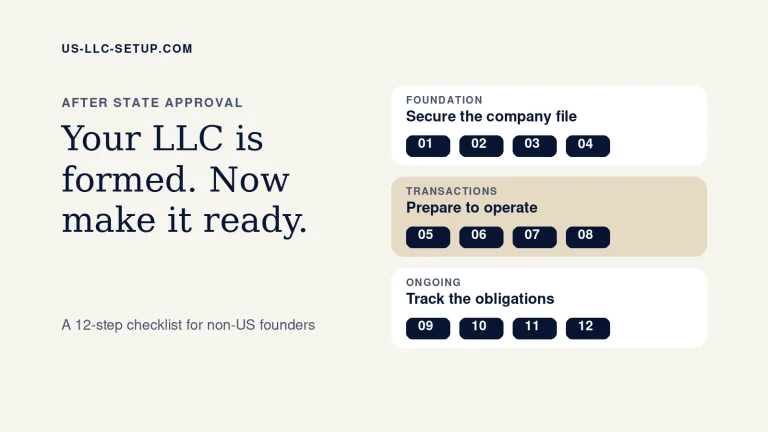
If you are organizing your business after formation, our 12-step post-formation checklist gives you the broader sequence. This article focuses on the payment and its supporting records.
Choose the real purpose of the payment
Before opening your banking app, finish this sentence: “The money is moving because…”
Your answer separates four situations:
| Payment purpose | Direction | What actually happens | Supporting evidence | Common mix-up |
|---|---|---|---|---|
| Owner draw / distribution | LLC → owner | The owner withdraws company funds through a permitted distribution | Authority or decision record, availability check, bank proof, log entry | Treating the draw as a business expense |
| Expense reimbursement | LLC → owner | The LLC repays a genuine business cost the owner paid personally | Vendor invoice, business purpose, personal payment proof, reimbursement proof | Counting the underlying expense twice |
| Capital contribution | Owner → LLC | The owner funds the company | Funding purpose, contribution record, bank proof | Calling the deposit customer revenue |
| Actual financing / repayment | Depends on the real arrangement | Money moves under an existing, documented financing arrangement | Genuine terms, original funding and repayment records | Calling an ordinary draw “loan repayment” |
An owner draw does not reduce the underlying business profit as an expense. For a reimbursement, any expense treatment concerns the original business cost; the repayment should not produce a second deduction for that same cost. (IRS business deductions)
A payment reference helps connect the records. It does not create a tax classification. Writing “salary,” “reimbursement” or “loan repayment” in a bank memo cannot replace the facts and documents behind the payment.
A real loan needs its own review
Use a financing label only when financing actually exists. Civil-law documents, federal income-tax treatment and related-party reporting can lead to different conclusions. In this disregarded owner/entity setup, a written loan document does not automatically establish a separately recognized US income-tax loan or deductible interest. Have a qualified professional review a real financing arrangement instead of using it as a convenient label for ordinary withdrawals.
Three practical payment examples
All examples below are fictional. The amounts illustrate administration; they are not recommended payout levels, tax calculations or provider limits.

Example A: a $1,500 owner draw
A solo consultant wants to transfer $1,500 from the LLC account to their personal account for personal use.
First, they check the Operating Agreement, decision-making authority, actual company funds and upcoming obligations. Wyoming’s distribution rules include the company’s ability to pay ordinary-course debts and an assets-versus-liabilities test. Sections 17-29-405 and 17-29-406 address distribution limits and liability for improper distributions. A visible bank balance alone does not complete this check. (Wyoming Title 17)
Once the payment is confirmed as permitted, the consultant transfers the money through an available provider-supported route. A clear reference could be “Owner draw — OT-01.”
They save the transaction confirmation, the supporting decision or review record and the owner-log entry together. The LLC account shows the outgoing $1,500; the personal account shows the receipt, subject to any actual fees or conversion. The draw is recorded separately from operating expenses.
Example B: a $120 software reimbursement
A founder paid $120 personally for software genuinely used by the LLC’s business. Later, the LLC reimburses that amount.
The records should tell the complete story: which supplier provided the software, when the cost arose, why it related to the business, how the founder originally paid, and how the LLC repaid them. The invoice and the personal payment evidence support the original cost; the LLC transfer proves the reimbursement. (IRS records)
The founder links these records under “SW-01” and uses “Software reimbursement — SW-01” as the payment reference.
The underlying software cost is captured once in the appropriate records. If it has already been recorded, the later reimbursement is connected to that entry rather than entered as another software purchase. The precise bookkeeping treatment belongs with the professional responsible for the books.
Separate transfers are often easier to follow. If a permitted $1,620 payment combines the $1,500 draw and $120 reimbursement, preserve the two components and their evidence separately; one bank line should not obscure two different purposes.
Example C: a $500 capital contribution
A founder transfers $500 from their personal account into the LLC to fund real company costs.
The direction is reversed: owner → LLC. The founder documents that the payment is an owner contribution, records its amount and date, and saves the sending and receiving bank evidence.
A suitable reference could be “Capital contribution — OT-03.” The deposit is not described as a customer sale. If the LLC later uses the money to pay a supplier, that outgoing payment has its own record and supporting invoice.
Make this part of your wider company records
Keep owner transfers, company documents and upcoming duties in one clear workflow. The eBook + DIY Toolkit includes an owner-transaction log, a compliance dashboard and an annual calendar to help organize your setup.
Choose the English or German edition; each is purchased separately. If you already own the eBook, use your existing Toolkit alongside these examples.
Your eight-step transfer-and-record workflow
1. Confirm the setup and the payment purpose
Record who owns the LLC, its US federal classification and why this particular payment is happening. Decide whether it is a draw, a supported reimbursement, a contribution or a transaction under actual financing terms. Resolve an unclear purpose before selecting a label.
2. Check authority, documents and available funds
For a draw, review the relevant company authority, distribution rules and commitments. For a reimbursement, check the underlying business cost and personal payment evidence. Money committed to obligations should be considered when deciding what is available. There is no universal private-withdrawal percentage.
3. Verify the correct recipient details
For a draw or reimbursement, use your own personal account. For a contribution, use the LLC’s business account. Verify the account holder, account number or IBAN, and required bank identifiers. Check the receiving account can accept the intended currency and payment type.
4. Choose a supported payment route
Use a route permitted by the sending and receiving providers for your accounts, country and payment purpose. Their supported corridors, limits and evidence requests vary. Check current terms and any requested documents before submitting. If you still need to establish the account, start with our non-resident business banking guide.
5. Capture amounts, currency and fees
Save the original amount and currency, the amount actually received, any conversion details and fees. Where relevant, retain the documented basis used to prepare a USD amount for reporting. Currency conversion does not change the original reason for the transaction. The examples here use USD throughout and assume no conversion.
6. Use a clear reference and record the event
Choose a short reference tied to an evidence ID, such as “Owner draw — OT-01.” Enter the actual date, counterparties, direction, amount and purpose in your log. If the transfer is pending, update the record when it settles rather than treating an instruction as proof of completed payment.
7. Connect the evidence
Link the log entry to the bank confirmation and the relevant documents. For a reimbursement, include the original invoice and personal payment proof. A simple folder or consistent file-ID system can work well when it makes the full transaction easy to reconstruct.
8. Reconcile and prepare for review
Match the settled transactions to the bank statements and the broader company records. Keep contributions, reimbursements and draws individually visible. Supply the complete trail to the person reviewing local tax treatment, US information reporting and the books. Your log supports that review; it is not the completed return.
Keep a usable owner-transaction trail
The public mini-register below shows the principle. It is an administrative illustration, not a universal chart of accounts, prescribed journal entries or a completed Form 5472 classification.

Transaction overview
| Date / ID | Counterparty | Direction | Original amount | Purpose |
|---|---|---|---|---|
| 2026-10-10 / OT-01 | Sole owner | LLC → owner | $1,500 USD | Owner draw |
| 2026-10-11 / OT-02 | Sole owner | LLC → owner | $120 USD | Reimburse software cost SW-01 |
| 2026-10-12 / OT-03 | Sole owner | Owner → LLC | $500 USD | Capital contribution |
Linked evidence and payment details
| ID | Supporting file IDs | Payment reference | Illustrative fee |
|---|---|---|---|
| OT-01 | DEC-01, BANK-01 | Owner draw — OT-01 | $0 |
| OT-02 | SW-01 invoice, PAY-01 personal proof, BANK-02 | Software reimbursement — SW-01 | $0 |
| OT-03 | CAP-01, BANK-03 | Capital contribution — OT-03 | $0 |
These fictional transactions assume $0 fees solely to keep the illustration simple; actual provider fees must be recorded. All original amounts are USD, so no exchange rate is used. SW-01 relates to a fictional software purchase personally paid on 2 October 2026.
Preserve the individual events. A single year-end net balance would hide how much went into the company, how much came out, and which payments reimbursed existing costs. Where several records relate to one cost, connect them clearly so that a reviewer can follow the chain.
Store records for the periods required by the obligations that apply to you. US reporting, local tax, company and contractual requirements may differ; there is no single retention period for every founder. (IRS records; record-maintenance rule)
Keep tax treatment and information reporting separate
The transfer does not determine the business’s tax position
For this US federal disregarded setup, retaining business earnings in the LLC account or transferring them to the owner does not, by itself, decide whether the underlying activity is taxable. Review the actual income and operations. Our US-source versus foreign-source income guide explains that separate question.
General US sole-proprietor examples also do not establish the return or self-employment-tax position of every nonresident alien. International social-security agreements can matter. This article’s owner-transfer workflow is not a payroll, Form 1040 or Schedule C instruction. (IRS nonresident rules)
Form 5472 is a separate information-reporting check
A foreign-owned US disregarded entity is treated separately for the limited information-reporting rules under section 6038A. Reportable related-party transactions can require Form 5472 with a pro forma Form 1120, even when there is no customer revenue or US income-tax amount. (IRS reporting instructions)
Contributions, distributions and certain formation-related transactions are expressly included in the instructions. A year with genuinely no reportable transactions needs its own assessment; zero sales alone does not establish that situation. Keep the evidence for the preparer to determine the appropriate reporting. (IRS reporting instructions)
Form 5472 requires monetary amounts in US dollars. Retain original currencies and any conversion basis so the reporting figures can be traced. For filing scenarios and deadlines, see the annual filing requirements guide and check the current IRS instructions for the relevant year. (IRS Form 5472)
Check your country’s treatment
Your residence and operating country may classify the LLC and payments differently from the US federal treatment described here. Ask a qualified professional to establish the local classification, treatment of the underlying profits and owner payments, and any social-security obligations. Our US LLC guide for EU residents provides the wider context.
Give that professional your company documents, business facts and transaction trail. Clear records make this a concrete review of what happened.
Put your records into a clear workflow
You now have a practical sequence: identify the purpose, confirm the payment is permitted, choose the route, and connect the transfer to its evidence.
For a wider setup-and-admin resource, get the eBook + DIY Toolkit for €59. It includes practical worksheets and an owner-transaction log alongside the guide. English and German editions are available separately as PDF and EPUB downloads. It provides general practical guidance; individual tax and accounting review remains separate. (eBook details)
Still preparing to form your LLC? Choose a formation package with the level of personal setup support you need. The packages cover formation and administrative setup support; tax, legal, accounting and bookkeeping services are not included.
Bosse LLC provides practical setup support and administrative guidance only. We do not provide legal, tax, accounting or regulated financial advice. Government, bank, fintech and payment provider approvals cannot be guaranteed.