Can You Run Multiple Businesses Under One Wyoming LLC?
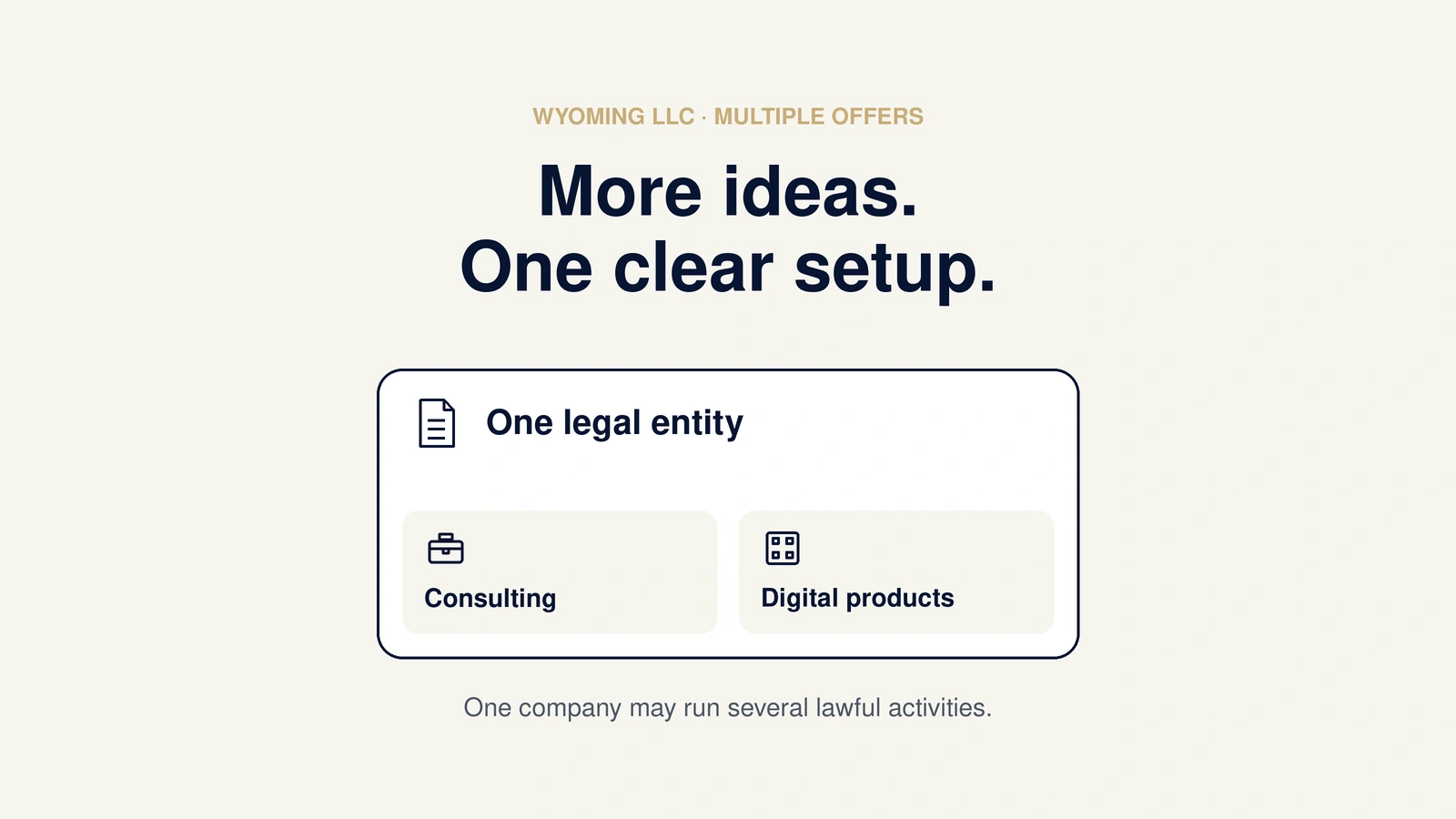
Yes. A Wyoming LLC can generally run several lawful business activities, so you may not need a separate company for every offer or brand. A consultant could also sell digital templates; a software founder could operate two product brands. The practical question is whether the activities fit the same ownership, contracts, risk profile and provider relationships. Brands and DBAs do not create separate legal entities. For European and other non-US founders, a clear company setup starts with those distinctions—and with the rules where the business actually operates.
Last reviewed: October 14, 2026.
Table of contents
- Can one Wyoming LLC run more than one business?
- Company name, brand, DBA and separate LLC: four different roles
- When a shared entity can be a practical starting point
- What Wyoming’s trade-name rules mean for remote founders
- Three realistic examples
- What to clarify with banks and payment providers
- When separate LLCs deserve closer review
- Your pre-filing decision checklist
- Choose the support that fits your formation
Can one Wyoming LLC run more than one business?
Wyoming’s LLC Act permits lawful purposes and gives an LLC the capacity to carry on its activities. It does not impose a general one-company, one-product rule. That is the basis for operating multiple businesses under one LLC, provided the particular activities and arrangements are permitted.
For a solo founder, this can make it easier to build a service business and add a related product without forming another company solely because the offer has a new name.
The permission has boundaries. The Act excludes acting as a financial institution or insurer under this chapter and preserves professional licensing requirements. Local registrations, industry permits and contractual restrictions still need their own checks. See Wyoming’s LLC Act, sections 17-29-104 and 105.
If you are new to the terminology, our guide to what an LLC setup includes explains the formation foundation. Here, the decision is how your actual offers should sit within that foundation.
Company name, brand, DBA and separate LLC: four different roles
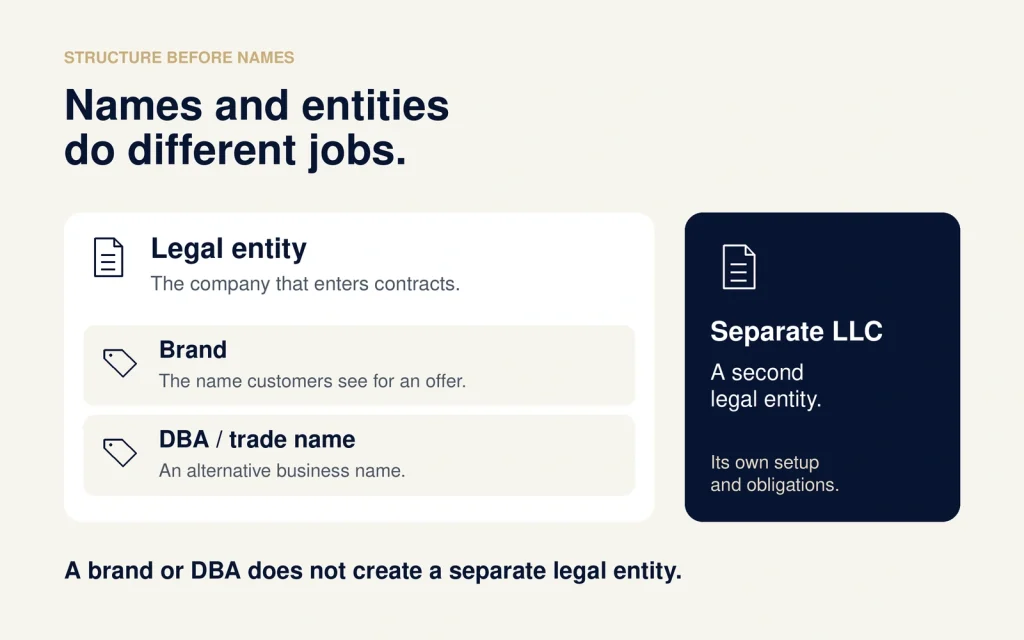
These terms describe different parts of a business:
| Term | What it does | Does it create another legal entity? |
|---|---|---|
| Legal company name | Identifies the formed LLC, such as the fictional Clearpath Studio LLC. | It identifies the existing entity. A name change alone does not form another one. |
| Brand | Presents an offer to customers through a name, design or product identity. | A brand alone does not. |
| DBA / trade name | An alternative name under which a person or company does business; registration rules depend on location. | A DBA alone does not. |
| Separate LLC | A separately formed legal entity, with its own ownership and company records. | Yes. Its practical and legal separation depends on the arrangements and operation. |
A brand can also function as a trade name when used to conduct business. These are overlapping roles, rather than four mutually exclusive naming choices.
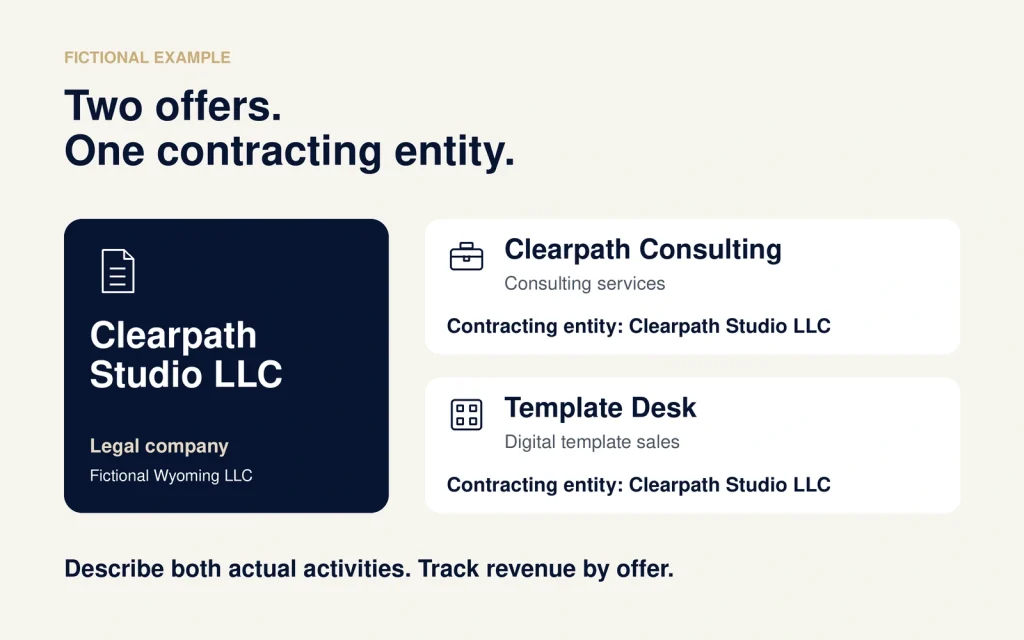
For example, Template Desk might be the customer-facing brand, while Clearpath Studio LLC is the company supplying the templates. The website should make that relationship understandable, and the customer documents should identify the correct contracting party.
Two websites, two revenue categories or two payment accounts within that LLC help organise operations. They do not create legal separation between the activities. A claim against the LLC can affect assets used across its business lines; a different brand name does not ring-fence them.
Keep three naming checks distinct: company-name availability, any required trade-name registration, and existing trademark rights. A successful Wyoming filing is not worldwide trademark clearance. The SBA’s naming guidance distinguishes entity names, trademarks, DBAs and domains.
When a shared entity can be a practical starting point
A shared entity can be worth considering when the same founder owns the activities, the commercial risks are compatible, and the company can describe and document everything it actually does.
This often starts with a simple expansion: a consultant adds templates, an agency adds a digital training product, or a software founder develops another tool. Each offer can have its own positioning and reporting while the legal supplier remains the same.
The administrative benefit is concrete: one entity to form and maintain, rather than several. That does not remove activity-specific duties or guarantee a particular saving. Compare the continuing work in our annual-cost guide for non-US LLC owners.
Use this comparison to prepare the decision:
| Decision point | One LLC, several offers / brands | Same LLC with a trade name / DBA where appropriate | Several separate LLCs |
|---|---|---|---|
| Contracting party | The same LLC for each offer | The same LLC behind the alternative name | The relevant LLC for each activity |
| Ownership | One entity’s ownership arrangements | The same ownership arrangements | Ownership can differ by entity |
| Customer identity | Distinct offer or product brands | Alternative trading identity | Separate company identities and possible brands |
| Separation of activities | No legal separation merely from branding | The DBA adds no separate entity | Distinct entities; effectiveness needs appropriate setup and operation |
| Documents and providers | One company identity; all material activities disclosed | Company-to-name relationship also documented | Records and provider checks for each entity |
| Formation and upkeep | One entity’s formation and continuing administration | Same entity, plus relevant name administration | Formation and continuing administration for each entity |
Preparing a suitable new LLC for several offers? Bring the activities, owners and intended brands into one clear formation brief. Choose the administrative support that matches your preparation needs.
What Wyoming’s trade-name rules mean for remote founders
The Wyoming Secretary of State’s business FAQ states that registering a DBA name is not mandatory in Wyoming. So a new product brand does not automatically mean a Wyoming trade-name filing.
A voluntary registration has specific conditions. The currently linked Trade Name Application, checked on October 14, 2026, requires:
- Prior use of the name in Wyoming, with the date of first use.
- A business-entity applicant registered and in good standing with the Wyoming Secretary of State.
- A signed and notarised application.
- A $100 filing fee.
For a founder working remotely from Europe, forming a Wyoming LLC alone should not be treated as proof that the brand has been used in Wyoming. Establish whether the actual use meets the requirement before applying. This is not a blanket step to complete for every planned brand before launch.
Other states, cities and countries can apply different rules. Check the places where you operate and any evidence a bank or payment provider requests.
Before committing to a name, check the relevant company and trade-name records, search for similar existing uses, and review trademark registers in your intended markets. The USPTO’s comprehensive-clearance guidance explains why a federal database search alone is incomplete. Obtain suitable trademark advice where a conflict or important launch investment warrants it.
Three realistic examples
These examples are fictional illustrations, not customer cases or pre-approved structures.
A consultant adds digital templates
Maya owns Clearpath Studio LLC. She offers consulting as Clearpath Consulting and downloadable business templates as Template Desk.
One entity may be a workable starting point if the activities, contracts and provider requirements fit. Customers should be able to identify Clearpath Studio LLC as the supplier behind both offers. Maya can track consulting and template revenue separately within the company’s records.
Her business description should include both activities. Adding digital products can introduce different consumer or indirect-tax questions, so the consulting setup should not simply be copied without checking. A Wyoming DBA is not assumed for either brand.
For the wider service-business context, see our guide for freelancers in Europe.
A software founder operates two product brands
Leo owns the fictional Northbridge Tools LLC, which supplies two software products under separate brands and websites.
Both sites identify the same operating company. Product names, descriptions and customer-facing payment information match the relevant product, while legal company details remain consistent.
The payment-account design follows the provider’s rules. Independently operating projects may need separate Stripe accounts even under the same LLC. Each account still needs accurate information and its own provider assessment. Another product brand does not guarantee approval or create another entity.
Our SaaS founder guide covers the contracts, subscriptions and billing workflow in more depth.
A new activity brings in a co-founder
Sara owns a consulting LLC and wants to launch a software product with Daniel. Daniel would invest in the software venture, while Sara intends to retain sole ownership of her consulting business.
That changes the questions: what would Daniel own, who would control decisions, which company would own the software, and how would contracts and revenue be allocated?
A separate entity may deserve closer review because the ownership and governance needs differ. The solution requires appropriate legal and tax input; a second brand or revenue category alone does not establish Daniel’s rights. Neither does this example mean every new partner automatically requires another LLC.
What to clarify with banks and payment providers
Think in two layers: the legal company behind the accounts, and the customer-facing information for each offer.
Stripe’s current multiple-account documentation says independently operating projects, websites or businesses must use separate accounts. Multiple accounts belonging to the same legal entity can use the same tax ID and company information. Each newly activated account is subject to Stripe’s standard policies; existing approval does not carry special status into it.
Different product names can therefore mean separate payment accounts without separate companies. Confirm the public business information and statement descriptor so customers recognise their purchase.
Mercury’s Terms of Use, section 1.2, require accurate customer information, including the nature of the business and ownership. Incomplete, inaccurate or outdated information can affect account access. The practical lesson is to describe every material business line honestly and ask what needs updating when activities change.
Prepare a short identity map:
| Field | Consulting offer | Template offer |
|---|---|---|
| Legal supplier | Clearpath Studio LLC | Clearpath Studio LLC |
| Customer-facing name | Clearpath Consulting | Template Desk |
| Website reference | Consulting site’s actual URL | Template site’s actual URL |
| Activity | Consulting services actually supplied | Downloadable templates actually sold |
| Provider setup | Confirm account and display requirements | Confirm account and display requirements |
| Addresses | Correct address for each requested role | The same facts, mapped to the requested roles |
This is an illustrative preparation tool, not prescribed invoice, contract or website wording. A brand name does not replace a real operating address. Our LLC address guide and company-document checklist explain those supporting records.
Use brands to explain your offers clearly. They must not conceal restricted activities, owners or transactions. Our
covers the wider preparation.
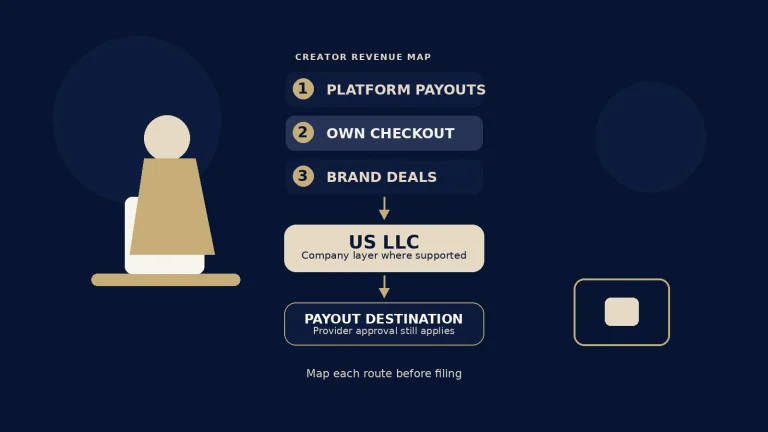
For creators combining direct sales and platform income, our creator guide explains the different payment routes.
When separate LLCs deserve closer review
Several companies can be appropriate where the actual businesses have different needs. The strongest reasons to review that option include:
- Different owners or investors: an investment should relate to the intended venture.
- Different risks: claims, insurance and contractual exposure may be materially different.
- Independent contracts or operations: each business may need its own supplier relationships and authority arrangements.
- A planned sale: ownership of the relevant assets, rights and customer agreements needs clarity.
These are decision criteria, not universal formation requirements. Separate companies add administration and need appropriate operation; the act of filing alone is not a guarantee of liability protection.
An additional brand within the same continuing entity is also not automatically a new EIN application. The IRS’s LLC-specific guidance says a name or location change does not require a new EIN. Review the applicable rules when ownership, structure or relevant tax circumstances actually change.
Several offers can have different tax treatments and local obligations. Neither a DBA nor an additional LLC guarantees tax-free income. Use our US-source versus foreign-source income guide and EU resident guide to identify questions for your tax adviser.
Your pre-filing decision checklist
Before choosing the formation route:
- List the activities. Include every material offer, not only the one launching first.
- Record the owners. Note co-founders and any planned investors.
- Identify the contracting party. Map every brand to its intended legal supplier.
- Check the names. Review existing rights and required registrations in the relevant places.
- Flag special requirements. Identify licences, risks, insurance and contractual questions.
- Check provider fit. Present the real combined activity to intended banking and payment providers.
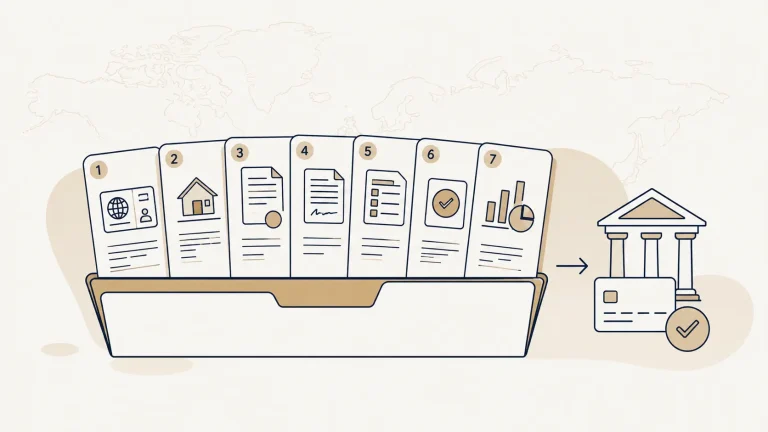
- Prepare the identity map. Align company name, brands, websites, activities and address roles.
- Choose your formation support. Resolve any necessary specialist questions before submitting the Wyoming filing.
Formation itself does not automatically move existing contracts, intellectual property, assets or provider accounts into the new LLC. Plan the relevant arrangements separately. After formation, our 12-step launch checklist helps organise the next administrative tasks.
Already have a suitable LLC? Review and update its records and provider arrangements before buying another formation solely for a new brand.
Choose the support that fits your formation
You can build several suitable offers around one clearly identified company. The next step is to prepare that company consistently and select the amount of administrative support you need.
For a new formation with several offers, Guided Setup / US LLC Setup for Europeans (€849) is a practical route when you want onboarding, review of formation information before filing, banking readiness and a structured handover. It includes 14 days of support. This is practical setup assistance; it does not replace specialist advice on the legal structure.
Starter LLC Setup (€599) suits founders whose setup is already clear. It includes formation, the state filing fee, first-year registered agent, EIN support without an SSN, Operating Agreement and Initial Resolutions templates, and seven days of email support.
Premium Launch (€1,190) can fit a wider preparation workload involving banking applications, payments and first invoices, with 30 days of support. Choose it for those additional tasks rather than the number of brands alone. See the current Wyoming formation service and Europeans setup page for context; the pricing page specifies each package’s scope.
More than one idea? Start with one clear formation brief. Once the suitable structure is established, choose the package that helps you turn your planned activities into an organised company setup.
Prefer to prepare and file yourself? The
offer a separate DIY route. If you switch to a formation package before its Wyoming filing is submitted, the €59 book price can be credited toward that package under the current offer terms.
Bosse LLC provides practical setup support and administrative guidance only. We do not provide legal, tax, accounting or regulated financial advice. Government, bank, fintech and payment provider approvals cannot be guaranteed.