US LLC for European Content Creators: Stripe, Platform Payouts and Banking
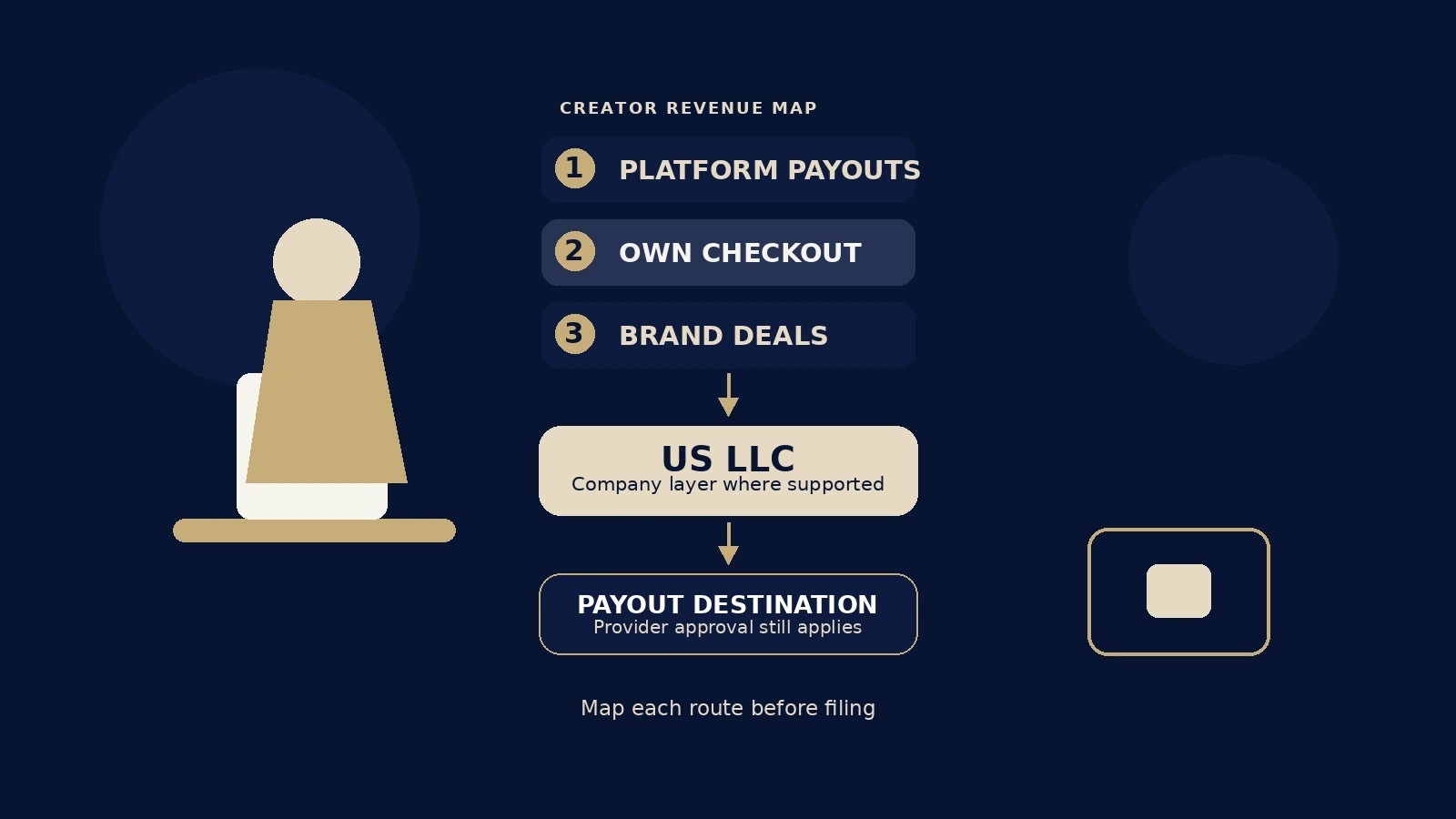
A US LLC can give a European content creator a professional company layer for direct sales, brand contracts and some supported business-payee arrangements. It does not turn platform monetization, an account for your own Stripe checkout and business banking into one approval. Each route has its own rules. Before forming a company, map who pays you, who the contractual payee is, who processes the payment and which account can receive it.
If you are building more than a public persona, the right question is how to structure the business behind your creator identity.
Table of Contents
- Start with the money flow
- Three creator revenue routes
- Four independent decisions
- Platform payouts versus your own Stripe account
- What a US LLC can add
- Stripe for direct sales
- Platform payout reality check
- Banking and payout destination
- Five alignment checkpoints
- Website and evidence
- Restricted activity and European obligations
- Tax forms
- Fit and seven-step sequence
- FAQ
Start with the money flow
Write down every way money actually reaches your creator business: a video platform’s revenue share, paid subscriptions, a course or digital download sold on your website, sponsorship, UGC production, licensing, affiliate commissions and invoices to agencies or brands. For each route, name the buyer or payer, the contract, the onboarding system, the processing or payout rail, the recipient and the receiving currency. Add the country in which you perform the work and any platform tax interview.
“Content creator” alone is too vague a business description. A reviewer needs to understand what you produce or sell, who pays for it, how it is delivered and why a payment is expected. A YouTuber selling a course and licensing footage to a brand has three different commercial relationships, even if one person appears on camera for all three.
For a separate direct-sales merchant account, our US LLC and Stripe guide covers provider verification in depth. First map the other routes alongside it.
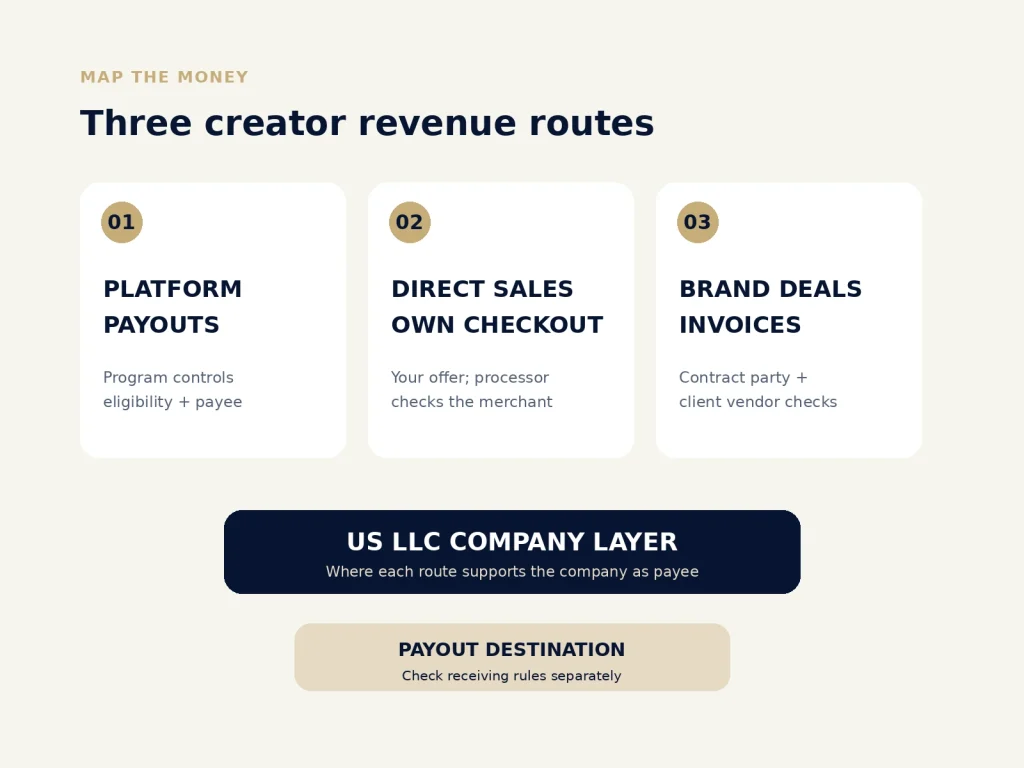
Three creator revenue routes
| Revenue route | Who pays? | Who controls onboarding? | What can the LLC organize? | What remains provider-specific? | Evidence to retain |
|---|---|---|---|---|---|
| Platform-controlled payouts | The platform or its payout partner under the program terms | Platform, often with its processor | A business payee where that exact program allows one; company records and bookkeeping | Eligibility, payee changes, tax interview, country, currency and payout method | Program terms, statements, tax profile, payout notices |
| Direct sales or subscriptions through your own checkout | Customers | You set the offer; Stripe or another processor verifies the merchant | Legal seller, contracts, receipts, website and business records | Processor eligibility, restricted activity, verification and eligible payout account | Orders, invoices, fulfillment, refunds and processor reports |
| Brand deals, licensing and invoices | Brand, agency or business client | Both parties negotiate; the client may run vendor checks | Contracting party, invoice issuer, licensing terms and receivables | Client procurement, withholding/tax documentation and transfer method | Signed scope, usage rights, invoice, payment and delivery proof |
The LLC has the most direct influence where you control the customer contract. A platform program can still decide whom it will onboard and pay. In every route, a documented business structure helps tell a coherent story; it never substitutes for the payer’s approval.
Four independent decisions
- Program eligibility: can this creator account participate in this monetization feature in its actual region?
- Payee and entity setup: is the contractual recipient an individual or a company, and who owns or controls it?
- Processing or payout rail: is this your own merchant checkout, a platform-connected Stripe arrangement, or a platform’s separate payment process?
- Receiving account: will the designated account accept that specific transfer, currency and payee name?
A “yes” at one checkpoint does not carry to the next. A bank can accept your LLC while a platform keeps an individual payee profile. Stripe can accept a direct-sales account while a video program remains unavailable in your region. This is why the revenue map comes before the filing.
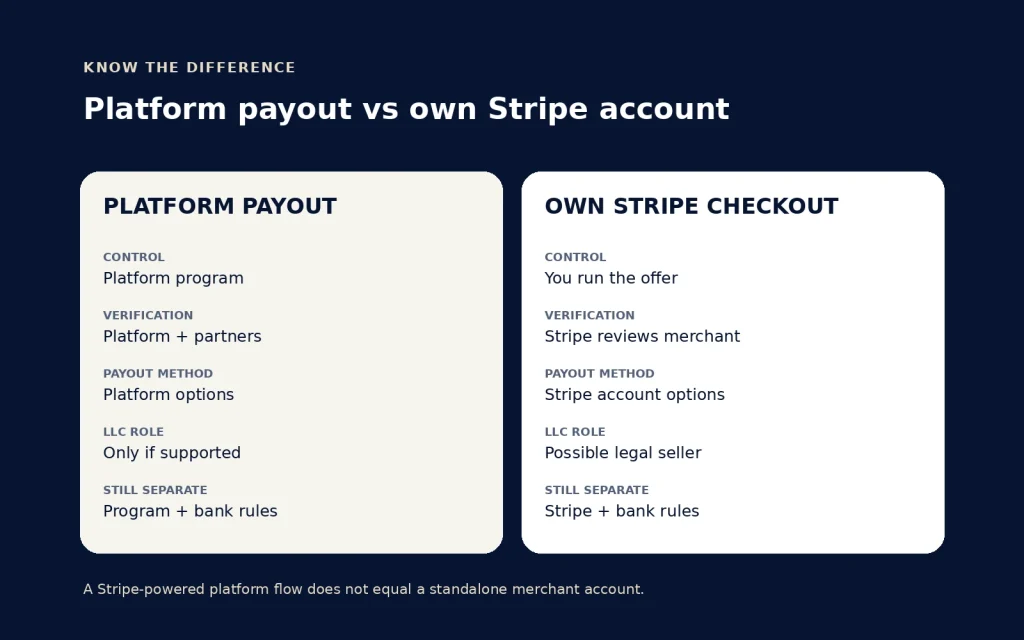
Platform payouts versus your own Stripe account
With your own Stripe checkout, your company applies as the merchant for sales it makes directly. Stripe reviews the entity, people, activity, website and payout details. You manage your offer and customer policies, subject to Stripe’s rules.
With platform payouts, the platform sets the program terms, payee options, tax workflow and available payout methods. Some platforms use Stripe Connect or other Stripe services behind the scenes. A connected account can have a Stripe relationship, but its control and responsibilities depend on the platform’s integration. The mere appearance of Stripe during onboarding does not mean you have an unrestricted standalone Stripe merchant account for your own website. Other platforms use different processors entirely. Stripe explains the distinct connected-account arrangements.
If your question is how a nonresident founder prepares a separate US merchant account, use our US LLC and Stripe guide. This guide concentrates on which revenue route that account would serve.
What a US LLC can add
A Wyoming LLC can give a real creator business one legal company and potential payee for routes that support it. Formation produces a state record; an Operating Agreement can document ownership and authority; an EIN identifies the business for federal administration. The company can sign sponsorship and licensing agreements, issue invoices, separate company records from personal spending and organize bookkeeping by revenue stream. See the core LLC document guide and EIN guide for those separate steps.
A structured description and evidence folder can make direct-payment and banking applications easier to explain. Wyoming’s standard formation form does not ask for a public list of members, which can reduce public-record exposure in an appropriately prepared filing. Other filing details may be public, and banks, platforms, processors and authorities may still demand full identity, ownership and activity disclosure. Public-record privacy is not anonymity; professional positioning is not concealment.
The LLC does not change your nationality, place of work or tax residence. Nor does it upgrade an existing individual creator account automatically. Many European creators can use Stripe with an existing local structure. A US LLC makes sense only if the whole business use case—contracts, operations, payments, tax classification and administration—fits.
For creators who want their actual revenue routes considered before filing,
is the creator-specific support path.
Stripe for direct sales
If customers buy a membership, course, digital product, consulting session or other eligible offering through your own website, a US LLC may serve as the legal seller for a separate Stripe setup. Prepare its legal name and EIN, the real owners and representative, truthful residential and operating-address information, and a clear description of the actual activity. Your functioning site should explain the offer, price and currency, delivery or access, support contact and applicable refund or cancellation terms. The payout destination must be eligible for the account and match the relevant ownership details.
Stripe decides verification, supported countries, product eligibility and any restrictions. Its restricted-business rules matter even when an activity is lawful. A local European Stripe setup may already cover your direct sales. The LLC is not a Stripe access shortcut.
For the full company, owner, website, address and payout review, continue with the nonresident Stripe deep dive. No account opening, lifetime or payout outcome can be promised.
Platform payout reality check
Before filing—or altering a live account—ask the specific platform and program: Does it support a business payee for your country? Who is the contract party and beneficial owner? Can an existing individual profile be changed, or is a new profile required? Will verification or a payout hold follow? Which tax interview applies to the actual payee and federal classification? Which account names, countries, methods and currencies can receive the payout?
The table is a set of representative checks, not a universal acceptance list. Its provider observations reflect official guidance checked on September 28, 2026.
| Revenue stream | Who controls eligibility? | Potential LLC-payee role | Key constraint | Practical verdict |
|---|---|---|---|---|
| Brand deal or direct invoice | Client and contract parties | Often direct, if client contracts with the LLC | Client vendor checks, tax paperwork and transfer details still apply | Strong potential fit when the company truly supplies the work |
| Your own Stripe checkout | Stripe for processing; you for the offer | Possible merchant entity | Separate Stripe verification and restricted-business review | Strong potential fit for eligible direct sales; independently approved |
| Substack paid publication | Substack and Stripe | Do not assume; check the connected Stripe and publication details | Web paid subscriptions connect to Stripe; iOS in-app purchases have a separate Apple-first path | Check the exact paid-subscription and payout flow before changing the payee |
| YouTube / AdSense for YouTube | Google and program rules | Organization payments can be made to a company in an organization account | Activated account type cannot simply change; AdSense payment country cannot be changed | Plausible only with the correct organization and payments setup; plan a transition with Google |
| Patreon | Patreon and its payout partners | Patreon onboarding offers individual or business/corporation selection | Payout country, creator status, method and tax details govern; changing payout details currently imposes a five-day lock | Conditional fit; verify the actual country and payee profile before a change |
| TikTok Creator Rewards | TikTok | No LLC-based eligibility shortcut | TikTok’s official program description requires a personal account in good standing where the program is available | Keep this program’s personal-account and region tests separate from company formation |
Substack’s current paid-publication instructions describe both its connected Stripe process and the different iOS purchase path. Google documents organization versus individual AdSense accounts and country limitations. Patreon documents its business selection and payout lock. TikTok’s Creator Rewards Help and official program description state the personal-account and availability conditions. Meta/Instagram monetization also depends on program, country, policy and payout onboarding, but the accessible official material did not support a specific LLC-payee verdict, so no acceptance claim is included here.
Banking and payout destination
Start with the function: Do you need US ACH details, USD wires, EUR/SEPA receipts, currency conversion, card spending, processor payouts or international supplier payments? A multi-currency account may solve some of these without supplying every function of a traditional bank account. The platform or processor must also support that particular account and transfer route.
A provider may ask about the company, account holder, owners, residence, operating country, industry, source of funds and expected flows. The legal names and factual business story should be consistent. A Wyoming Registered Agent address, the owner’s residential address and the place where the company operates serve different purposes; do not force them to look identical. Read the address guide and our business banking pillar for the deeper account and document comparison.
A bank or fintech approval does not grant a platform program or Stripe approval. A platform payout approval does not promise a receiving-account approval either.
The free Self-Check asks ten high-level questions about provider/country fit, LLC and identity records, address roles, business evidence and intended account use. It is an orientation to possible gaps—not an approval score, provider selection, document review or personal application preparation.
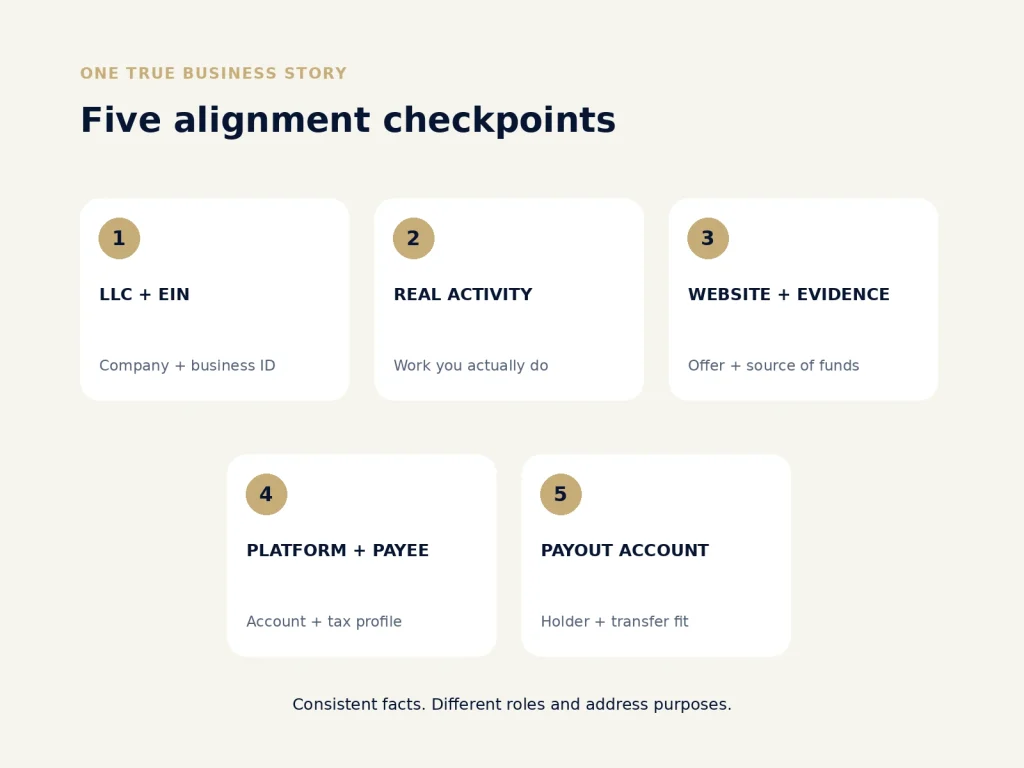
Five alignment checkpoints
| Checkpoint | What to verify |
|---|---|
| 1. LLC and state record | Legal name, formation state, agent and actual ownership records |
| 2. IRS and EIN record | Company name, responsible party, address role and EIN confirmation |
| 3. Real activity and website | What is sold, where the work occurs, customers, terms and support |
| 4. Platform payee and tax profile | Actual contract party, account type, beneficial owner, residence and program rules |
| 5. Receiving account | Legal account holder, supported country, currency, transfer type and source of funds |
These checkpoints should tell one true business story, not repeat identical entries in every field. A mailing address is not automatically an operating location; a beneficial owner is not the same as a company payee; a platform’s tax interview may have a different purpose from an EIN application. Resolve discrepancies at the actual issuer or provider, not by editing official documents or inventing facts.
Website and evidence
An application-ready website or professional presence should show the actual content, service or product, who buys it, what they receive, prices and currency where relevant, access or delivery, customer support, and applicable cancellation, refund and fulfillment terms. Publish appropriate terms and privacy information. If your main business is B2B, keep the signed sponsor, UGC, agency or licensing agreements, usage rights, deliverables and invoices. Retain platform earnings statements and payment records to explain source of funds.
Pre-revenue creators can be transparent about launch status and show a credible offer and real work. Do not manufacture customers, contracts or earnings evidence. A focused evidence folder is useful for reviews and for your own bookkeeping even when no provider asks for every document.
Restricted activity and European obligations
Describe the work you actually perform. “Digital media,” “content production” or “online marketing” are useful only when true. Some lawful activities—including adult content—may be restricted or unsupported by particular processors, banks or programs. Stripe’s current restricted-business list expressly matters to a proposed direct checkout. Re-labeling the same activity will not change its eligibility. An LLC can provide administrative structure without promising provider access.
Living and working in Europe remains relevant after Wyoming formation. Your country may tax your income or business and may apply VAT, social-security, management-location and reporting rules. The European Commission’s DAC7 summary describes defined platform activities; it does not mean every creator receipt is reported in the same way. Patreon’s EU reporting explanation covers specified services and tangible goods and can request individual or entity details. Direct consumer sales may bring different VAT analysis. Get country-specific advice where your residence, work, entity classification or customer mix makes it necessary. A US LLC is not a “tax-free creator setup.”
Creator receipts are not one tax category either. US sourcing principles generally look to where personal services are performed for service income and where property is used for royalties. A sponsor fee, an IP license and platform advertising revenue should not be assigned one tax treatment from their labels alone.
Tax forms
Do not choose W-8BEN, W-8BEN-E or W-9 simply because you formed an LLC. The correct documentation depends on the contractual and tax payee, beneficial owner, US federal classification, income type, payer and the platform’s actual questions. A default single-member LLC can be disregarded from its owner for US federal income-tax purposes. The company and its foreign individual owner are not automatically two independent tax persons for every withholding question.
The IRS distinguishes the payee of a disregarded entity, W-8BEN for foreign individuals, W-8BEN-E for relevant entities, and W-9 for US persons. These are context-dependent rules, not a platform-wide form recommendation. Do not change a live tax interview based only on a blog post; use qualified cross-border tax advice for uncertain classifications or withholding.
An EIN identifies the business; an ITIN is an individual US tax identifier issued for a valid reason. An ITIN is not automatically required merely to form the LLC or request its EIN. Read EIN versus ITIN for non-US founders for that distinction. A separate platform or processor may still request additional personal information.
Fit and seven-step sequence
A US LLC may fit a creator with several genuine revenue sources, international brand contracts, a direct customer checkout, USD or multi-currency needs, a clear offer, documentation and a reason to use one professional contractual company. It may be a poor fit if the sole aim is to circumvent an unsupported country or activity, there is no credible offer, ownership or residence cannot be documented, the platform disallows the intended business payee, or the expected result is anonymity, automatic tax freedom or guaranteed accounts. For a wider comparison, read US LLCs for freelancers in Europe.
- Map every revenue route and identify payer, payee, processing rail and receiving account.
- Check each platform’s eligibility and payee rules before filing or changing a live profile.
- Confirm home-country and US classification fit with qualified advisers where needed.
- Form the LLC and request the EIN using accurate company and responsible-party facts.
- Prepare the real website, contracts and evidence folder.
- Verify a workable receiving route before moving platform payouts or direct sales.
- Change only supported profiles carefully; retain statements, bookkeeping and ongoing compliance records.
See the formation-to-banking timeline for the separate company, EIN and account milestones.
Frequently asked questions
A US LLC can help organize a real creator business with several revenue routes, such as direct sales, brand contracts and supported business-payee arrangements. It can bring contracts, invoices and company records under one structure. The fit depends on your actual operations, platform and payout rules, and tax position in your country of residence.
It can where the specific program supports a business payee for your account and country. Check who the contractual payee can be, which verification and tax profile apply, and whether the receiving method fits before filing or changing a live account.
With your own checkout, the LLC may apply as the merchant for its direct sales, subject to Stripe’s review. With platform payouts, the platform controls its program and payee options, even if it uses Stripe services behind the scenes. Each route has its own onboarding and receiving rules.
Check the platform’s supported process first. A business-payee change may require a different profile, new verification or a new account, and it may temporarily affect payouts. Plan the transition around the rules for your specific program before changing a live setup.
That depends on the platform or direct-checkout configuration, the account holder, country, currency and transfer method. Map your revenue routes and confirm an eligible destination for each one before moving payouts.
An LLC can be formed for a lawful business, but individual payment processors, platforms and financial providers may decline the actual activity. Describe it truthfully and check each intended route first.
Build the business behind the creator identity
Your work may now involve customers, platforms, agencies and recurring contracts. A suitable company can put the real business on clearer legal and administrative footing. Map each revenue route first, then build an entity, payment and banking plan around what is actually supported.
Bosse LLC provides practical setup support and administrative guidance only. We do not provide legal, tax, accounting or regulated financial advice. Government, bank, fintech and payment provider approvals cannot be guaranteed.