
Do I Need a US Address for My LLC? Registered Address vs Trading Address Explained
One of the most common questions from European and non-US founders is simple:
“Do I need a US address to open a US LLC?”
The answer is not just yes or no. It depends on what type of address we are talking about.
A US LLC can involve several different address types: the address used for formation, the registered agent address, a mailing address, a principal business address and, for some banks or fintech providers, a trading address.
These terms sound similar, but they are not the same. Understanding the difference can save you confusion when forming your LLC, applying for an EIN, opening a bank account or setting up payment providers.
Table of Contents
- Do you need a US address to form a US LLC?
- The short answer for non-US founders
- The different address types explained
- Registered address vs trading address
- Why the trading address matters for banks and fintechs
- Can you use your registered agent address for everything?
- What address should European founders use?
- Practical examples
- How US LLC Setup helps with address readiness
- Final thoughts
Do You Need a US Address to Form a US LLC?
In many cases, you do not need to personally live in the United States to form a US LLC.
A non-US resident can usually own a US LLC, including a Wyoming LLC. That is one reason why the structure is popular with international founders, freelancers, consultants, online businesses and digital entrepreneurs.
However, the LLC itself still needs to meet state formation requirements. In Wyoming, for example, your LLC needs a registered agent with a physical presence in the state.
This does not mean that you, personally, need to rent an office in Wyoming.
It means the company needs a proper official contact point for state notices and legal correspondence.
For a broader overview, see our guide to a US LLC for Europeans or our page on Wyoming LLC formation.
The Short Answer for Non-US Founders
For most European and non-US founders, the practical answer is:
You usually do not need to personally have a US office to form a US LLC.
But you do need to understand which address is used for which purpose.
A registered agent address may be suitable for the official state formation side.
A trading address or principal business address may be needed for banking, fintech, payment providers or compliance checks.
Your personal residential address may still be requested by banks, fintechs or the IRS as part of owner verification or responsible party information.
So the real question is not simply:
“Do I need a US address?”
The better question is:
“Which address do I need for formation, tax identification, banking and business operations?”
The Different Address Types Explained
Let’s break down the most important address types.
1. LLC Formation Address
The LLC formation address is the address used during the company formation process.
Depending on the state and provider, this may include:
- the organizer’s address
- the company’s mailing address
- the principal office address
- the registered agent’s office address
- the address shown on state documents
For a Wyoming LLC, the most important point is that the company must have a registered agent in Wyoming. This is part of the state-level formation setup.
For non-US founders, this is normally handled through a professional registered agent service as part of the LLC formation process.
2. Registered Agent Address
The registered agent address is the official address of the person or company appointed to receive certain legal and state correspondence for your LLC.
This address is not the same as your everyday business address.
It is not automatically your office.
It is not automatically your trading address.
It is not automatically your bank account address.
The registered agent address has a specific administrative purpose: it provides the state with a reliable official contact point for your LLC.
For a non-US founder, this is helpful because it allows the LLC to meet state requirements without the owner living in the United States.
However, it is important not to treat the registered agent address as a universal address for every possible use case.
3. Mailing Address
A mailing address is where your business can receive mail.
This may be different from the registered agent address.
Some founders use a US mail forwarding address, virtual mailbox or business mailbox to receive letters, bank cards or business correspondence.
This can be useful, but it does not automatically solve every address requirement.
Some providers may accept a mailing address for correspondence.
Others may ask for a physical place of business or trading address.
That is why it is important to understand what the provider is asking for.
4. Principal Business Address
The principal business address is usually the main place where the business is operated or managed.
For a remote founder, this may be outside the United States.
For example, a German consultant running a Wyoming LLC from Spain may have:
- a Wyoming registered agent address for state purposes
- a Spanish residential or business address as the place where the business is actually managed
- a separate mailing address for receiving business mail
This can feel confusing at first, but it is normal for international setups to have different addresses for different functions.
5. Trading Address
The trading address is especially important for banks, fintechs and payment providers.
In simple terms, it is the address where the business actually operates from.
For an online business, this may be your home office, coworking space, studio, agency office or other real operating location.
A trading address is usually not just a formal registration address.
It is meant to show where the business activity happens in practice.
This is why some providers do not accept registered agent addresses, PO boxes, UPS boxes, mail forwarding addresses or purely virtual addresses as trading addresses.
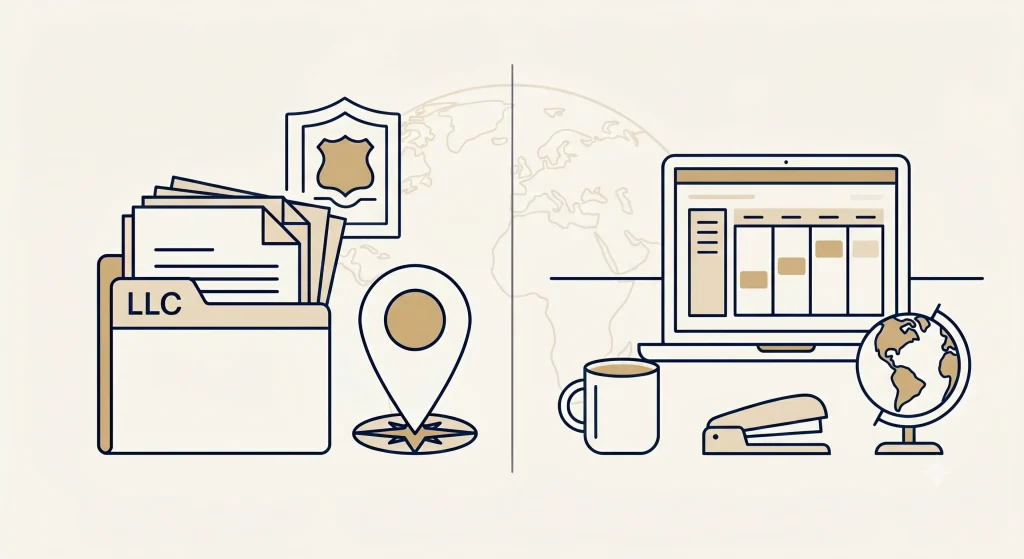
Registered Address vs Trading Address
The difference between registered address and trading address is one of the most important points for non-US founders.
Registered Address
The registered address is connected to the official company setup.
It is used for formal registration, state records or legal correspondence.
For a Wyoming LLC, this usually involves the registered agent address in Wyoming.
This address helps your company meet state requirements.
Trading Address
The trading address is connected to actual business activity.
It answers the question:
“Where does this company really operate from?”
For a European founder, the trading address may be in Spain, Germany, Portugal, the Netherlands, France, Poland or wherever the business is actually run.
That can be completely normal.
The important point is that the address should match the reality of your business.
Why the Trading Address Matters for Banks and Fintechs
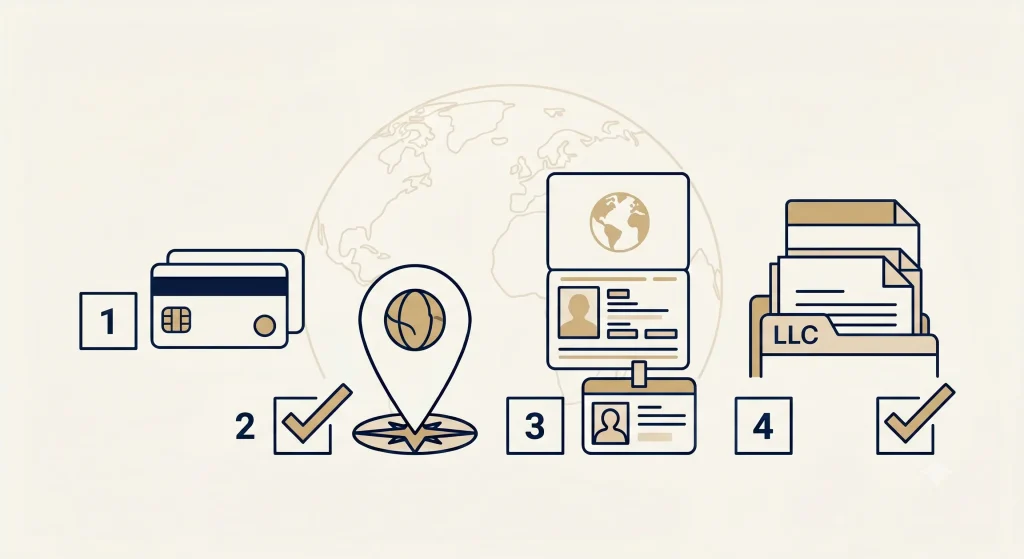
The trading address becomes especially important when you apply for:
- a US business bank account
- a fintech account
- Wise Business
- Mercury
- Stripe
- PayPal Business
- payment processors
- business cards
- merchant services
These providers usually need to understand both the legal structure and the real business activity.
They may ask questions such as:
- Where is the company registered?
- Where does the owner live?
- Where is the business managed?
- Where are the customers located?
- Where does the company actually trade from?
- Where should cards, letters or verification documents be sent?
- Can you provide proof of address if requested?
This does not mean that approval is impossible for non-US founders.
It simply means that your address setup should be consistent, realistic and prepared before you apply.
That is why we call this banking readiness.
You can learn more about this on our Bank Account Support page.
Can You Use Your Registered Agent Address for Everything?
In most cases, you should not assume that your registered agent address can be used for everything.
The registered agent address may be suitable for official state correspondence.
It may appear on formation documents.
It may be part of your company’s official setup.
But that does not automatically mean it is accepted as:
- your trading address
- your principal place of business
- your bank account address
- your Wise trading address
- your Stripe operating address
- your personal address
- your proof of where the business is actually managed
Some providers may allow a registered agent or mail address in certain fields.
Other providers may specifically reject it for trading address or principal business address purposes.
The safest approach is to treat the registered agent address as one part of the setup, not as the full address solution for the entire business.
What Address Should European Founders Use?

For many European founders, the most practical setup looks like this:
For State Formation
Use the required official address structure connected to the LLC formation, including the registered agent address where appropriate.
For EIN Application
Use consistent and accurate address information.
The IRS may need a mailing address and business-related address information. If these change later, address updates may be required.
For Banking and Fintech Applications
Use the address that reflects your real business activity.
This may be your home office, coworking space or business location outside the United States, depending on the provider’s requirements.
For Mail and Cards
Consider whether you need a reliable mailing solution.
Some founders use a mail forwarding address or commercial mailbox for receiving bank cards, letters or service provider correspondence.
But this is separate from the trading address question.
Practical Examples
Example 1: Freelancer in Spain
You are a consultant living in Spain and form a Wyoming LLC.
Your possible address setup could be:
- Wyoming registered agent address for official state purposes
- Spanish home office or coworking space as trading address
- Spanish residential address for owner verification
- US mailbox only if needed for mail or cards
This setup reflects the reality that the LLC is registered in the US, but the founder operates remotely from Spain.
Example 2: E-commerce Founder in Germany
You run an online store from Germany and use a US LLC for international business operations.
Your possible address setup could be:
- Wyoming registered agent address for LLC formation
- German business address as trading address
- warehouse or fulfillment address if relevant
- separate mailing address if required by providers
In this case, the trading address should not pretend that the business operates from the registered agent’s office if it does not.
Example 3: Digital Nomad Without a Fixed Office
You travel frequently and manage your business online.
This can be more complex.
Banks and fintechs may still ask for a stable address connected to your business or personal residence.
In this case, you may need to think carefully about:
- your tax residence
- your personal residential address
- your business operating address
- where you can receive documents
- whether you can provide proof of address if requested
A US LLC can still be useful, but the address setup should be realistic from the beginning.
Address Setup: A Simple Checklist
Before forming your LLC or applying for banking, ask yourself:
- Where will my LLC be formed?
- Who provides the official registered address?
- Where do I actually run the business from?
- What address will I use as trading address?
- Can I provide proof for that address if needed?
- Do I need a separate mailing address?
- Will banks or fintechs accept my address setup?
- Is the information consistent across formation, EIN, banking and payment providers?
This does not need to be complicated, but it should be prepared.
Common Mistakes to Avoid
Mistake 1: Thinking the Registered Agent Address Is Your Full Business Address
The registered agent address is important, but it is not automatically your full operating address.
Mistake 2: Using a Virtual Address Without Checking Provider Rules
Some providers may accept certain virtual or mailing addresses for correspondence
Others may reject them for trading address or principal place of business purposes.
Mistake 3: Giving Different Address Stories to Different Providers
If one provider sees a US address, another sees a European address and another sees a completely different location, this can create confusion.
Consistency matters.
Mistake 4: Ignoring Proof of Address
Some banks, fintechs or payment processors may ask for documents to verify the address.
A professional setup should consider this before the application is submitted.
Mistake 5: Assuming Approval Is Guaranteed
Even with a good setup, banks and fintech providers make their own decisions.
No formation provider can guarantee approval.
What you can do is prepare your documents, address logic and application information in a clear and consistent way.
How US LLC Setup Helps With Address Readiness

US LLC Setup helps European and non-US founders understand the practical address structure before and during the LLC setup process.
We do not just look at the formation document.
We also look at the operational side:
- What address is used for the LLC?
- What address may be needed for EIN application?
- What address may be needed for banking?
- What address may be needed for Wise, Mercury or payment providers?
- Where does the business actually operate from?
- Which information should be prepared before applying?
This is especially useful if you are forming a Wyoming LLC from outside the United States and want to avoid unnecessary confusion later.
You can view our setup packages or book a call if you want practical support with your US LLC formation, EIN application and banking readiness.
Final Thoughts
You do not necessarily need to live in the United States or personally rent a US office to form a US LLC.
But you do need to understand the different address types.
The registered agent address helps with the official state-level setup.
The trading address explains where your business actually operates.
The mailing address helps with correspondence.
The banking address requirements depend on the provider.
For European and non-US founders, the best setup is usually not about pretending to have a US office. It is about creating a clear, consistent and realistic address structure that matches your business.
That is the foundation of a clean US LLC setup.
Bosse LLC provides practical setup support and administrative guidance only. We do not provide legal, tax, accounting or regulated financial advice. Government, bank, fintech and payment provider approvals cannot be guaranteed.


One Comment