Your Business Bank Account Can Be Frozen or Closed — Lessons from Habanos
Even without proven wrongdoing, payment access can change. Prepare suitable options before you need them.
Your invoices are paid, your records are organised and your business is running smoothly. Then a bank asks for more information, restricts a payment or announces that it will close your account. Suddenly, a banking relationship becomes an operational problem.
A business bank account closure does not, by itself, prove wrongdoing. Reviews, commercial decisions, legal restrictions and bank failures are different events. Understanding the difference helps you prepare the right response.
The recent Habanos distribution cases show another source of disruption: ownership connections outside a company’s everyday business. A distributor can have its own management, employees and customers while remaining exposed to legal questions concerning its shareholders.
For other suitable international businesses, the useful question is practical: which dependencies could interrupt our payments, and which additional lawful options can we prepare now?
This article explains the documented cases, a realistic preparation plan and when a genuine US business structure can support additional banking options. Case and provider information was checked on 6 October 2026.
Contents
- The Habanos case: ownership links and operational consequences
- Four banking events that need different responses
- Build a usable second payment route
- When a US LLC supports your business banking plan
- Deposit protection and payment access are different
- What changes across borders
- If your account is already restricted or closing
- Questions worth asking before you rely on a backup
- Prepare additional options while you have time
The Habanos case: ownership links and operational consequences
Start with the allegations and the ownership connection
On 14 October 2025, the US Treasury and UK government announced measures against Chen Zhi and Prince Group. Their statements attribute serious allegations involving online fraud operations and human-rights abuses to the network. Allegations and sanctions designations should not be presented as a final criminal conviction.
On 30 July 2026, the Council of the EU announced sanctions including Chen Zhi and Prince Holding Group. That announcement does not mean every company in the Habanos distribution network was individually named on the list.
Ownership reporting connects Chen through Simply Advanced Limited and intermediate holding companies to Tabacalera SLU, a co-owner of Habanos S.A. A company-supplied ownership chart published in September 2025 depicts a separate connection through ITI Cigars to Altabana. Registry-based trade reporting identifies Altabana as 5th Avenue’s 80% shareholder.
This is not a claim that Habanos itself owns every distributor, or a determination of legal control under every sanctions regime. OFAC’s October 2025 action separately lists Simply Advanced Limited.
The official Habanos directory identifies local management at the distributors; 5th Avenue describes its German warehouse and distribution work. Those are distinct local operations, not proof of independence from group ownership or control.
Different documented outcomes
| Region and company | Documented event | Reported operational effect | Source and date |
|---|---|---|---|
| Germany / 5th Avenue, also serving Austria and Poland | The company confirmed an application to open insolvency proceedings. It described the reasons as outside its operational business. | Its stakeholder letter describes specialist legal advice and efforts to obtain official clarification of its sanctions-related status. | Company notice, 14 September 2026; stakeholder letter, September 2026. |
| Spain / Tabacalera | A trade-media report described frozen accounts and payments requiring prior Spanish Treasury clearance. | It reported a payroll delay followed by authorisation to release wages. Retailers interviewed said deliveries continued that week. | Cigars Connect, 12 September 2026; no authority order independently inspected. |
For 5th Avenue, a Cigars Connect report published on 5 September and updated on 9 September 2026 quoted a company communication saying banking restrictions during a shareholder-related sanctions review prevented new orders and shipments. Its insolvency application is a distinct procedural development, not completed liquidation or proof of permanent closure.
An earlier Cigars Connect report of 18 March 2026 also described unilateral bank-account closures at 5th Avenue, citing industry sources. An account closure is not a company closure; that report does not establish its account availability today.
Distribution companies have wages, deliveries and customer commitments. Payment disruption can affect people whose work has no demonstrated connection to allegations against an upstream individual. That does not establish blanket innocence for every shareholder or company.
5th Avenue documents legal work and official clarification, without establishing particular bills, available cash balances, layoffs or penalties. Delayed payments can create contractual costs depending on the agreement and law; that is a possible consequence, not a reported Habanos fact.
The lesson is about dependencies. Which connections could affect your payments even when your daily operations remain orderly? Extra accounts do not overcome a legal sanctions restriction. The preparation below concerns other suitable, lawful businesses.
Four banking events that need different responses
| Event | What it means | Useful response |
|---|---|---|
| Review or transaction restriction | A provider needs to clarify identity, business activity, fraud concerns or KYC/AML information. Restrictions may be temporary. | Respond through verified channels with consistent records and ask what information is required. |
| Commercial account closure | A provider ends the relationship, for example because its supported industries or risk policy change. | Read the notice, confirm deadlines and organise permitted business payments with another suitable provider. |
| Legal asset freeze or transaction prohibition | Sanctions or a judicial measure limit what may lawfully happen to funds or transactions. | Establish the applicable measure and seek appropriate legal advice or official authorisation where available. |
| Failure of an insured bank | The bank itself fails. Deposit-guarantee rules become relevant. | Confirm the insured institution, eligible depositor, coverage category and applicable payout process. |
Ownership and control rules vary by jurisdiction. The US OFAC rule, for example, addresses aggregate direct or indirect ownership of 50% or more by blocked persons. That rule should not be copied into an explanation of UK or EU law as though the systems were identical. A sanctions-driven restriction is also different from a bank’s voluntary commercial withdrawal.
In its 5 March 2026 supervisory communication, Spain’s Sepblac described findings from 2025 inspections and warned against over-applying AML/CFT measures to exclude legitimate clients or sectors. It establishes neither a general closure rate nor that European banking as a whole is becoming unsafe.
Build a usable second payment route
1. Map the dependencies behind the screen
List your providers, licensed banks, processors and important payment routes. Identify partner and correspondent banks where information is available.
Two apps may rely on the same underlying bank. A multi-currency balance may depend on one login and account relationship. Check what is independent before treating it as a backup.

2. Prepare an appropriate second relationship
Check support for your entity, residence, citizenship, industry, address and actual business activity. Apply with accurate information through the normal approval process.
An independently usable second banking relationship can help with a provider-specific closure. It does not override a restriction applying to your company, its funds or the transaction itself.
3. Test the lawful operational basics
Confirm access, permissions, authentication and payment methods. Small legitimate test payments can show whether the route works before you depend on it.
Keep instructions for updating payment details and paying suppliers. Protect against invoice fraud: verify changes through a trusted contact method.
4. Organise funds around real obligations
Know where money for wages, taxes, subscriptions and suppliers is held, and which account can pay them. Match arrangements to your payment schedule and responsibilities, without relying on a universal percentage or guaranteed buffer duration.
Separate personal funds, company funds and different entities. One company’s account is not automatically an alternative account for another.
5. Keep the evidence ready
Maintain current formation documents, ownership details, contracts, invoices and descriptions of your actual activities. Explain address roles consistently rather than using a registered-agent address as proof of operating premises.
Our US LLC documents guide covers the document categories; the US business banking guide explains provider preparation in more detail.
6. Review customers and suppliers too
A second bank does little if you depend entirely on one customer or supplier. Review those concentrations when ownership, activities or provider conditions change.
When a US LLC supports your business banking plan
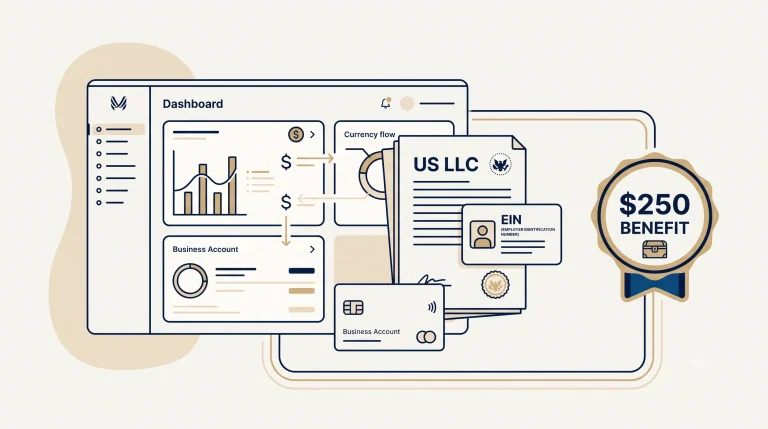
A genuine US business structure can create additional options for suitable international entrepreneurs: applications for supported US business accounts, relevant USD and ACH payment routes, and more flexibility in organising real business transactions.
For someone without a US company, a suitable plan follows this order: check eligibility and business purpose → establish the Wyoming LLC → prepare documents and EIN → apply to appropriate providers → integrate approved accounts into lawful operations.
This is one route within a wider diversification plan. A reader who already has a suitable US LLC can focus on
without forming another company.

A fictional SaaS example
Consider a software founder living in Germany whose business has actual US customers requesting USD billing and ACH payments. The founder evaluates a Wyoming LLC as a genuine contracting and operating structure for that business, checks appropriate providers and documents how the US entity would deliver its services.
After formation and EIN preparation, the LLC can apply for supported accounts. If approved, an account can receive payments owed to that LLC and pay its own legitimate operating expenses. The founder can assess another independently usable relationship for the same entity. Accounts and records of any existing European business remain separate, with genuine transactions between entities properly documented.
The practical benefit is an additional organised business setup with relevant payment options. Account availability still depends on citizenship, residence, ownership, industry, real activity, address requirements and provider decisions. German tax residence and applicable local tax, reporting and legal duties remain relevant. Our SaaS guide and EU-resident guide explain those preparation questions further.
US entities are subject to US sanctions obligations. Cuban goods and sanctions-related transactions have specific restrictions. The Habanos distributors are therefore not presented as customers for this route or as examples of a US account solution.
Choose support that matches the preparation work
US LLC Setup’s Starter LLC Setup (€599) covers formation and EIN support. US LLC Setup for Europeans / Guided (€849) adds an onboarding call, pre-filing review and client-only Banking Readiness Workbook with guidance. Premium Launch (€1,190) adds banking-application preparation, review where possible, and payment and first-invoice orientation. The published package comparison explains the scope.
For a suitable founder who wants personal banking preparation alongside formation, Guided or Premium matches that need more closely. Provider approval remains the provider’s decision.
Ready to establish a US structure for your actual business?
If you first need to assess your preparation, use the
Deposit protection and payment access are different
Deposit protection answers what happens to eligible deposits when an insured bank fails. It does not promise uninterrupted access or prevent an account review, closure or legal freeze.
| Arrangement | Basic coverage or advertised programme | Important conditions |
|---|---|---|
| EU / Germany statutory protection | Generally €100,000 per eligible depositor per bank or credit institution. | Accounts at the same institution are aggregated. Specified temporary high balances and additional schemes may provide further protection. German coverage law. |
| US FDIC standard protection | $250,000 per depositor, per FDIC-insured bank, per ownership category. | Same-category accounts at the same insured bank are aggregated. Coverage requires eligible deposits and an insured institution. FDIC explanation. |
| Lili’s advertised deposit sweep | Up to $3 million, through Sunrise Banks, N.A., and additional insured programme banks. | Programme and FDIC conditions apply. Other same-capacity deposits at those banks affect available coverage. Lili is a fintech; banking services are provided by Sunrise Banks, N.A., Member FDIC. Coverage explanation and sweep agreement. |
Lili is an illustration of conditional extended coverage, not a recommendation for every European founder. Its non-US citizen eligibility page lists 20 supported citizenships; EU countries are absent, as checked on 6 October 2026. Citizenship eligibility is different from residence or permitted transfer destinations, and other application requirements still apply.
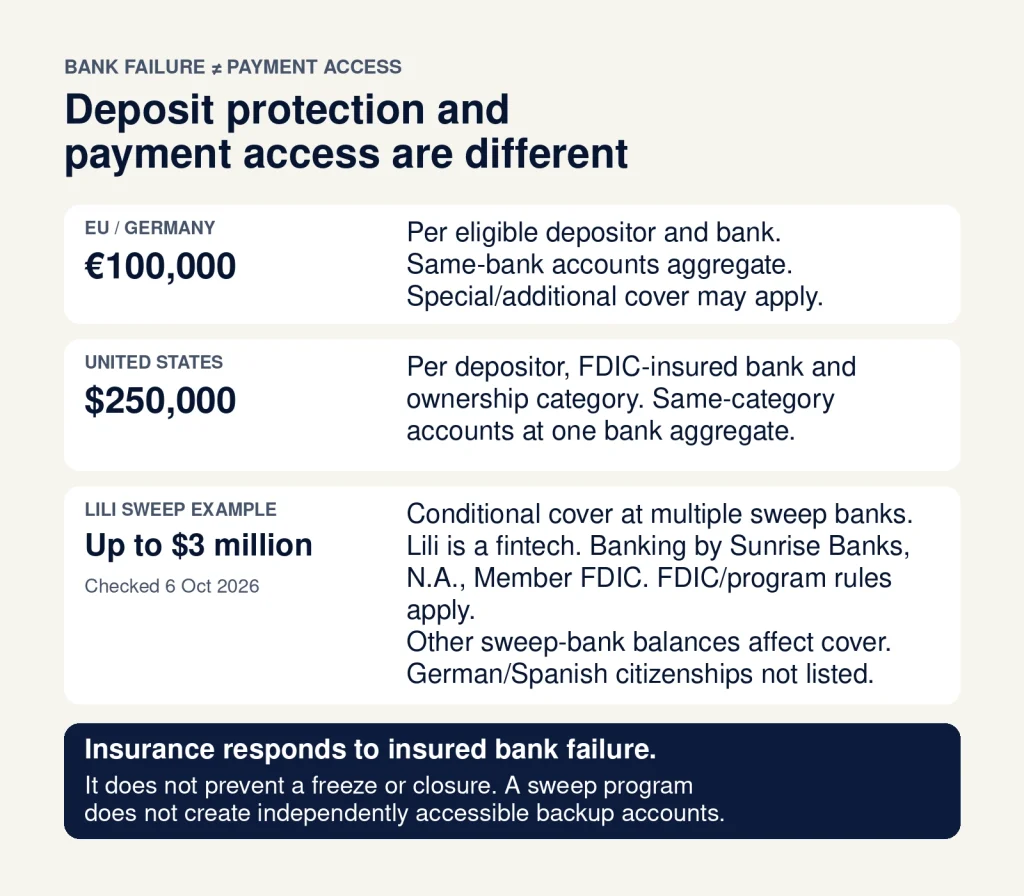
Lili’s sweep agreement also states that customers access swept deposits by instructing the provider rather than directly instructing the programme banks. Multiple underlying banks therefore do not automatically provide independently accessible replacement accounts. A nonbank intermediary can itself be an access dependency.
Assess coverage and usable payment access separately. Both matter; one does not establish the other.
What changes across borders
Geographic diversification changes the banking and legal relationships involved. It does not make funds unreachable.
For a private creditor, enforcement of a foreign judgment in the US can require recognition and local procedural steps, depending on the jurisdiction and judgment. The US State Department’s guidance explains that foreign judgments are not governed by one universal recognition rule.
Tax information exchange and treaty-based collection assistance are separate mechanisms, as is criminal mutual legal assistance. The absence of a particular EU enforcement route does not imply immunity in the US. Tax, reporting, disclosure and cooperation duties continue to apply.
The useful business objective is a more resilient lawful operating network, with transparent ownership and records.
If your account is already restricted or closing
Begin with the actual notice. Save messages, deadlines, statements and relevant contracts. Verify communications before sharing sensitive documents.
Ask the provider which event has occurred, what information it can disclose, whether any payment functions remain available, and the permitted process for remaining balances or outstanding payments. A commercial closure notice and a legal freeze require different actions.
Prepare your supporting records and organise legitimate obligations through permitted arrangements. Where a legal restriction applies, get suitable professional advice and identify the responsible authority or licensing process. Check complaint or review channels appropriate to the provider and jurisdiction.
A newly formed LLC does not automatically unlock already restricted funds. Nor should customers be told to redirect a prohibited transaction. Acute resolution starts with understanding the restriction; diversification is preparation for future lawful operations.
Questions worth asking before you rely on a backup
Check the actual institution and provider relationship, then verify separate access. Different brands can share infrastructure; a sweep arrangement can involve several banks while retaining one access route.
It covers eligible deposits when an insured bank fails, within the applicable rules. Prepare payment access separately: insurance does not prevent a review, closure or legal freeze.
Start with your actual business need and provider eligibility. A Wyoming LLC can be the first implementation step for a suitable US banking plan. Existing suitable LLC owners can prepare their applications; other readers may improve continuity within their current structure.
Prepare additional options while you have time
Provider policies, ownership circumstances and legal requirements can change. You can prepare an additional suitable banking relationship, organise your documents and understand your payment dependencies while your business is running normally.
If a US structure fits your actual business, establish the Wyoming LLC and prepare its banking applications in a clear sequence. Choose the support level that matches the work ahead.
Bosse LLC provides practical setup support and administrative guidance only. We do not provide legal, tax, accounting or regulated financial advice. Government, bank, fintech and payment provider approvals cannot be guaranteed.