US LLC for Spain Residents: Business Uses, Banking and Taxes
Yes, you can generally form a US LLC while living in Spain. For a consultant or freelancer with international business clients, it can provide a clear company structure for contracts, USD payments and business administration. The useful starting point is the job you want the LLC to do, followed by how that exact arrangement will be treated in Spain.
This guide connects the practical benefits with banking preparation and six Spanish tax, social security and reporting checks. You will also find a question list to take to a Spanish tax adviser and a practical route to formation with Guided Setup.
Our example is entirely fictional: Lena is an invented UX consultant in Sevilla, Spain. Her identity, customers, revenue and proposed business arrangements are made up for illustration. This is not a real person or client case.
Last reviewed: November 5, 2026. The example assumes ordinary Spanish tax residence and a nonresident alien owner for US federal income-tax purposes, with no US citizenship or green card. Special regimes, including Spain’s inbound expatriate regime under Article 93 of the personal income-tax law, are outside this example.
Table of contents
- When a US LLC can support a business run from Spain
- Fictional example: a UX consultant in Sevilla
- US LLC banking when you live in Spain
- Six Spanish checks before formation
- US administration and filing obligations
- Six questions for your Spanish tax adviser
- From a confirmed plan to Guided Setup
- Frequently asked questions
When a US LLC can support a business run from Spain
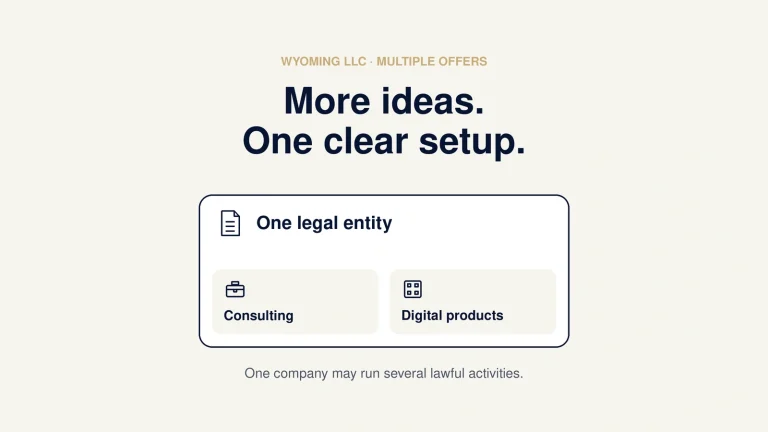
A useful LLC has a defined role in your business. You might want one company to enter international client contracts, receive recurring USD payments or organize several services under a consistent business identity.
| Business use | Practical benefit | What to establish first |
|---|---|---|
| International B2B contracts | Quotes, contracts and invoices identify one contracting company. | Will the customer onboard the LLC, and what supplier documents will they need? |
| Recurring USD revenue | A suitable business account can make collections and currency planning easier. | Which payment methods, features and fees are available for your actual setup? |
| Several services or brands | One company can provide a common administrative framework. | Do your website, business description, contracts and account activity describe the same business? |
| Growing US client relationships | The structure can support ongoing contracts and customers’ payment processes. | What real or planned US business activity can you explain to a provider? |
A Spanish sole trader can also serve international clients and use foreign-currency payment services. Compare the LLC’s additional value with its ongoing costs and administration. A business with recurring international contracts may have a stronger reason to consider an LLC than a business whose work and customers are almost entirely local.
Our US LLC guide for European residents provides the wider country overview. This article focuses on living, working and running the business from Spain.
Fictional example: a UX consultant in Sevilla
Imagine Lena, an independent UX consultant living in Sevilla. She provides tailored advice to businesses and is considering a Wyoming LLC as the contracting company for her international projects.
These are the invented facts for the example:
| Area | Fictional assumption |
|---|---|
| Home and work location | Sevilla; all consulting work is performed in Spain. |
| Customers | Businesses in the United States, Germany and Spain. |
| Service | Personally delivered UX consulting; no goods, royalties or automated digital products. |
| Sample contract | A US business pays $1,500 per month for ongoing consulting. |
| Proposed company | A Wyoming single-member LLC owned only by Lena, with no election for US corporate income-tax treatment. |
| Physical US presence | No US office, employees, inventory or consulting work performed in the United States. |
The example shows how to prepare a decision. It does not assume a particular Spanish tax classification or a successful bank application.
1. Define the LLC’s role in the contracts
Lena would first establish how the proposed company is treated in Spain and which registrations are needed. If the structure fits, new quotes, agreements and invoices could consistently name the LLC as the supplier.
Existing contracts would need their own review and, where necessary, the customer’s agreement to a transfer. Updating payment details alone does not change the contracting party.
2. Plan a payment route that fits the work
For the invented US contract, Lena would prepare an application for a suitable business account to receive the monthly $1,500. She would compare supported payment methods, currency conversion and fees for the actual company and operating location.
Contracts, payments and supporting records would then tell the same story. Later transfers to Lena would have their own documented purpose.
3. Keep three accounting events clear
The $1,500 example helps separate three events:
- Customer revenue: payment for the agreed consulting service.
- Currency conversion and charges: the EUR valuation and associated costs needed for Spanish records, using the approach confirmed with the adviser.
- A transfer to the owner: a separate movement whose tax treatment follows the confirmed structure and the reason for the payment.
An account receipt is also different from taxable profit. Expenses and the applicable accounting rules must be taken into account. Good preparation makes the relationship between the contract, payment and accounting records easy to follow.
What the example tells us about US income source
For ordinary personal services, the US source analysis generally follows where the work is performed. The customer’s location and the account receiving payment do not decide the source by themselves. See the IRS guidance on personal service income.
Applied to our invented facts, having a US customer would not by itself turn consulting performed entirely in Spain into US-source service income. Any US income-tax or return obligations still require their own analysis. Spanish taxation is a separate question as well.
Royalties, goods, automated digital products or workdays in the United States can change the analysis. Our US-source vs foreign-source income guide explores those distinctions.
US LLC banking when you live in Spain
Start with a business description a reviewer can understand: what the company sells, who buys it, where the work happens and what payments you expect. The description should match your website, contracts and company documents.
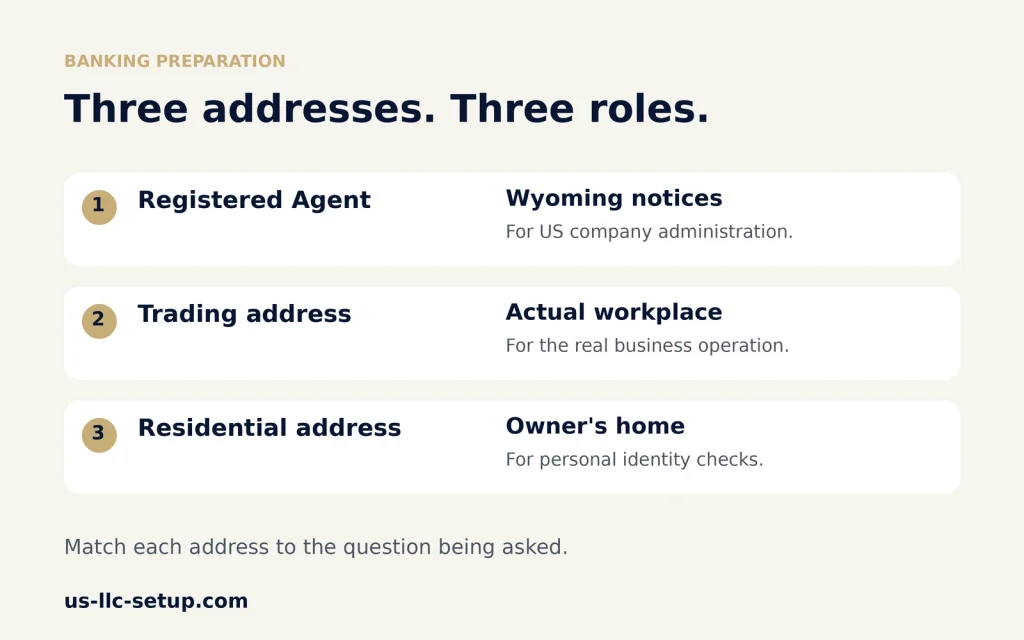
Three address functions to keep separate
| Address | Purpose | Application to the fictional example |
|---|---|---|
| Wyoming Registered Agent address | Receipt of specified legal and official documents for the LLC. | Part of US company administration. |
| Actual operating or trading address | The physical place where the business operates. | Lena’s documented work location in Sevilla, where supported by the provider. |
| Personal residential address | Identity and residence checks for the owner. | The owner’s real home address and suitable supporting evidence. |
Check the exact registered-address fields separately against the formation documents and provider requirements. Using an address in an application does not change its real function. Our US LLC address guide explains the distinctions in more detail.
Mercury: prepare the US business connection and operating address
Mercury accepts applications from international founders of US companies. Its published requirements include existing or planned US operations and a principal business address in the US or abroad. A residential operating address can be accepted; a Registered Agent address, PO box or UPS Store address cannot serve as that principal business address.
If Lena implemented the fictional plan, she would need to explain her real or planned US activity and provide supporting records when requested. Mercury would assess whether those facts satisfy its requirements, along with the business type, ownership, source of funds and other application information. Mercury is a fintech company whose banking services are provided through partner banks.
Wise Business: distinguish registered and trading addresses
Wise distinguishes the registered address from the trading address. The trading address is a physical place where you run the business, such as an office, home or coworking space. Virtual addresses and mail-forwarding services do not meet that role.
US business verification can include the EIN, company details, ownership and identity documents. Where registration and operation are in different countries, check the supported combination and the features available before choosing an account. Use Wise’s US business requirements and general verification guidance, and confirm any unresolved country or feature question with the provider.
Check your banking readiness before you apply
Prepare the formation documents, EIN confirmation, Operating Agreement and ownership information. Add identity and address evidence, an accurate business description, and records supporting activity or source of funds where requested.
Not sure whether you have covered the basics? Our free Banking Readiness Self-Check guides you through 10 high-level questions about company records, addresses, business activity and expected account use. It helps you identify areas that may need further preparation before approaching a bank, fintech or payment provider.
Six Spanish checks before formation
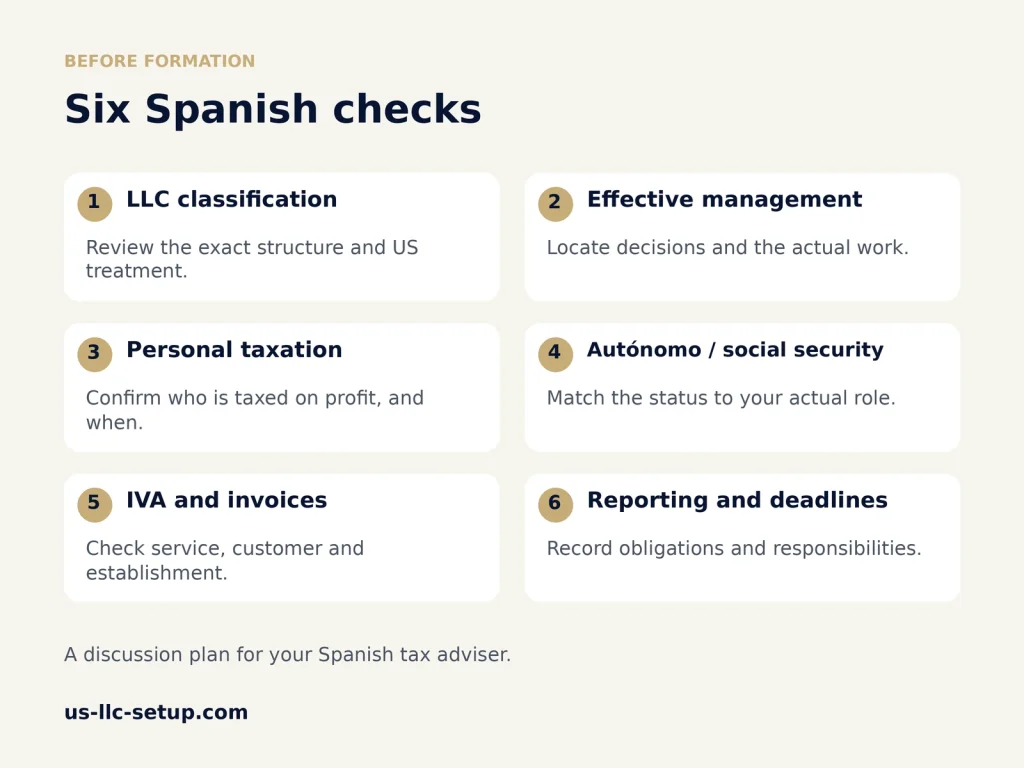
Use the following six areas to prepare a productive conversation with a qualified Spanish tax adviser. Ask for an assessment of your documents and proposed activity, with the practical steps recorded clearly.
1. How will Spain classify this particular LLC?
A domestic single-member LLC is generally disregarded as separate from its owner for US federal income-tax purposes unless it elects corporate treatment. That is the IRS starting point.
Spain applies its own classification framework. The DGT Resolution of February 6, 2020 identifies three characteristics for a foreign entity to qualify for Spanish income attribution:
- The entity is not itself a taxpayer for a personal tax on income in its formation jurisdiction.
- Income is attributed to members as it arises and taxed in their personal income tax, regardless of whether it is distributed.
- Attributed income retains the character of its original activity or source for the members.
Your adviser needs to apply those characteristics to the actual LLC, its documents and its US treatment. In Lena’s fictional case, that includes the significance of a non-US-resident owner. The US label alone does not complete the Spanish assessment.
2. Where are management and the real work located?
In the example, Lena would make pricing, customer and contract decisions from Sevilla. For a real business, describe who makes the decisions, where they make them and where the services are delivered.
Spain’s corporate residence rules include effective management in Spain: the direction and control of the entity’s activities as a whole.
The adviser must connect those facts with the LLC classification. A separately taxable company, an income-attribution arrangement and a nonresident entity with a Spanish permanent establishment are different situations. The applicable registrations and returns follow the situation actually identified.
3. Who is taxed on profit, and when?
Ordinary Spanish tax residents generally fall within Spanish taxation on worldwide income. AEAT explains the residence criteria, including more than 183 days in Spain during the calendar year or the main base of economic activities or interests. Treaty rules may also matter where two countries claim residence. See AEAT’s overview of worldwide-income taxation.
If income attribution is confirmed, profit may be attributed to Lena as it arises. Leaving money in a US business account would not create an automatic deferral. If a different classification applies, company profit, compensation, distributions and other owner payments need the corresponding analysis.
For a separately taxed entity that is actually nonresident in Spain, your adviser may also need to assess the conditions for controlled foreign company rules under Article 91 of the Spanish personal income-tax law. That is a separate test from income attribution.
4. How do personal work and autónomo status fit together?
The fictional Lena regularly performs the consulting herself. Seguridad Social describes the self-employed regime, RETA, by reference to habitual, personal, direct work for profit on one’s own account. Certain controlling owners carrying out management or other work are also covered.
The relevant status follows the actual work and role. A US company does not itself remove Spanish social security obligations. Cross-border insurance coverage or other exceptional circumstances require a separate assessment.
Also establish who needs Spanish tax registration for the activity and what must be recorded on Modelo 036. AEAT provides the registration, amendment and deregistration procedure.
5. Which Spanish VAT rules apply to the services?
Spanish VAT is called IVA. The service, customer status, place-of-supply rules and relevant establishment determine the treatment.
For ordinary consulting supplied from a business established in Spain’s IVA territory, the starting points are:
| Customer | General starting point | What to confirm before invoicing |
|---|---|---|
| A US business | The B2B place of supply is generally with the business customer, often outside Spanish IVA. | Business status, receiving establishment, service and exceptions. |
| A business in another EU member state | Customer-country taxation and reverse charge commonly apply. | Supplier registration, NIF-IVA/ROI, customer evidence, invoice wording and Modelo 349 where required. |
| A business in Spain | Ordinary consulting taxable in the IVA territory can attract Spanish IVA. | The supplier, relevant establishment and applicable rate. |
| A private customer | B2C rules require a separate check. Automated digital services have specific rules. | Customer location, exact service and any OSS or local registration requirements. |
This is a planning summary; your adviser must first establish the LLC’s actual VAT position. Spain’s IVA territory covers the mainland and Balearic Islands. The Canary Islands, Ceuta and Melilla require a different territorial analysis.
Sources: AEAT on cross-border services, ROI and NIF-IVA, and electronic services.
Personally delivered advice does not become an automated electronic service merely because it is provided through email or a video call. Income-tax treatment must also be assessed separately from whether an invoice carries Spanish IVA.
6. Which reporting and wealth questions belong in the calendar?
Spain’s Modelo 720 contains separate information-reporting categories for foreign accounts, certain investments or rights, and real estate.
Whether an LLC interest, account or other right must be reported depends on the classification, legal position, account authority, thresholds and exemptions. Signing authority can matter as well as ownership. AEAT’s threshold examples illustrate why this needs an individual review.
Wealth-tax obligations and any other applicable wealth levies may also need attention. Ask about the rules for your residence and assets, alongside income tax and IVA.
Have you confirmed the Spanish treatment and decided the LLC fits your business? Guided Setup helps you move into Wyoming formation, the EIN application and organized banking preparation.
US administration and filing obligations
Plan US administration alongside the Spanish work. A Wyoming LLC needs ongoing Registered Agent service and its annual state report. The Wyoming Secretary of State provides the official filing procedures.
For a wholly foreign-owned US disregarded entity, Form 5472 with a pro forma Form 1120 requires attention when reportable transactions with related parties occur. These can include owner contributions or distributions. An absence of US income tax on a particular profit therefore does not settle the information-filing question. Refer to the IRS instructions for Form 5472.
Agree who prepares the US filings and who handles the Spanish obligations. A Spanish tax adviser does not automatically prepare US forms, and company formation support does not automatically include ongoing tax returns.
Budget for formation, Registered Agent renewal, state obligations, required US filings, Spanish advice and accounting, and any applicable social security. Our annual LLC filing guide covers the US side in more detail.
Six questions for your Spanish tax adviser

Take it to your meeting: Download the one-page Spanish tax adviser checklist
Bring a description of your work, customer types and countries. Add the proposed LLC documents or drafts, US tax classification, actual work location, decision-making arrangements and expected money flows.
- LLC classification: Does this particular LLC meet the DGT Resolution’s criteria? What documents or further clarification do you need?
- Effective management: What do my decisions and work in Spain mean for residence, permanent establishment and registrations?
- Personal taxation: Who is taxed on profit, and when? How are owner transfers, compensation and distributions recorded?
- Autónomo and registration: Which social security status and tax registrations apply to the work I actually perform?
- IVA and invoices: Who supplies the service, what belongs on the invoice, and which rules apply to my US, EU and Spanish customers?
- Reporting and annual calendar: Which Spanish returns, foreign-asset reports and wealth obligations apply, and who handles the US filings?
Leave with an assessment you can use: classification, outstanding questions, required registrations, invoice requirements, deadlines and named responsibilities. Resolve open points before introducing new contracts and payment arrangements.
From a confirmed plan to Guided Setup
Once the Spanish assessment supports your proposed LLC, the practical formation work can begin. A useful sequence is:
- Record the business model, owners and actual addresses.
- Confirm Spanish treatment and the required local steps.
- Choose the level of formation support you need.
- Form the Wyoming LLC and complete the EIN application process.
- Prepare consistent company documents and the banking application.
- After provider approval, put the payment route and agreed invoicing and accounting process into operation.
Guided Setup costs €849 once and is designed for founders who want personal help with the US setup. The current package includes:
- Wyoming LLC formation, including the state filing fee and Registered Agent service for year one;
- EIN application support without an SSN, plus Operating Agreement and Initial Resolutions templates;
- a 30–45-minute onboarding call and review of your information before filing;
- a Banking Readiness Workbook for structured preparation;
- organized document handover, compliance reminders and 14 days of email support.
Renewal and annual obligations are planned separately. Spanish tax advice, legal advice, accounting and tax returns are outside the formation package. Account opening remains subject to the provider’s decision. EIN issuance follows the IRS’s own processing timeline.
Ready to turn your confirmed Spanish plan into a practical US setup?
If you first need to choose the scope of our support
We can discuss the package and practical next steps; your qualified Spanish adviser assesses your individual Spanish tax position.
Frequently asked questions
Yes, generally. For this guide, the main questions are your actual home and work location, the LLC’s structure and its Spanish treatment. Connections to another country may need additional review.
It can provide a common contracting company and a basis for suitable business accounts and payment processes. The benefit is especially tangible where clients, contracts and USD collections recur. Compare that benefit with the additional administration and annual costs.
Start with the owner’s tax residence and Spain’s classification of the actual company. Ordinary Spanish residents generally have worldwide-income obligations. A US income-tax result does not decide Spanish treatment, and keeping profit in an LLC account does not itself establish a deferral.
Social security follows your actual activity and role. Someone regularly working independently from Spain needs the appropriate RETA assessment. The LLC’s tax classification and the owner’s social security status are separate checks.
Yes, funds needed for the business can remain in its account. The timing of taxation follows the confirmed classification. Under income attribution, profit may be taxed before an owner transfer takes place.
It helps you choose the scope of our formation, EIN and Banking Readiness support. Your Spanish adviser handles the individual Spanish tax assessment using your actual facts and proposed documents.
Bosse LLC provides practical setup support and administrative guidance only. We do not provide legal, tax, accounting or regulated financial advice. Government, bank, fintech and payment provider approvals cannot be guaranteed.