Single-Member LLC Operating Agreement for Non-US Owners: What to Check Before Signing
Before signing your Wyoming LLC’s Operating Agreement, compare the document with the company you actually plan to run. Check its exact legal name, sole member and ownership, management and authority, contribution records, dates and current version. Separate factual corrections from questions about what a clause means or whether it fits your situation. A clear signed record helps you explain ownership and internal decisions later. Use the checklist below to organize that review, and obtain suitable individual legal advice where the terms or structure need it.
This guide covers a straightforward Wyoming LLC with one individual owner living outside the United States. Its purpose is practical document checking before signing, whether you are preparing formation or organizing a recently formed company.
Table of contents
- What your Operating Agreement does
- Articles, Operating Agreement and initial decisions
- Your 12 checks before signing
- A compact review table
- Three fictional examples
- What banks may verify and what the agreement does not decide
- When individual legal review is the next step
- Keep the signed record and choose your formation route
What your Operating Agreement does
Your Operating Agreement describes the company’s internal arrangements. Even with one owner, you want a usable record of who owns the LLC, how it is managed and how decisions are documented.
Wyoming’s LLC law, particularly sections 17-29-102 and 110–112, recognizes agreements for a sole member and oral, recorded or implied forms. A signed written version is the practical recommendation here. Statutory defaults fill gaps, while mandatory legal limits still apply. The agreement does not universally override conflicting effective state-filed records.
For your review, ask a concrete question: Can I connect each important statement in this document to the facts, records and arrangements of my actual company?
Living outside the US does not by itself identify a special universal agreement format under those provisions. The company’s ownership, management and actual arrangements still matter. If your template introduces a provision you cannot explain, put it on a clarification list before signing.
Articles, Operating Agreement and initial decisions
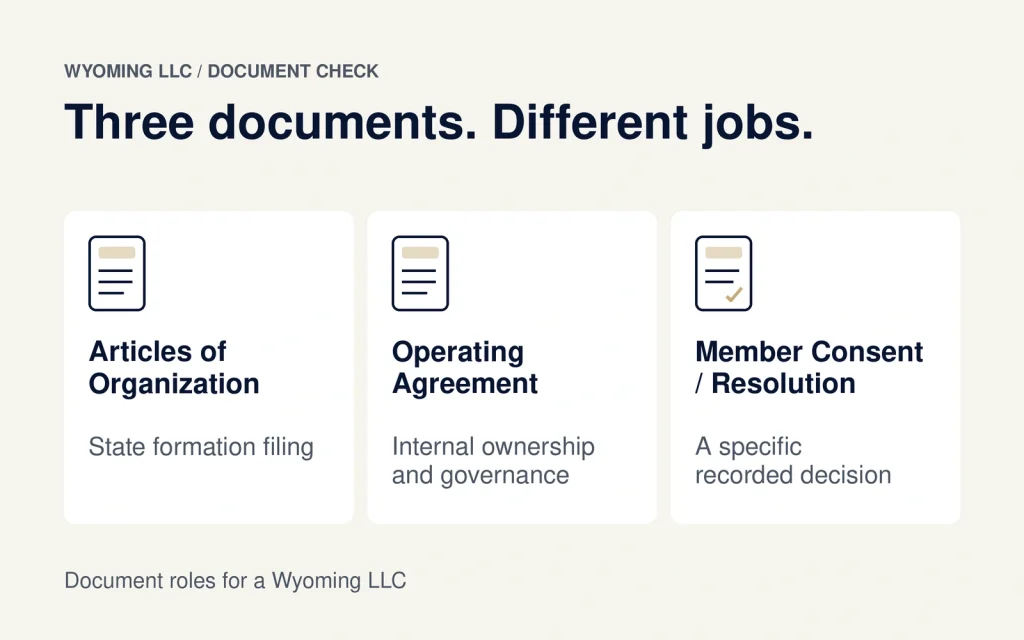
These documents have different jobs. Keep each in its own place rather than expecting one document to answer every question.
| Document | Main job | Prepared or issued by | Usual filing or storage context |
|---|---|---|---|
| Articles of Organization | Establish the LLC through Wyoming’s formation process | Organizer submits; the state records the filing | State formation record; retain your filed copy |
| Operating Agreement | Describe internal ownership and governance arrangements | Member agrees to the company’s terms | Internal records; outside the ordinary formation filing |
| Initial Resolutions or Member Consents | Record particular decisions, such as an appointment or account-related authorization | Relevant decision-maker under the company’s rules | Keep with the agreement and supporting decisions |
Wyoming’s official Articles form and instructions show the ordinary formation packet. An organizer or Registered Agent listed there is not automatically your LLC’s owner or manager.
For the wider document sequence, use our guide to US LLC documents for non-residents.
Your 12 checks before signing
This is a practical review checklist, not a statutory list of mandatory fields. Templates vary. Review the provisions and fields your document actually contains.
1. Match the exact company identity
Compare the legal name, state and entity type with the filed Articles and state record. For a planned company, use your approved formation information and check again after filing.
Look through the whole document, including schedules and signature pages. A brand name in one paragraph and the legal LLC name elsewhere can create ambiguity. Record every mismatch for correction before signing.
2. Identify the actual sole member
Compare the member’s name with your identity evidence and ownership records. Check spelling, name order and any schedule identifying the member.
If a filing service or organizer appears in the Member field, investigate rather than assuming the entry is correct. Ask who the document identifies as owner and why. Resolve unclear ownership facts before proceeding.
3. Confirm the simple ownership picture
For this article’s starting case, one individual owns 100% of the LLC. Compare that fact with every ownership table, exhibit and reference to members.
Look for leftover co-founder names, additional membership interests or percentages that do not match the arrangement. If another person has ownership or negotiated rights, obtain appropriate review for the actual structure instead of treating it as this simple case.
4. Understand member management and manager management
Compare the management provisions with your Articles, planned roles and any appointments. Wyoming’s default is member management unless the Articles or Operating Agreement provide for manager management or similar arrangements (§17-29-407).
Write down who is supposed to run the company. If the documents give different answers, clarify the conflict and the appropriate correction process before signing or using them.
5. Locate authority for particular actions
Find the provisions dealing with contracts, accounts and important decisions. Compare them with actual appointments and any relevant resolutions or consents. Membership alone does not automatically create agency authority under Wyoming law (§17-29-301).
For an upcoming transaction, identify the person, action and supporting authority. If the connection is unclear, ask what clarification or decision is needed; do not treat a signature block as the whole answer.
6. Separate promised contributions from completed contributions
Compare contribution wording and schedules with transfer confirmations, receipts and your owner-transaction records. Identify what has already happened and what is only a commitment.
A template’s example amount is not evidence of a payment. Flag unsupported entries and distinguish commitments from completed contributions in your clarification list. Unusual funding arrangements or uncertainty about contractual obligations deserve suitable advice.
7. Read the rules for distributions and owner transfers
Find the provisions on distributions, reimbursements or other owner-related payments. Compare them with your intended payment practice and any relevant decisions.
Ask how each transfer will be authorized and recorded. Avoid assuming every payment to you has the same legal or tax character. Distribution decisions also remain subject to applicable statutory limits; take unresolved classification questions to the appropriate adviser.
8. Find the amendment and new-member process
Locate how the agreement can be changed and how another owner may be admitted. Compare that process with existing amendments and your future plans.
Make a note of required approvals, conditions and records. If an investor or co-founder is already expected, raise that now. A plan to add an owner is a reason to reassess the structure before adopting a simple solo template.
9. Recognize succession, incapacity and transfer questions
Read any provisions about death, incapacity or transferring an interest. Compare them with your wishes, existing planning and the people expected to act.
Identify questions rather than designing a solution yourself. Cross-border succession or someone acting on your behalf can need coordinated individual advice. Prepare a short list of the outcomes you want and ask whether the document supports them.
10. Keep dates and the signing role accurate
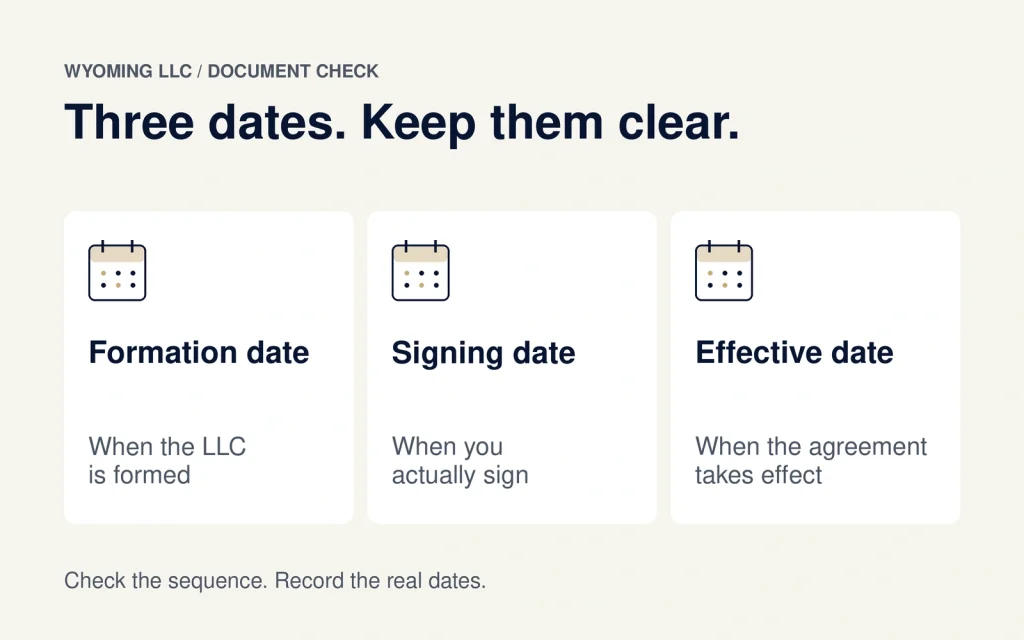
Compare formation, effective and signing dates with the state record and actual events. Wyoming permits preformation terms to become the agreement on formation (§17-29-111); those dates therefore need not coincide.
Use the actual signing date and confirm the capacity in which you sign. Never backdate a signature to make the paperwork look aligned. Clarify an unexplained effective date before signing.
11. Check blanks, example data and address roles
Search for placeholders, old names, unexplained references and incomplete schedules. Compare addresses with your address record by function: Registered Agent, mailing, business operations or residence.
Different address roles may legitimately use different addresses. Our LLC address guide explains that distinction. Do not invent an EIN that has not been issued. An EIN is not a universal mandatory Operating Agreement field. Log unanswered fields and establish how they should be handled.
12. Identify the current version and related decisions
Compare the file you will sign with any earlier signed agreement, amendments and member decisions. Check that schedules belong to the same version.
Choose a clear filename and record what is current. Keep previous versions as history, clearly marked, rather than silently overwriting them. If a change requires an approval or consent, retain that supporting record too.
A compact review table
Use this table to track the most important factual comparisons while keeping clause questions on a separate list.
| Area | Concrete check | Compare with | Next action |
|---|---|---|---|
| Company | Exact legal name, Wyoming, LLC | Articles or planned filing details | Resolve every mismatch |
| Ownership | Actual individual, 100% in this case | ID and ownership records | Remove uncertainty before signing |
| Management | Who runs the LLC? | Articles and appointments | Clarify conflicting roles |
| Authority | Who may perform the intended action? | Agreement and relevant decisions | Identify required authorization |
| Contributions | Paid amount versus commitment | Transfer and transaction records | Flag unsupported entries |
| Dates | Formation, effective date, actual signature | State record and real events | Explain differences accurately |
| Version | Current text, schedules and amendments | Company records | Preserve a clear current set |
Preparing your new Wyoming LLC? Start with formation and an organized document handover. Every US LLC Setup formation package includes Operating Agreement and Initial Resolutions templates; choose the level of personal administrative guidance that suits you.
Three fictional examples
These examples are illustrative and do not describe clients or provide contract wording.
A. A solo consultant connects ownership and decisions
Elena has formed a Wyoming consulting LLC. Her formation record identifies the company’s legal name; the agreement identifies Elena as the sole member with 100% ownership and describes member management.
Before an account application, she checks the relevant authority provisions and any required company decision. She keeps the resulting consent with the agreement. Her useful outcome is a connected record: company identity, ownership, management and the particular decision can each be explained.
B. A reused template contains facts from another company
Jonas finds an old company name in a schedule, a sample co-founder on the signature page and a contribution described as paid even though he has not transferred it. His EIN is still pending.
He compares each entry with his actual records and prepares a correction list. He flags unclear contribution language for clarification and leaves no invented tax number. He also distinguishes the intended effective date from the date he will actually sign. Completing the fields accurately comes before adopting the document.
C. A solo founder plans to admit an investor
Maya starts with one owner. Later, an investor proposes ownership and negotiated decision rights.
She gathers the current agreement and investment proposal for suitable legal and tax review. Ownership, governance, applicable state and IRS updates, provider information and residence-country treatment need reassessment. She does not assume changing “100%” to two percentages will complete that work. The original agreement remains part of the company’s history.
What banks may verify and what the agreement does not decide
An institution may ask for the agreement as evidence of ownership or internal authority. Follow its actual request. Mercury’s normal application guide addresses formation, EIN and identity evidence; it does not present an Operating Agreement as a universal LLC onboarding requirement. Its separate ownership-dispute guidance includes the agreement among possible evidence in that specific context.
Keep those contexts separate. For broader preparation, see our non-resident business banking guide. Clear records help you respond to questions; each institution still makes its own decision.
Tax classification is another separate question. The IRS explains that a domestic one-owner LLC is generally disregarded for federal income tax unless it elects corporate treatment. Agreement wording does not replace a required IRS election. S-corporation eligibility excludes nonresident alien shareholders.
Your residence country has its own classification questions. Use our EU-resident LLC guide and income-source guide to prepare for appropriate tax advice.
When individual legal review is the next step
A factual check can reveal where tailored advice adds value. Seek it when the document involves additional owners, negotiated investor rights, unusual management, regulated activities, succession planning or a complex international structure. The same applies when you cannot explain a consequential clause or resolve conflicting records.
Bring your Articles, current agreement, amendments, relevant decisions and a concise question list. Explain what you plan to do next. That gives the adviser a concrete situation to assess.
An included template and administrative formation support serve useful purposes. Individual clause advice and tailored contract drafting require the appropriate professional.
Keep the signed record and choose your formation route
Keep the complete signed agreement, its schedules, relevant decisions and later amendments together, with a secure backup. Record the current version so you can retrieve it without guessing. Our 12-step post-formation checklist places that task within the wider setup sequence.
If you already have a suitable LLC, use this review to organize its records and resolve any open questions.
If you are forming a new LLC, our Wyoming formation service and support for founders in Europe explain the practical process. Starter costs €599; Guided Setup costs €849; Premium Launch costs €1,190. All include the stated document templates.
Guided Setup is the preferred route when you want personal administrative orientation: onboarding, review of your information before filing, structured next steps and Banking Readiness. Premium suits additional banking-application and payments-preparation needs. These services do not include individual legal review of agreement clauses.
Choose the formation package that fits your launch and the support you want around it.
Prefer a deliberate DIY route? The
provides general guidance, an Operating Agreement template and resolutions. Each language edition is purchased separately. If you switch to one of our three formation packages before your Wyoming formation filing is submitted, the eBook price paid is credited toward that package and the book remains yours. This is not a cash refund or a credit for an already-submitted filing.
Bosse LLC provides practical setup support and administrative guidance only. We do not provide legal, tax, accounting or regulated financial advice. Government, bank, fintech and payment provider approvals cannot be guaranteed.