What Is an LLC Setup? A Practical Guide for Non-US Founders
People often say that “your LLC setup” is important.
But what does that actually mean?
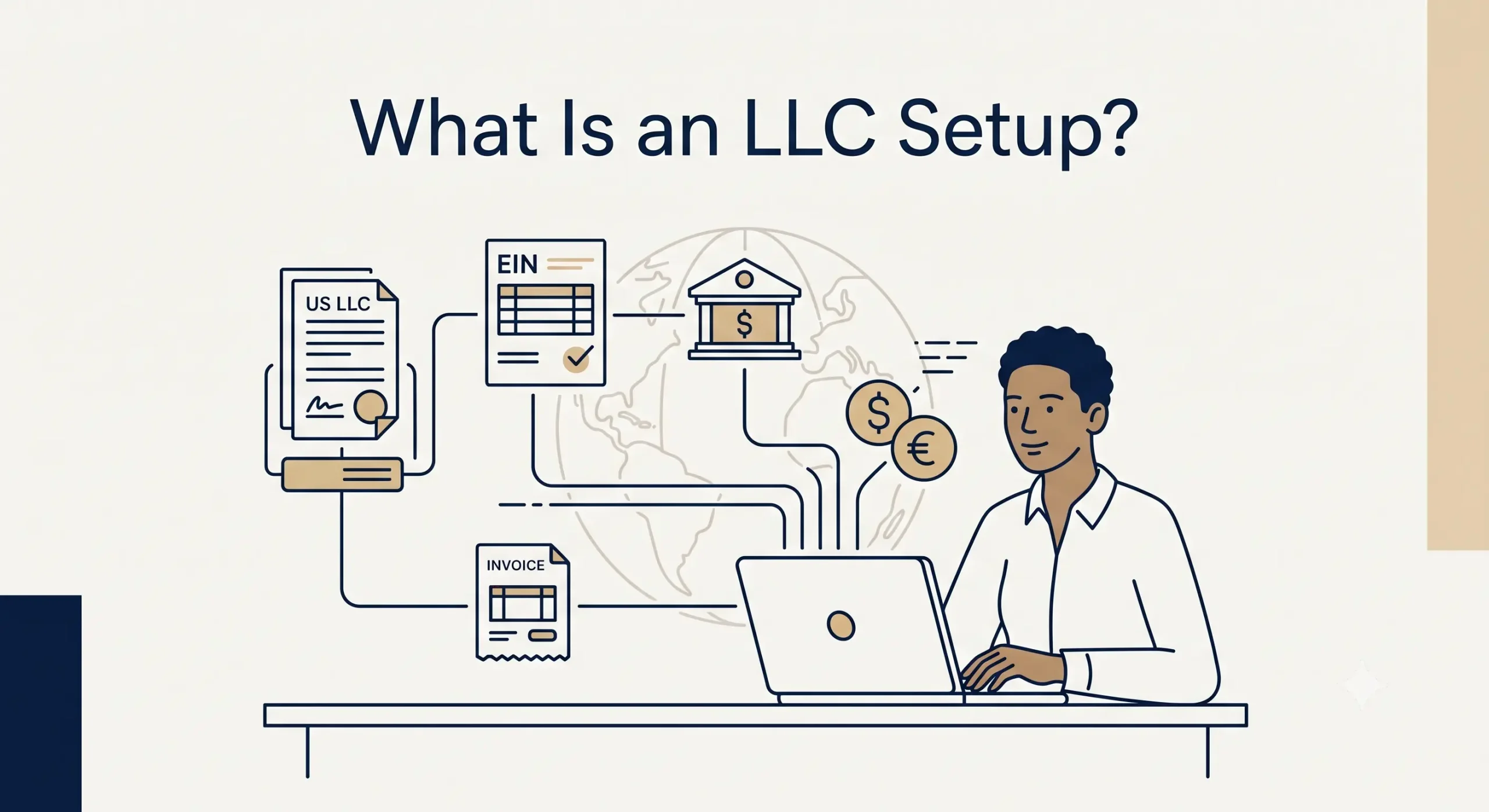
For many non-US founders, the first thought is simple: form a US LLC, receive the documents, apply for an EIN and open a bank account.
That is part of the process.
But it is not the full setup.
A real LLC setup is the practical structure around the company. It is about how the LLC fits into your personal situation, your country of residence, your tax residency, your clients, your payment flows, your business model and your long-term goals.
In other words: forming the LLC is the starting point. The setup is how you actually use it.
Inhaltsverzeichnis
- What does “LLC setup” actually mean?
- LLC formation is only one part of the setup
- Your country of residence matters
- Tax residency, Lebensmittelpunkt and perpetual travelers
- Banking: how money enters your LLC
- Invoicing clients through your LLC
- Currency, markets and payment methods
- Why client payment behavior matters
- Business models that may fit an LLC setup
- Service companies, digital work and consulting
- Licensing, marketing services and intercompany structures
- Why there is no one-size-fits-all LLC setup
- Practical questions before starting your LLC setup
- How US LLC Setup can support you
- Abschließende Gedanken
What Does “LLC Setup” Actually Mean?

In the US LLC context, “setup” usually means the full operational structure behind your company.
That can include:
- where the LLC is formed
- who owns and manages it
- which address is used for official purposes
- whether the LLC has an EIN
- how the LLC receives money
- how the LLC invoices clients
- which bank or fintech accounts are used
- which currencies are relevant
- which markets the business serves
- how the LLC fits into your personal residence and tax situation
- whether the structure makes sense for your business model
This is why two people can both have a Wyoming LLC, but completely different setups.
A freelance software developer living in Germany has different needs than a digital nomad travelling between Thailand, Portugal and Dubai.
An e-commerce seller with US customers has different requirements than a consultant invoicing European clients.
A founder who needs card payments has different payment needs than someone who only receives bank transfers from B2B clients.
The LLC may look similar on paper. The practical setup may be very different.
LLC Formation Is Only One Part of the Setup
The first step is usually the legal formation of the company.
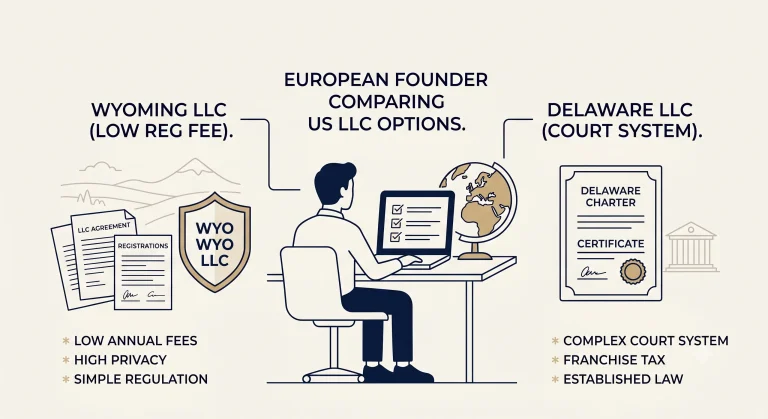
For many non-US residents, a Wyoming LLC is a popular option because it can be relatively simple to maintain compared with many European company structures. It can also be useful for international founders, consultants, freelancers and online businesses.
But the formation alone does not answer the practical questions.
After formation, you still need to think about:
- EIN application
- Bankbereitschaft
- payment providers
- client invoicing
- bookkeeping workflow
- contracts and terms
- local tax reporting
- how profits are treated in your country of residence
- how the LLC fits into your personal life
This is why the word “setup” matters.
A company that exists on paper is not the same as a company that is ready to operate.
Your Country of Residence Matters

One of the most important parts of an LLC setup is your country of residence.
Many non-US founders focus heavily on the US side of the structure. That is understandable, because the LLC is a US company. But your personal country of residence can be just as important.
For example, your local situation may influence:
- whether and how the LLC income is reported
- whether the LLC is treated transparently or differently
- whether you need local tax registration
- whether you need to charge VAT or sales tax equivalents
- whether your local authorities consider the business managed from your country
- whether you need local accounting support
A US LLC does not automatically remove your obligations in the place where you live, work or have your center of life.
That is especially important for European founders.
If you live in Germany, Spain, France, the Netherlands or another European country, the LLC setup should be reviewed in relation to your local rules and personal circumstances.
A US LLC can be a useful tool. But it should not be treated as a magic shield against local compliance.
For a broader overview, see our guide to LLC setup for European founders:
Tax Residency, Center of Life and Perpetual Travelers
Your tax residency is one of the key questions behind any international LLC setup.
Tax residency usually depends on where you live, where you spend time, where you have personal and economic ties, and where your center of life is located.
In German, people often use the term Lebensmittelpunkt aka Center of Life. This describes the practical center of your life. It can include where you live, where your partner or family is, where you work from, where you have your home, where your main interests are and where you are socially or economically connected.
For some founders, this is simple.
They live in one country, work from that country and are tax resident there.
For others, it is more complex.
Some founders are perpetual travelers. They move between countries, avoid spending too much time in one place and try not to become clearly tax resident in a traditional way.
But even then, the LLC setup should not be built on assumptions.
A perpetual traveler lifestyle can make the analysis more complex, not less. Banks, fintechs, tax authorities and payment providers may still ask for a real residential address, proof of residence, source of funds, business activity and personal identification documents.
A good LLC setup should therefore consider:
- where you are personally tax resident
- where you physically work from
- where your clients are located
- where the business is effectively managed
- where you receive payments
- where your bank or fintech provider sees your residence
- whether your lifestyle is stable enough for compliance checks
The LLC is only one piece of the structure. Your personal situation remains central.
Banking: How Money Enters Your LLC

Banking is one of the most practical parts of an LLC setup.
Without a usable banking or fintech solution, your LLC may be formed but not ready to operate.
A banking setup may include:
- ein US-Geschäftskonto
- ein Fintech-Konto
- USD account details
- international wire details
- ACH receiving options
- debit card access
- payment provider connection
- transfer options to your personal or local account
- currency conversion workflow
For many non-US founders, banking readiness is just as important as the LLC formation itself.
That does not mean bank approval can be guaranteed. Banks and fintech providers have their own onboarding rules, risk checks and compliance processes.
But you can prepare properly.
That preparation may include:
- clean company documents
- EIN confirmation
- clear business description
- website or landing page
- professional email address
- expected transaction volume
- explanation of clients and markets
- source of funds information
- proof of identity and residence
A well-prepared LLC setup makes the banking process more structured and professional.
For more information, see:
Invoicing Clients Through Your LLC
Another important question is how you invoice your clients.
This sounds simple, but it can shape the whole setup.
You should think about:
- who your clients are
- where they are based
- whether they are private customers or businesses
- whether they expect invoices from a US company
- whether they can pay in USD
- whether they prefer EUR, GBP or another currency
- whether they require VAT numbers or local tax details
- whether they need contracts with a US entity
- whether they can pay by card, bank transfer or payment platform
For example, if you work with US clients, invoicing from a US LLC in USD may feel natural.
If you work with European clients, some may be comfortable paying a US LLC. Others may need additional documentation or may have internal requirements for cross-border payments.
If your clients are large companies, their procurement departments may ask more questions than a small business client.
The LLC setup should match how your clients actually pay.
Currency, Markets and Payment Methods
Currency is another practical part of the setup.
Some founders want a US LLC because they work in global markets and want to invoice in USD. Others serve mostly European clients and prefer EUR.
There is no universal answer.
You may need to consider:
- USD invoices for US or global clients
- EUR invoices for European clients
- GBP invoices for UK clients
- exchange rate costs
- transfer fees
- payment provider fees
- currency conversion timing
- whether to keep funds in USD or convert them
- whether suppliers are paid in the same currency
For example, a software consultant with US clients may prefer to invoice in USD and keep part of the balance in USD.
A European freelancer with mostly EU clients may need to think carefully about whether USD invoicing makes the client experience easier or harder.
A founder selling digital products globally may need card payments, payment links or platform integrations.
This is why “setup” is not only about company documents. It is also about money flow.
Why Client Payment Behavior Matters
Many founders think about how they want to receive money.
But it is just as important to think about how clients want to pay.
A client may ask:
- Can I pay by bank transfer?
- Can I pay by card?
- Can I pay in EUR?
- Can I pay in USD?
- Do you have ACH details?
- Do you accept international wire transfers?
- Can you send a proper invoice?
- Can you work with our procurement system?
- Can we pay through Stripe, Wise, PayPal or another provider?
- Do you have a business website?
- Is the company name consistent across documents?
If your LLC setup does not support the payment behavior of your clients, it may create friction.
That friction can delay payments, create unnecessary questions or make the business look less professional.
A strong LLC setup should make it easy for the right clients to pay you.
Business Models That May Fit an LLC Setup
A US LLC can be relevant for many types of international businesses.
Common examples include:
- software development
- IT consulting
- web design
- marketing consulting
- business consulting
- coaching
- online education
- digital products
- SaaS projects
- affiliate businesses
- creator businesses
- e-commerce
- remote agency work
- international B2B services
The right setup depends on how the business earns money.
A freelance developer selling services has different needs than a founder building a SaaS product.
A digital agency billing monthly retainers has different needs than an e-commerce seller handling hundreds of small transactions.
A consultant with a few high-value B2B invoices per month has different needs than a creator receiving platform payouts.
Before forming an LLC, it is useful to define the actual business model.
Service Companies, Digital Work and Consulting
Digital service businesses are often a natural fit for an LLC setup discussion.
Examples include:
- software development
- UX/UI design
- IT project work
- online marketing
- SEO consulting
- paid ads management
- copywriting
- brand consulting
- remote operations
- business development
- technical support
- fractional executive work
These business models often work across borders.
The founder may be based in Europe, the clients may be in the US, the UK or globally, and the payments may arrive in USD or EUR.
For this type of business, the setup should answer practical questions such as:
- Who signs the client contract?
- Which company issues the invoice?
- Which currency is used?
- Where does the money arrive?
- How are business expenses paid?
- How is income transferred to the owner?
- Which local reporting obligations may apply?
- Does the client accept invoices from a US LLC?
This is where a clean setup can make daily operations much easier.
Licensing, Marketing Services and Intercompany Structures
Some founders also consider more advanced structures.
For example, they may ask whether a US LLC could invoice another business for:
- marketing services
- consulting services
- management support
- software development
- brand usage
- intellectual property licensing
- platform access
- content production
- sales support
These ideas are sometimes discussed as “loopholes”.
But that is not the right way to look at it.
A serious setup should not be based on empty invoices or artificial arrangements. If an LLC invoices for services, licensing or marketing support, there should be a real business reason, real work, clear contracts, proper documentation and pricing that makes commercial sense.
For example, a US LLC might provide digital marketing services to another company if it actually performs those services.
A company might license software, content, brand assets or intellectual property if the rights, ownership and commercial logic are properly structured.
A consulting entity might charge for business development if there is a real service relationship.
But these setups require careful review.
They may involve local tax rules, transfer pricing considerations, substance questions, VAT or sales tax topics, accounting treatment and documentation requirements.
For that reason, these structures should be reviewed with qualified legal, tax and accounting professionals before implementation.
The key point is simple:
An LLC setup should reflect real business activity, not just paper movement.
Why There Is No One-Size-Fits-All LLC Setup
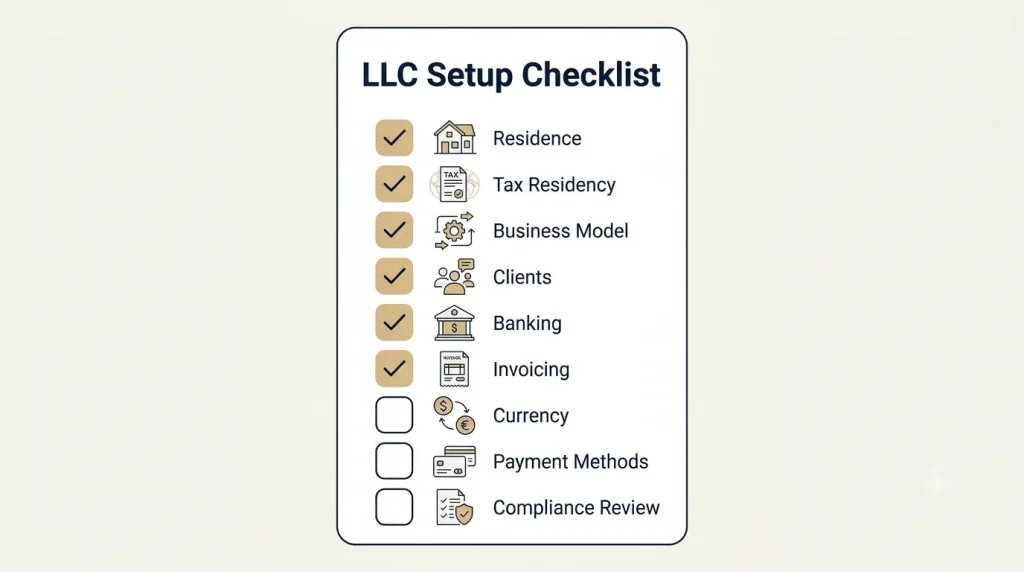
There is no perfect LLC setup for everyone.
The right structure depends on your personal and business situation.
Important factors include:
- your country of residence
- your tax residency
- your center of life
- your citizenship
- your travel pattern
- your client locations
- your business model
- your expected revenue
- your payment methods
- your required currencies
- your risk tolerance
- your local compliance obligations
- your banking needs
- your long-term goals
This is why copying someone else’s LLC setup can be risky.
A setup that works for a digital nomad with US clients may not work for a founder living full-time in Germany.
A setup that works for an e-commerce seller may not work for a consultant.
A setup that works for a single-member LLC may not work for a partnership.
A setup that works for a low-volume freelance business may not work for a fast-growing agency.
Your setup should be built around your needs.
Practical Questions Before Starting Your LLC Setup
Before forming a US LLC, it can help to answer a few practical questions.
Personal Situation
Where do you live?
Where are you tax resident?
Where is your center of life?
Do you travel frequently?
Are you a perpetual traveler or clearly based in one country?
Business Model
What services or products do you sell?
Who are your clients?
Are they businesses or consumers?
Are they mainly in the US, Europe or globally?
Do you need contracts, subscriptions, payment links or platform payouts?
Banking and Payments
Do you need USD account details?
Do you need to receive ACH payments?
Do you need card payments?
Do clients prefer EUR or USD?
Will you use Wise, Mercury, Stripe, PayPal or another provider?
How often will you transfer money out of the LLC?
Operations
Will the LLC have a website?
Will you use a professional email address?
Will you need bookkeeping?
Will you have recurring monthly invoices?
Will you pay contractors or suppliers?
Will you need local tax advice in your country of residence?
These questions help define what “LLC setup” actually means for you.
How US LLC Setup Can Support You
US LLC Setup helps European and non-US founders with practical formation support and administrative guidance.
Depending on your situation, this can include:
- Wyoming LLC formation support
- EIN application guidance
- preparation for banking readiness
- document checklist support
- practical explanation of the setup process
- guidance on what banks and fintechs may ask for
- support with a clear administrative workflow
The goal is not to sell a one-size-fits-all promise.
The goal is to help you understand the steps, prepare the documents and build a setup that fits your actual business needs.
You can view the available packages here:
For banking-related preparation, see:
For EIN support, see:
Abschließende Gedanken
An LLC setup is more than registering a company.
It is the practical structure that connects your US LLC with your personal situation, tax residency, clients, banking, invoicing, payment methods, currencies and business model.
For some founders, the setup may be simple.
For others, especially perpetual travelers, European residents or founders with multiple companies, it may require more planning.
The most important question is not only:
“Can I form a US LLC?”
Die bessere Frage ist:
“How should this LLC be set up so it actually works for my life, my clients and my business?”
That is where a proper LLC setup begins.
Bosse LLC bietet ausschließlich praktische Einrichtungsunterstützung und administrative Anleitung. Wir bieten keine Rechts-, Steuer-, Buchhaltungs- oder regulierte Finanzberatung. Staatliche, Bank-, Fintech- und Zahlungsanbieter-Genehmigungen können nicht garantiert werden.