Können Nicht-US-Residenten eine US-LLC besitzen? Ein grundlegender Leitfaden für internationale Gründer
Yes, non-US residents can own a US LLC.
You do not generally need to be a US citizen or live in the United States to form or own a US limited liability company. This is one of the reasons why US LLCs are often considered by international founders, digital nomads, remote workers, consultants, online businesses and startup founders.
However, “possible” does not automatically mean “suitable for everyone.”
Before forming a US LLC, it is important to understand the difference between nationality, residence, tax residence, business activity, banking requirements and ongoing compliance. This basic guide explains the key ideas in a practical, non-technical way.
Table of contents
- Can a non-US resident own a US LLC?
- Nationality vs. tax residence: what is the difference?
- Who is a US LLC suitable for?
- Why many non-US founders consider a US LLC
- What a US LLC does not automatically solve
- Why Wyoming is often considered by non-US founders
- What you usually need to set up a US LLC
- Practical next steps
- Abschließende Gedanken
1. Can a non-US resident own a US LLC?
Yes. A US LLC can generally be owned by a person who is not a US citizen, does not hold a US passport and does not live in the United States.
This makes the US LLC an interesting structure for many international entrepreneurs.
For example, a founder based in Germany, Spain, the Netherlands, France, Portugal, Italy or another country may consider a US LLC for an online business, consulting activity, software product, agency model, content business or international service business.
At US LLC Setup, we focus especially on practical support for European and non-US founders who want to understand the setup process clearly before starting.
You can learn more about this on our page about a US LLC for Europeans and non-US founders:
/llc-for-europeans/
2. Nationality vs. tax residence: what is the difference?

A common misunderstanding is that nationality and tax residence are the same thing.
They are not.
Your nationality usually refers to your citizenship or passport. For example, you may be German, Spanish, Dutch, French, Italian, British, Turkish, Brazilian or from another country.
Your tax residence is a different question. It usually depends on where you live, where you spend time, where your personal and economic life is centered, and how the tax rules of the relevant country apply to you.
This distinction matters because owning a US LLC does not automatically change your personal tax residence.
For example:
- A German citizen living in Spain may have German nationality but Spanish tax residence.
- A Dutch citizen traveling as a digital nomad may need to analyze where they are tax resident.
- A non-US founder may own a US LLC while still being tax resident in their home country or another country.
- A person can own a US LLC without automatically becoming a US tax resident.
This is why international founders should not only ask: “Can I own a US LLC?”
A better question is:
“Does a US LLC make sense for my business model, my country of residence, my customers, my banking needs and my compliance situation?”
3. Who is a US LLC suitable for?
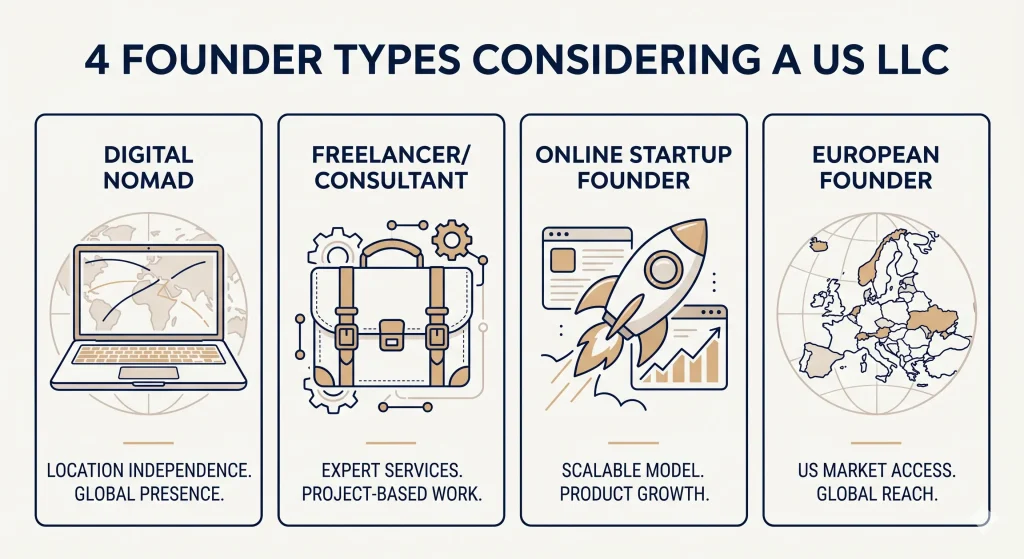
A US LLC can be suitable for different types of international founders, especially when the business is location-independent, digital or internationally focused.
It can be particularly relevant for the following groups.
Digital nomads and remote workers
Digital nomads often work across borders. They may live in one country, serve clients in another country and receive payments from international platforms or customers.
A US LLC may be attractive because it can provide a clear business structure, a US company name, and a practical framework for invoicing and international business operations.
However, nomads should be especially careful with tax residence. Moving around does not automatically mean having no tax obligations. The personal tax position should always be reviewed separately with a qualified advisor.
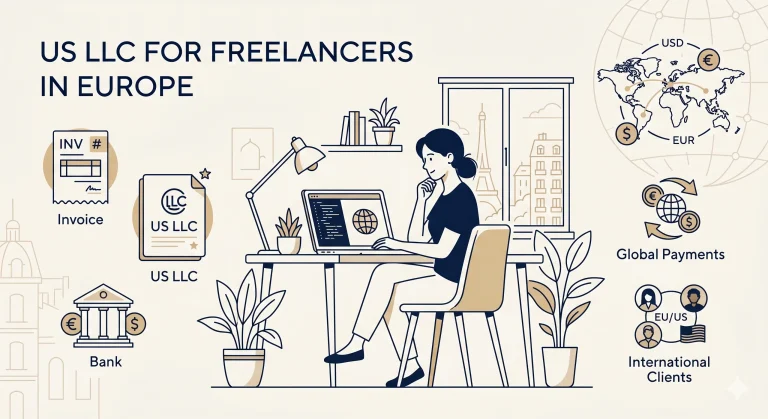
Freelancers and consultants
Consultants, marketing specialists, developers, designers, coaches, content creators and other freelancers may consider a US LLC when they work with international clients.
A US LLC can help present the business in a more structured way, especially when dealing with clients outside the founder’s home country.
For European freelancers and consultants, the key question is not only formation. It is also how the LLC interacts with local tax obligations, invoicing, payment providers and business administration.
Online businesses and startups
A US LLC can also be relevant for online businesses, SaaS projects, e-commerce businesses, digital products, newsletters, communities, agencies and startup-style projects.
Many online founders want a simple and internationally recognizable structure. A US LLC can be part of that setup, especially when combined with an EIN and proper banking preparation.
If your goal is to build an international online business, you should think about the full setup, not only the company formation.
European founders selling internationally
For European founders, a US LLC may be interesting when the business is aimed at international customers or US-based platforms.
Examples may include:
- selling digital services internationally
- working with US clients
- using international payment providers
- building a software or online business
- working with marketplaces or platforms that are more familiar with US entities
This does not mean every European founder needs a US LLC. But for some business models, it can be a practical option worth reviewing.
4. Why many non-US founders consider a US LLC
There are several reasons why international founders look at US LLCs.
A US LLC can be:
- relatively simple to form compared with some other structures
- internationally recognized
- useful for online and service-based businesses
- suitable for single-member ownership
- practical for founders who want a clear business entity
- often combined with an EIN for administrative and banking purposes
For many non-US founders, the appeal is not only the LLC itself. It is the combination of:
- company formation
- EIN application
- Bankbereitschaft
- Zahlungsanbieter-Vorbereitung
- clear documentation
- ongoing administrative awareness
This is why the setup should be approached as a process rather than a single form.
5. What a US LLC does not automatically solve
A US LLC is not a magic solution.
It does not automatically remove tax obligations in your country of residence. It does not guarantee bank account approval. It does not guarantee payment provider approval. It does not make your business anonymous. It does not remove the need to keep records or understand your obligations.
This is important.
You should be cautious with any provider or online content that presents a US LLC as a “tax-free” or “zero compliance” solution for everyone.
In practice, the right setup depends on your personal situation, your country of residence, your business model, your customers, your payment flows and your long-term plans.
That is why US LLC Setup focuses on practical setup support and administrative guidance — not unrealistic promises.
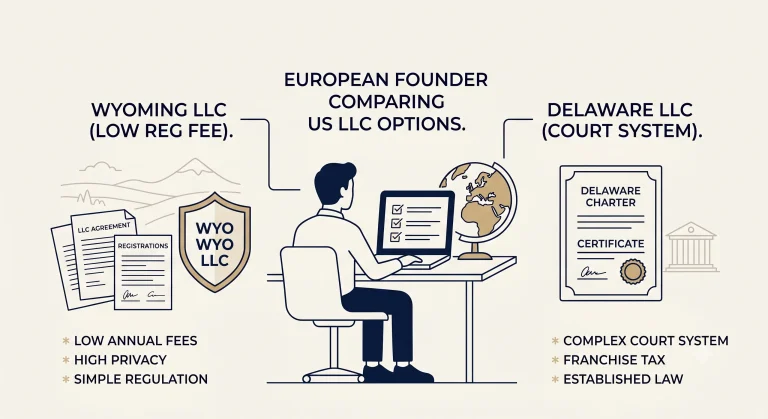
6. Why Wyoming is often considered by non-US founders
Many non-US founders consider Wyoming because it is often seen as a business-friendly state for LLC formation.
A Wyoming LLC may be attractive for international founders who want a relatively straightforward company structure, a registered agent in the US and a state commonly used for LLC formation.
That said, the state of formation is only one part of the decision.
You should also consider:
- your business activity
- Ihr steuerlicher Wohnsitz
- where your customers are located
- whether you need an EIN
- whether you need banking or fintech access
- how you will keep records
- what ongoing state and federal obligations may apply
You can learn more about our Wyoming LLC setup support here:
7. What you usually need to set up a US LLC
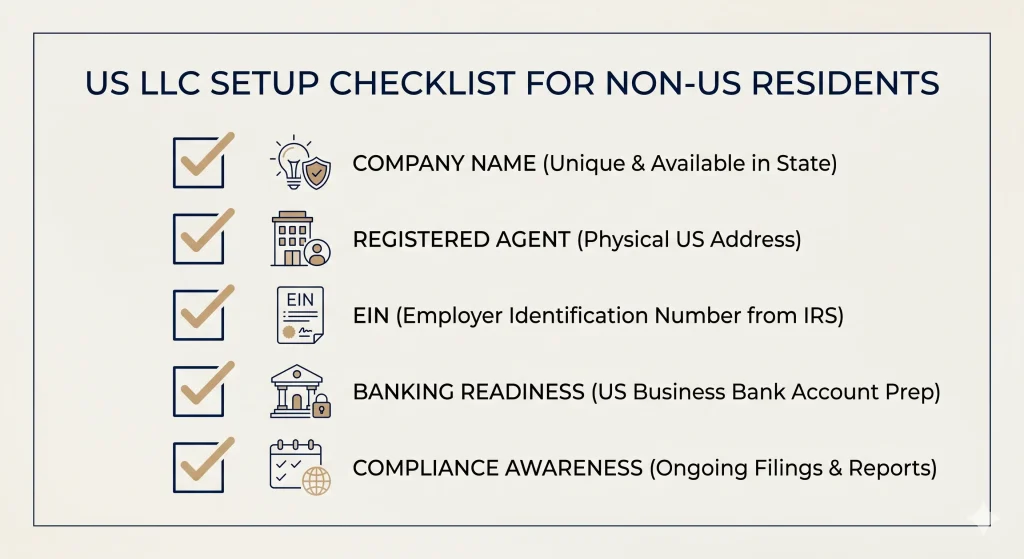
The exact requirements depend on the state and the specific setup, but non-US founders usually need to think about the following points.
Basic founder information
You will usually need to provide basic personal information about the owner or owners of the LLC.
This may include your full name, address, contact details and identification information depending on the provider, registered agent, bank, fintech or payment platform involved.
Company name
You need to choose a company name that is available in the state where you want to form the LLC.
The name should be professional, easy to understand and suitable for your business activity.
Registered agent
A US LLC usually needs a registered agent in the state of formation.
The registered agent receives official notices and state correspondence on behalf of the company. For non-US founders, this is typically handled through a professional registered agent service.
Business purpose
You may need a short description of your business activity.
This should be clear and broad enough to describe what the business does, without making unrealistic claims or creating confusion.
EIN
An EIN is often needed for practical administration, banking, payment providers and certain tax or reporting processes.
For non-US founders, the EIN application process can feel confusing because it involves US administrative terminology and IRS forms.
US LLC Setup provides practical EIN application support here:
Banking-Vorbereitung
After forming the LLC, many founders want to open a business bank account or fintech account.
This is often one of the most important practical steps.
However, bank, fintech and payment provider approval cannot be guaranteed. Providers may ask for identity documents, proof of address, business information, website details, invoices, contracts or additional explanations.
That is why preparation matters.
You can learn more about our bank account support for non-US founders here:
8. Practical next steps
If you are a non-US founder considering a US LLC, a practical next step is to look at the full setup process, not only the company formation.
Ask yourself:
- Where am I personally tax resident?
- What type of business will the LLC operate?
- Will I work with US clients, international clients or local clients?
- Do I need an EIN?
- Do I need banking or payment provider access?
- Do I understand the ongoing admin and compliance requirements?
- Do I need local tax advice in my country of residence?
If the structure still seems relevant, you can compare setup options and decide how much support you need.
US LLC Setup offers transparent packages for non-US founders who want practical support with formation, EIN application and banking readiness.
You can view our packages here:
If you are unsure which setup path fits your situation, you can also:
9. Final thoughts
Non-US residents can own a US LLC, and for many international founders this can be a practical business structure.
It may be especially relevant for digital nomads, remote workers, consultants, online businesses, startups and European founders working internationally.
But the LLC should be understood properly.
Nationality, residence, tax residence, company formation, EIN application, banking and compliance are connected — but they are not the same thing.
A US LLC can be useful, but it should be set up with realistic expectations, clear documentation and proper awareness of your personal situation.
For more common questions, you can also visit our
Bosse LLC bietet ausschließlich praktische Einrichtungsunterstützung und administrative Anleitung. Wir bieten keine Rechts-, Steuer-, Buchhaltungs- oder regulierte Finanzberatung. Staatliche, Bank-, Fintech- und Zahlungsanbieter-Genehmigungen können nicht garantiert werden.