US LLC for Freelancers in Europe: Is It Worth It?
For many freelancers in Europe, the question comes up sooner or later:
Should I keep operating through my local business structure, or should I set up a US LLC?
The answer depends on your business model, your tax residence, your clients, your banking needs and your long-term plans. A US LLC is not automatically the right solution for everyone. But for international freelancers, consultants, creators, digital nomads and online service providers, it can be a very practical structure.
Especially if you work with clients outside your home country, invoice in different currencies, use global payment providers or want a clean international business setup, a US LLC may be worth considering.
In this article, we explain the main advantages, the limitations and the practical points European freelancers should understand before setting up a US LLC.
Table of Contents
- What Is a US LLC?
- Why European Freelancers Consider a US LLC
- Keeping Your International Operations in One Place
- Is a US LLC More Trustworthy Than a UG or LTD?
- Banking and Payment Access: A Key Advantage
- Deposit Protection: US vs Europe
- Is a US LLC Easy to Handle Tax-Wise?
- What About the “Below 300k Revenue” Question?
- US LLC vs Eastern European Company Structures
- When a US LLC May Be Worth It
- How US LLC Setup Can Help
- Final Thoughts
What Is a US LLC?
A US LLC, or Limited Liability Company, is a flexible business entity formed under the law of a US state.
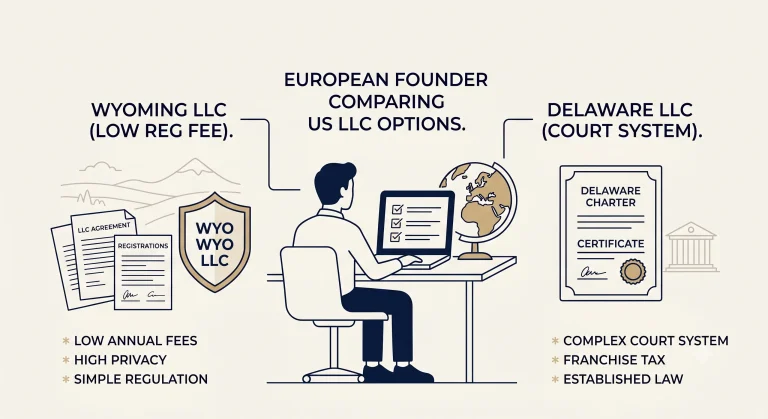
For non-US residents, one of the most common setups is a single-member LLC. This means the company has one owner. Many international founders choose Wyoming because it is known for relatively simple administration, clear annual requirements and a strong reputation among non-US entrepreneurs.
A US LLC can be used by freelancers, consultants, remote workers, online businesses, SaaS founders, agencies, creators and international service providers.
However, it is important to understand one thing from the beginning:
A US LLC is a business structure. It is not a magic tax-free solution.
Your personal tax residence still matters. Your local tax obligations still matter. And depending on your situation, you may need professional tax advice in the country where you live or are tax resident.
Why European Freelancers Consider a US LLC
European freelancers often look at a US LLC for practical reasons.
Many do not necessarily want to “move to the US” or build a US-based office. Instead, they want a business structure that works well internationally.
Common reasons include:
- They work with clients in several countries.
- They invoice international clients in USD or EUR.
- They want access to US banking or fintech providers.
- They need a business structure that looks familiar to global clients.
- They want a setup that is easier to scale than a local sole proprietorship.
- They want to separate personal and business finances more clearly.
- They want one central company for global freelance operations.
For freelancers a US LLC can be a natural next step. It gives your international business a clear structure, a globally familiar company format and a practical foundation for clients, banking and payment providers. Instead of adapting your setup around each new country, platform or client, the LLC can become the central business vehicle for your freelance operations.
Keeping Your International Operations in One Place

One of the biggest advantages of a US LLC for freelancers in Europe is operational clarity.
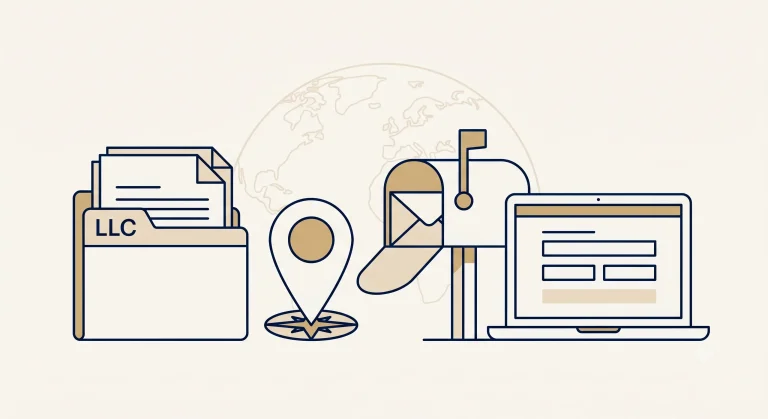
Instead of running different pieces of your business through different personal accounts, local registrations, payment tools and platforms, a US LLC can help centralize your business activity.
For example, a freelancer may use the LLC to:
- invoice clients, especially international,
- receive payments from platforms,
- open a business bank or fintech account,
- connect payment processors,
- keep revenue and expenses in one place,
- build a more professional business presence,
- separate private and business transactions.
This can make your business easier to understand — for yourself, for clients, for banks and for payment providers.
It can also help when your client base becomes more international. A US LLC can provide one consistent business identity, rather than constantly adapting your setup depending on where the client is based.
For European freelancers working with clients in the US, the UK, Europe, the Middle East or globally, this can be a major practical advantage.
Is a US LLC More Trustworthy Than a UG or LTD?
This is a sensitive question because every business structure has its place.
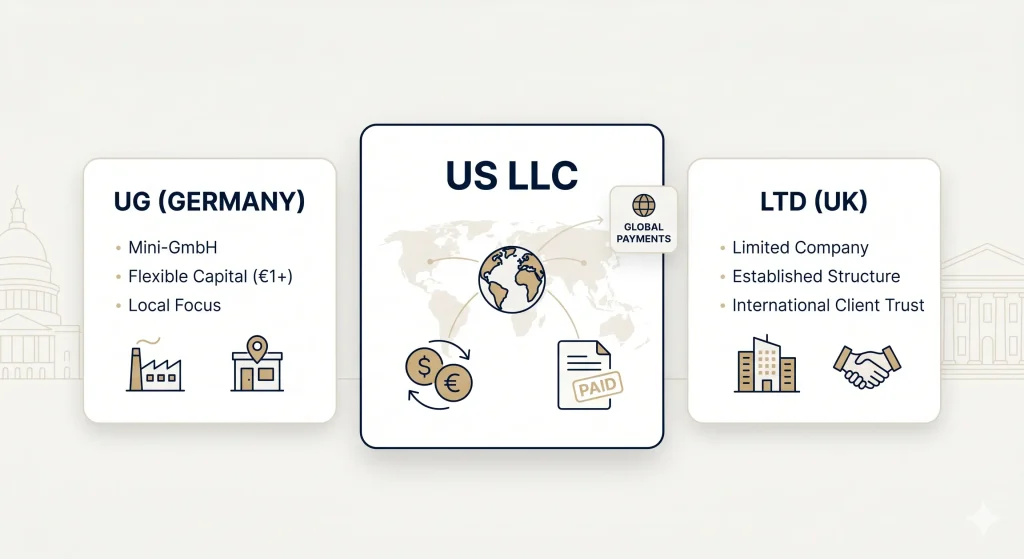
A German UG, a German GmbH, an Irish LTD, an Estonian OÜ or a UK LTD can all be legitimate structures. The right choice depends on the founder, the business model, the country of residence and the target market.
However, from an international client perspective, a US LLC often feels familiar and easy to understand.
The United States is one of the world’s most recognized business jurisdictions. Many global companies use US entities within their group structures. Google, for example, operates through Google LLC, while its publicly traded parent company is Alphabet Inc.
That does not mean that “all big companies are LLCs.” They are not. Many large companies are corporations. But the LLC is a well-established and widely recognized US business form.
For freelancers, the practical point is this:
A US LLC can often look more familiar to global clients than a small local structure they do not understand.
A German UG may be perfectly valid, but some international clients may not know what it is. An Irish LTD may be common in Europe, but it may still raise questions depending on the client. A US LLC, on the other hand, is often easier to recognize in international business contexts.
This can be useful when you sell services globally, especially if your clients are startups, SaaS companies, agencies, online businesses or US-based companies.
Banking and Payment Access: A Key Advantage

For many freelancers, the strongest reason to form a US LLC is access to the US banking and payment ecosystem.
A US LLC can be the entry point to:
- US business banking options,
- USD accounts,
- business debit and credit cards,
- payment processors,
- fintech platforms,
- marketplace payouts,
- international transfers,
- cleaner client payments.
This does not mean that every bank or payment provider will approve every application. Banks, fintechs and payment providers have their own KYC and compliance rules.
But having a US LLC, an EIN and proper company documentation can make you much more prepared for onboarding.
This is especially relevant if you want to work with US clients, receive USD payments or use providers that prefer or require a US business entity.
If banking readiness is one of your main reasons for forming a company, you can learn more about our practical support here:
Deposit Protection: US vs Europe
Another point freelancers often compare is deposit protection.
In the United States, eligible deposits at FDIC-insured banks are generally protected up to $250,000 per depositor, per insured bank, per ownership category.
In the European Union, statutory deposit protection is generally harmonized at €100,000 per depositor, per bank.
This does not mean that US banking is always “better” in every situation. It also does not mean that every fintech balance is automatically protected in the same way as a direct bank deposit. The exact protection depends on the provider, account structure and banking partner.
But for freelancers who hold significant business balances, the US banking system can be attractive because of its established deposit insurance framework and broad international reputation.
The key is to verify the actual protection of the specific bank or provider you use.
Is a US LLC Easy to Handle Tax-Wise?
A US LLC can be relatively straightforward to operate, especially compared with more complex corporate structures.
But “easy” does not mean “no obligations.”
A foreign-owned US LLC may still have US filing requirements, even if the owner is not a US resident. For example, foreign-owned disregarded entities may need to file certain information returns with the IRS when reportable transactions exist.
You may also have obligations in your country of tax residence. For a freelancer living in Germany, Spain, France, the Netherlands or another European country, local tax treatment can be very important.
This is why it is better to describe the LLC as:
administratively practical, but not compliance-free.
You still need to keep records. You still need to understand annual filing obligations. And you should speak with a qualified tax professional if you are unsure how your local tax residence treats foreign entities.
The good news: if your structure is simple, your revenue is clear and your bookkeeping is organized, a US LLC can often be easier to manage than people expect.
What About the “Below 300k Revenue” Question?
You may have heard that a US LLC is especially simple below a certain revenue level, such as 300k.
This needs careful wording.
There is no universal rule saying that a US LLC is automatically simple or tax-free below 300k revenue. Tax treatment depends on several factors, including:
- your tax residence,
- whether the LLC has US-source income,
- whether it has effectively connected income with a US trade or business,
- whether you have employees or contractors,
- where the work is performed,
- how your local country treats the LLC,
- whether VAT or sales tax issues apply,
- whether you have platform, marketplace or payment reporting obligations.
That said, many freelancers with simple service businesses and moderate revenue may find the LLC easier to manage than a more complex company structure — especially when they have no US office, no US employees and no physical US operations.
A practical way to think about it is this:
The simpler your business model, the easier the LLC is usually to administer.
For example, a solo consultant invoicing international clients is usually easier to handle than a company with employees, inventory, physical products, warehousing, US operations or multiple owners.
So instead of focusing on one fixed revenue number, it is better to look at the structure of the business.
US LLC vs Eastern European Company Structures
Some freelancers also compare a US LLC with company structures in countries such as Georgia, Armenia, Bulgaria or other lower-cost jurisdictions.
These countries can be interesting in certain situations. Some offer simple registration, low operating costs or attractive local tax systems. But they may not always provide the same international perception, banking access or client familiarity as a US entity.
For freelancers who work globally, the main advantages of a US LLC are often:
- stronger international recognition,
- access to the US banking ecosystem,
- familiar company format for global clients,
- clear state-level registration,
- strong business infrastructure,
- established legal and financial environment.
This does not mean that every Eastern European structure is unsafe or unsuitable. Many are legitimate. But if your goal is to build trust with international clients, access US banking and present a globally familiar business entity, a US LLC may have a stronger position.
For many freelancers, the decision is not only about the lowest setup cost. It is about long-term usability.
When a US LLC May Be Worth It

A US LLC may be worth considering if you:
- are a freelancer, consultant, creator or remote service provider,
- work with international clients,
- want to invoice under a professional business name,
- want access to US banking or payment tools,
- receive or want to receive USD payments,
- work with US clients or platforms,
- want to centralize your business operations,
- want a structure that can scale beyond local freelancing,
- prefer a globally recognized business jurisdiction,
- want a practical setup without forming a more complex corporation.
For many European freelancers, the biggest benefit is not one single feature. It is the combination of company structure, banking access, international reputation and operational clarity.
How US LLC Setup Can Help
Setting up a US LLC as a non-US resident involves several steps:
- choosing the right state,
- preparing the formation,
- working with a registered agent,
- applying for an EIN,
- organizing company documents,
- preparing for banking and payment provider onboarding,
- understanding the basic annual admin requirements.
US LLC Setup covers the practical steps for you — from formation support to EIN and banking readiness — so you can get started faster and with more confidence.
We help you understand the process, prepare the necessary steps and avoid common setup mistakes.
If you are ready to form your US LLC, you can view our packages here:
If you are still unsure whether it is the right structure for you, you can book a call or contact us with your questions:
Final Thoughts
So, is a US LLC worth it for freelancers in Europe?
For many internationally active freelancers, yes.
A US LLC can help you centralize your operations, invoice global clients, access US banking options, build a more professional business presence and work with a company structure that is widely recognized.
But it should be approached realistically.
It is not a tax-free promise. It is not a guaranteed bank account. It is not a way to avoid your local responsibilities. And it does not replace personal tax advice.
Used correctly, however, a US LLC can be a very practical structure for European freelancers.
Don’t wait until your business becomes messy. Set up the right structure early and build from there.
Bosse LLC provides practical setup support and administrative guidance only. We do not provide legal, tax, accounting or regulated financial advice. Government, bank, fintech and payment provider approvals cannot be guaranteed.